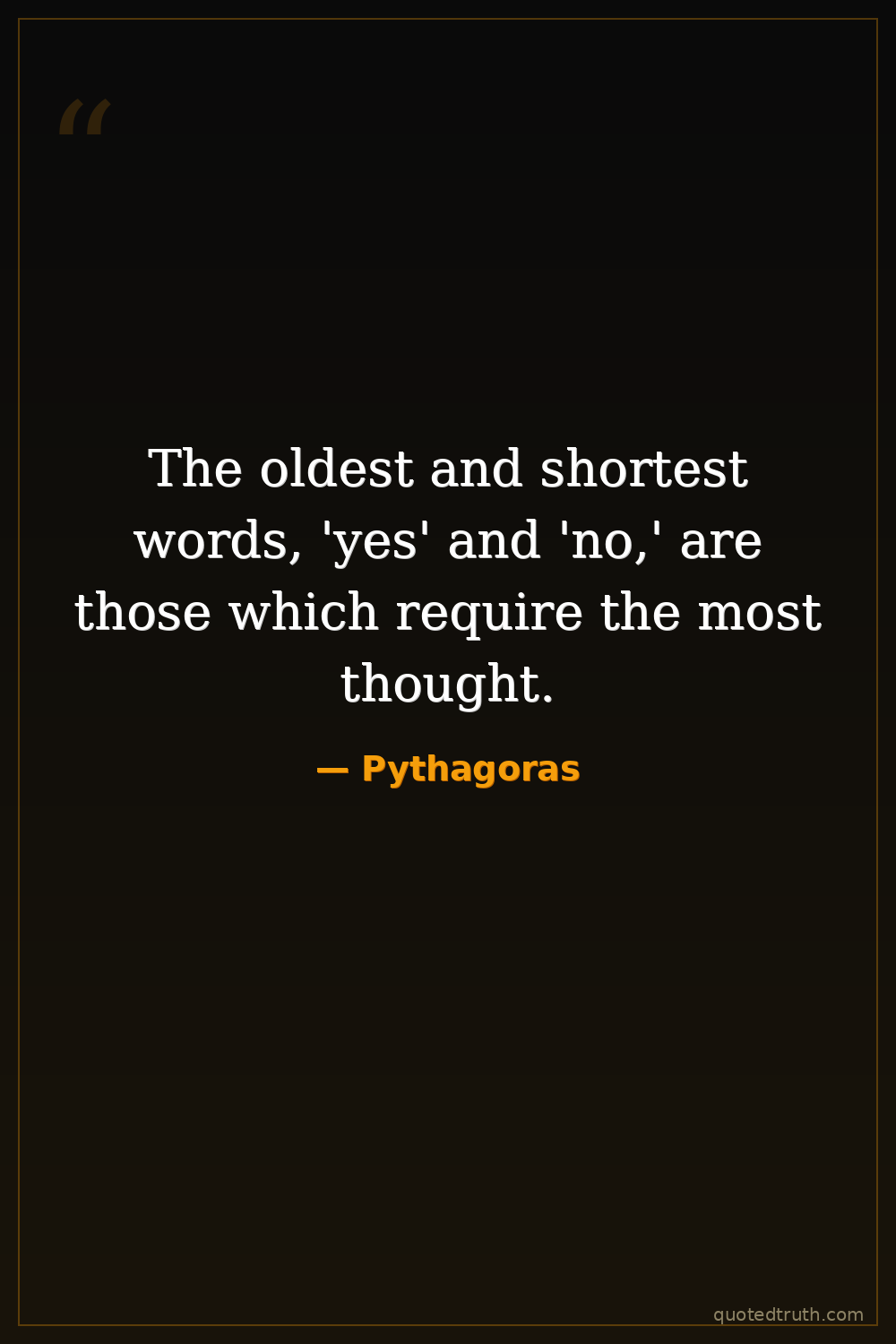
Pythagoras — "The oldest and shortest words, 'yes' and 'no,' are those which require the most …"
The oldest and shortest words, 'yes' and 'no,' are those which require the most thought.
The oldest and shortest words, 'yes' and 'no,' are those which require the most thought.
Click any product to generate a realistic preview. Up to 3 at a time.
* Initial load can take up to 90 seconds — revising the preview in another color is nearly instant.
"Do not sit on a quart measure."
"Don't share your roof with swallows."
"If there be light, then there is darkness; if cold, heat; if height, depth; if solid, fluid; if hard, soft; if rough, smooth; if calm, tempest; if prosperity, adversity; if life, death."
"All is number."
"The property of friends is common."
Greek philosopher and mathematician whose school in Croton combined geometry (the Pythagorean theorem), number-mysticism, and a religious-vegetarian way of life. Closely associated with Thales of Miletus (earlier pre-Socratic and the first philosopher). For an intellectual contrast, see Heraclitus, pre-Socratic Greek philosopher of flux — Heraclitus called Pythagoras 'the chief of swindlers' — among the founding insults of the philosophical-rivalry tradition. Their 'all is flux' vs 'all is number' poles still organize the philosophy of mathematics today (Platonist vs anti-realist).
Found in 3 providers: gemini,deepseek,grok
3 sources checked
Simple binary choices — saying yes or no — are where the most consequential thinking happens. Yes commits you to action, obligation, or belief; no closes doors and invites conflict or loss. Despite their brevity, these words shape relationships, opportunities, and character. We reflexively underestimate decisions that seem small because they're short, yet a single yes or no can permanently alter a life's direction. Brevity doesn't mean simplicity.
Pythagoras founded a brotherhood in Croton with rigorous admission standards — candidates took vows of silence, vegetarianism, and communal devotion. Every member's yes to membership was a lifelong oath. He built mathematics on precise logical foundations where proof demands absolute commitment. For someone who treated numbers as the bedrock of reality and demanded exactness from followers, insisting that even the briefest words carry maximum moral weight is entirely consistent.
Pythagoras lived in 6th-century BCE Greece, when oral commitment — sworn oaths, public vows — held legal and religious force. City-states like Athens were developing direct democracy where citizen votes, pure yes-or-no choices, decided war, exile, and execution. Meanwhile, pre-Socratic philosophy was separating reason from religious tradition. In this culture where words carried divine consequence and a mistaken pledge could ruin a family, the gravity of assent and refusal was viscerally understood.
AI-generated insights based on extensive research and information for context. Factual errors? Email [email protected].
Your cart is empty