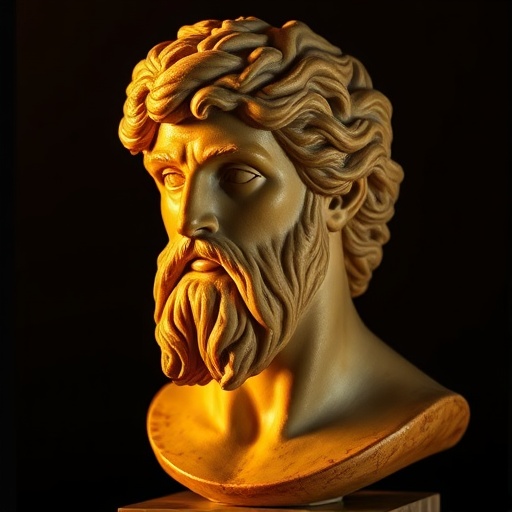
Pythagoras — "Don't walk on the highway."
Don't walk on the highway.
Don't walk on the highway.
Click any product to generate a realistic preview. Up to 3 at a time.
* Initial load can take up to 90 seconds — revising the preview in another color is nearly instant.
"Do not go to bed until you have gone over the day three times in your mind. What did I do wrong? What did I do right? What did I leave undone?"
"The most momentous thing in human life is the art of winning the soul to good or to evil."
"The beginning is half of the whole."
"The Pythagoreans regarded 10, which contains all the numbers, as the holiest number."
"Not to speak of Pythagorean beans, from which, it is said, Pythagoras himself abstained."
Greek philosopher and mathematician whose school in Croton combined geometry (the Pythagorean theorem), number-mysticism, and a religious-vegetarian way of life. Closely associated with Thales of Miletus (earlier pre-Socratic and the first philosopher). For an intellectual contrast, see Heraclitus, pre-Socratic Greek philosopher of flux — Heraclitus called Pythagoras 'the chief of swindlers' — among the founding insults of the philosophical-rivalry tradition. Their 'all is flux' vs 'all is number' poles still organize the philosophy of mathematics today (Platonist vs anti-realist).
A Pythagorean 'Symbol', interpreted as 'decline from public ways, walk in unfrequented paths' to seek wisdom and solitude.
Date: c. 570-495 BCE (interpreted later)
WisdomFound in 2 providers: gemini,grok
2 sources checked
Avoid following the path everyone else takes. The 'highway' represents the well-worn route of popular opinion, conventional thinking, and herd mentality. This urges independent thought — don't do something simply because the crowd does it. Forge your own intellectual and moral path rather than drifting wherever the masses go. Real wisdom requires departing from easy consensus and traveling roads most people never consider.
Pythagoras founded a secretive brotherhood in Croton with strict, unconventional rules — vegetarianism, mathematical mysticism, belief in reincarnation — deliberately distancing followers from mainstream Greek society. His entire life rejected popular paths: he traveled from Samos to Egypt absorbing esoteric knowledge before establishing his commune. His akousmata, symbolic cryptic sayings like this one, were designed to keep members thinking differently from ordinary citizens.
In 6th-century BCE Greece, the highway literally meant public roads crowded with merchants, soldiers, and commoners following established civic and trade routes. Intellectually, it meant dominant Homeric myths and religious convention. Pre-Socratic philosophers were just beginning to challenge these worldviews with rational inquiry. Urging followers to avoid the highway was a radical call to intellectual independence against deeply entrenched social, religious, and political conformity of the ancient world.
AI-generated insights based on extensive research and information for context. Factual errors? Email [email protected].
Your cart is empty