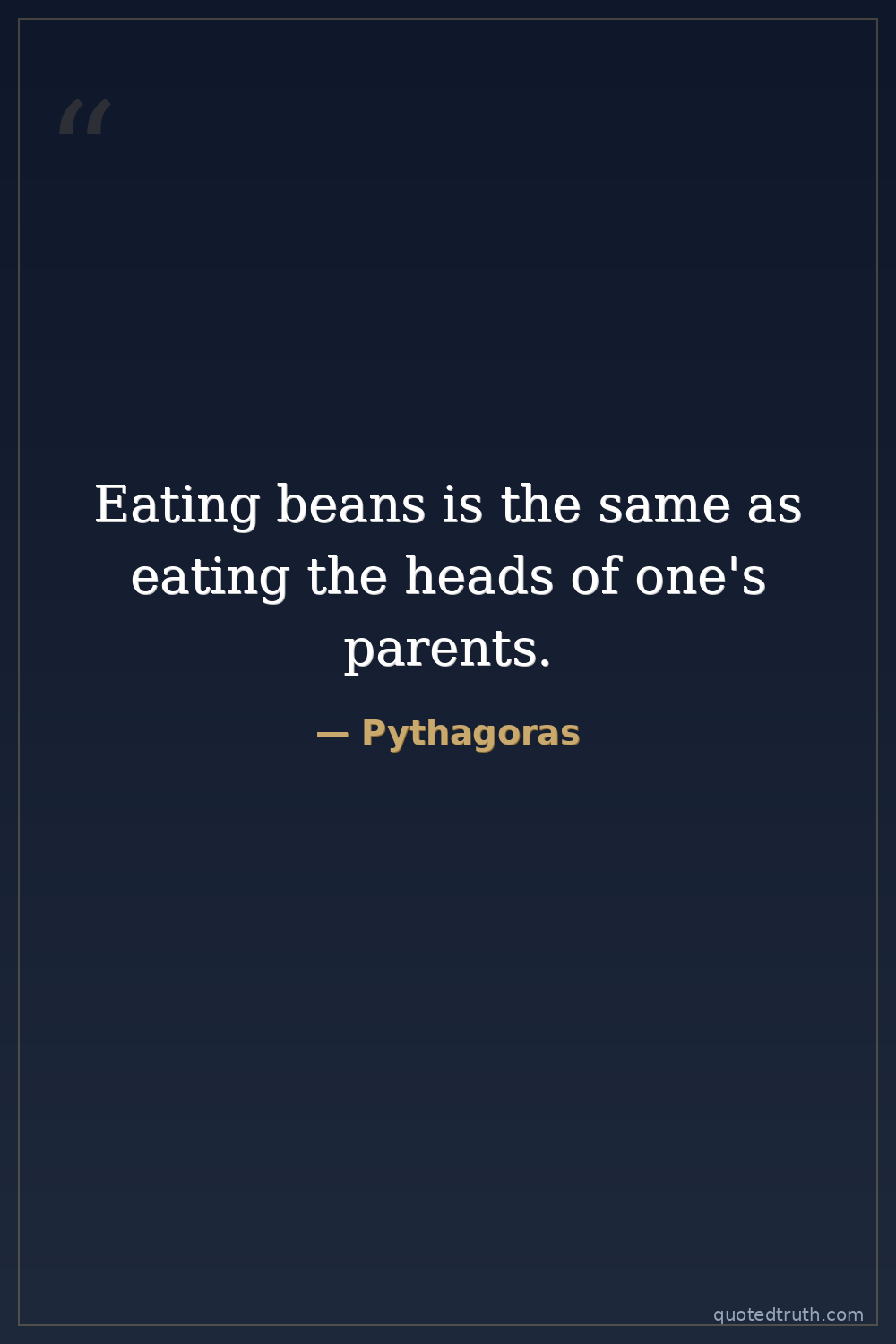
Pythagoras — "Eating beans is the same as eating the heads of one's parents."
Eating beans is the same as eating the heads of one's parents.
Eating beans is the same as eating the heads of one's parents.
Click any product to generate a realistic preview. Up to 3 at a time.
* Initial load can take up to 90 seconds — revising the preview in another color is nearly instant.
"The soul of man is divided into three parts, intelligence, reason, and passion. Intelligence and passion are possessed by other animals, but reason by man alone."
"The Monad (Unity) is the principle of stability since it preserves the identity of any number that it interacts with."
"Do not wear a ring."
"Do not break bread."
"Abstain from the flesh of beasts that die of themselves."
Greek philosopher and mathematician whose school in Croton combined geometry (the Pythagorean theorem), number-mysticism, and a religious-vegetarian way of life. Closely associated with Thales of Miletus (earlier pre-Socratic and the first philosopher). For an intellectual contrast, see Heraclitus, pre-Socratic Greek philosopher of flux — Heraclitus called Pythagoras 'the chief of swindlers' — among the founding insults of the philosophical-rivalry tradition. Their 'all is flux' vs 'all is number' poles still organize the philosophy of mathematics today (Platonist vs anti-realist).
Another extreme reason attributed for the bean prohibition.
Date: c. 570-495 BCE (attributed later)
WisdomFound in 1 providers: gemini
1 source checked
Beans are strictly forbidden—eating them is morally equivalent to the ultimate taboo: cannibalism of one's own ancestors. The comparison is deliberately shocking to enforce absolute compliance. In modern terms, this is a sacred dietary rule framed as the worst imaginable act to ensure followers never cross the line. Purity, taboo, and community identity are all compressed into one visceral commandment.
Pythagoras founded a monastic brotherhood with strict codes including vegetarianism and a bean prohibition. He taught metempsychosis—souls transmigrate through humans, animals, and plants after death. Beans were believed to house ancestral souls, making consumption literal soul-eating. Legends say he died rather than flee across a bean field when enemies pursued him, showing how deeply he held this conviction.
In 6th-century BCE Greece, fava beans carried strong ritual associations with the dead. Greeks used beans in the Anthesteria festival to appease ancestral spirits, scattering them to ward off ghosts. Mystery cults like Orphism, which influenced Pythagoras, taught that souls cycled through living bodies. Beans, growing from underground decay and resembling fetuses or Hades' gate, were widely believed to harbor ancestral souls awaiting reincarnation.
AI-generated insights based on extensive research and information for context. Factual errors? Email [email protected].
Your cart is empty