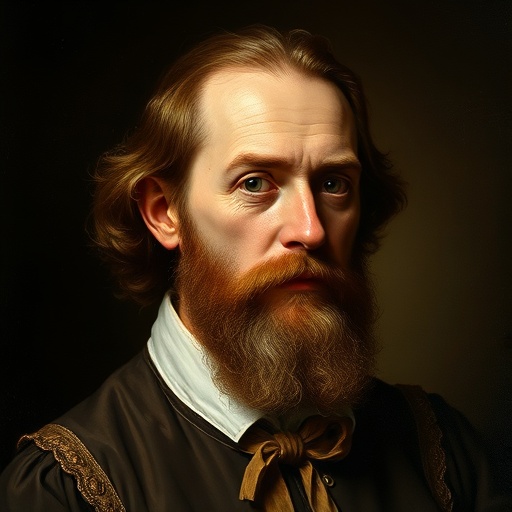
William Harvey — "Errors are not to be removed by violence, but by reason."
Errors are not to be removed by violence, but by reason.
Errors are not to be removed by violence, but by reason.
Click any product to generate a realistic preview. Up to 3 at a time.
* Initial load can take up to 90 seconds — revising the preview in another color is nearly instant.
"The semen is the efficient cause and the egg the material cause of generation."
"To search for truth is to search for God."
"I have seen, and by my own experiments, demonstrated the truth of what I assert."
"Nature is nowhere accustomed more openly to display her secret mysteries than in cases where she shows tracings of her workings apart from the beaten paths; nor is there any better way to advance the …"
"I began to think whether there might not be a motion as it were in a circle."
English physician whose On the Motion of the Heart and Blood in Animals (1628) demonstrated blood circulation, overturning 1,400 years of Galenic medicine. Closely associated with Francis Bacon (his contemporary in the new English empiricism). For an intellectual contrast, see Galenic medicine, the 2nd-century Greek medical tradition (humors, blood-as-consumed-fuel) — Harvey calculated that the heart pumps more blood per hour than the body could possibly produce as fuel — a single quantitative observation that demolished the entire Galenic-Aristotelian medical worldview. The cleanest example in medical history of arithmetic disproving 14 centuries of authority.
A statement on intellectual discourse and the proper method for correcting scientific misconceptions.
Date: c. 1650s (attributed)
WisdomFound in 1 providers: gemini
1 source checked
When someone holds a false belief, correcting them requires patient reasoning and evidence, not force or coercion. Truth cannot be imposed through threats or authority—it must be demonstrated and understood. Intellectual change happens through persuasion, not pressure. Changing minds, whether in science, politics, or everyday life, demands logical argument and proof rather than compulsion, intimidation, or the blunt power of whoever holds authority at a given moment.
Harvey's discovery of blood circulation directly contradicted 1,400 years of Galenic medicine. When he published De Motu Cordis in 1628, colleagues ridiculed him and patients abandoned his practice. Rather than retreating, he responded with meticulous dissections and quantitative evidence—demonstrating his claims through experiment, not authority. Serving as royal physician to Charles I, he witnessed political violence resolve nothing intellectually. His entire career embodied this belief: scientific truth emerges through demonstration, not domination.
Harvey lived through the English Civil War and the Thirty Years' War, watching violent force tear Europe apart without settling a single intellectual dispute. The Scientific Revolution was challenging ancient authorities like Galen and Aristotle, yet the Inquisition still threatened scholars who contradicted Church doctrine. In this climate of coercion and dogma, Harvey's insistence on evidence-based persuasion was genuinely radical—asserting that knowledge must be earned through reason, not enforced through inherited power or institutional pressure.
AI-generated insights based on extensive research and information for context. Factual errors? Email [email protected].
Your cart is empty