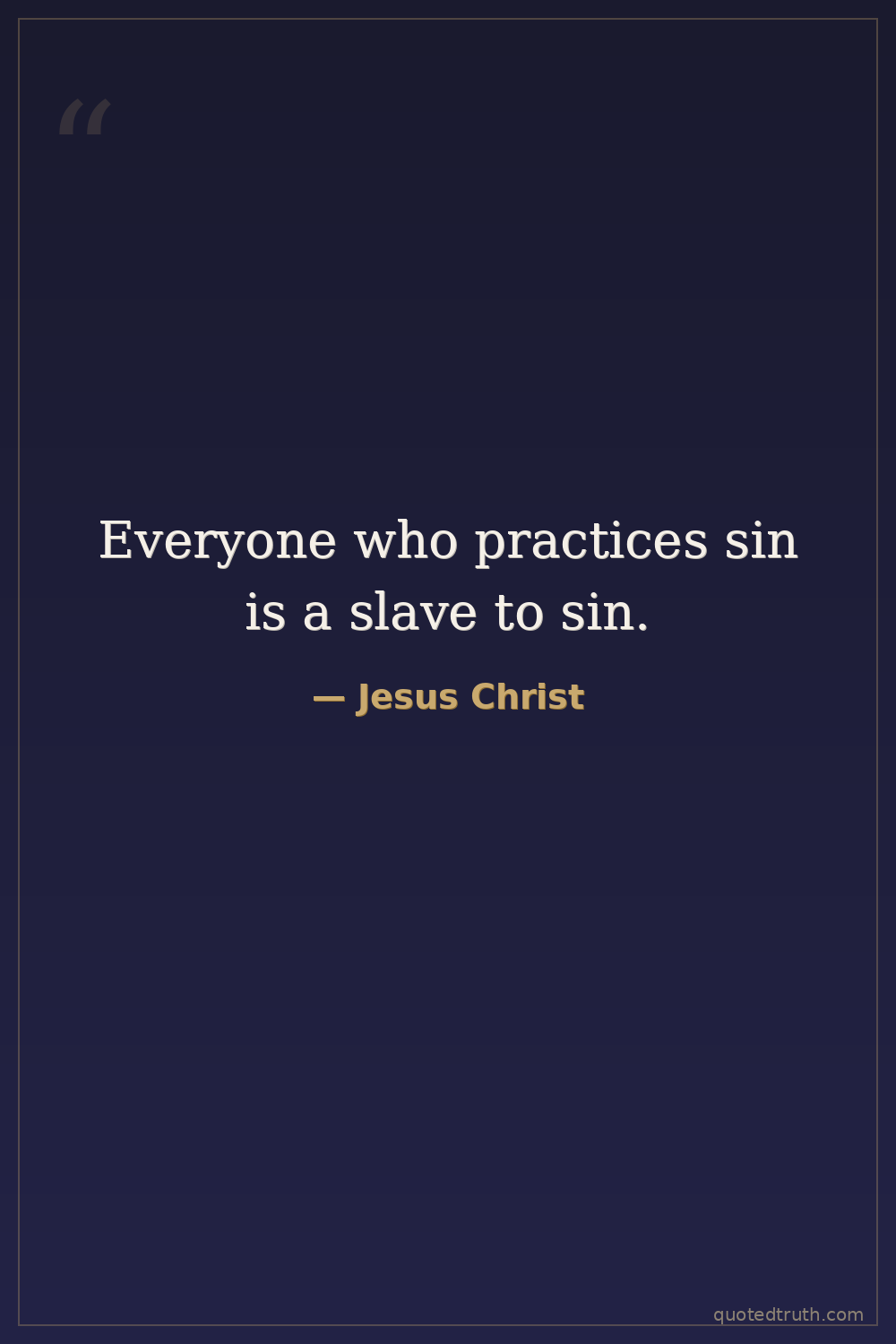
Jesus Christ — "Everyone who practices sin is a slave to sin."
Everyone who practices sin is a slave to sin.
Everyone who practices sin is a slave to sin.
Click any product to generate a realistic preview. Up to 3 at a time.
* Initial load can take up to 90 seconds — revising the preview in another color is nearly instant.
"Fear him who has power to cast into hell."
"Enter through the narrow gate. For wide is the gate and broad is the road that leads to destruction, and many enter through it. But small is the gate and narrow the road that leads to life, and only a…"
"It is easier for a camel to go through the eye of a needle than for someone who is rich to enter the kingdom of God."
"If anyone wants to be first, he must be the very last, and the servant of all."
"Let the dead bury their own dead, but you go and proclaim the kingdom of God."
Found in 1 providers: gemini
1 source checked
Habitual wrongdoing doesn't make you free or powerful; it traps you. When you repeatedly choose harmful actions, those patterns start choosing you back. What begins as a decision becomes a compulsion, then an identity. You think you're exercising freedom, but you've actually handed control over to the behavior itself. Real freedom isn't doing whatever you want whenever you want, it's being able to stop.
Jesus spent his ministry reframing religious categories around inner transformation rather than external rule-keeping. He confronted people who considered themselves righteous by lineage or law, arguing that moral bondage was deeper than political bondage. This saying, from John 8, was delivered to listeners who bristled at being called unfree because they were Abraham's descendants. It fits his pattern of exposing hidden captivity and offering liberation through allegiance to him.
First-century Judea was occupied by Rome, and literal slavery was everywhere: household slaves, debt bondage, prisoners of war. Jewish identity centered on the Exodus story of God freeing Israel from Egypt. Claiming someone was a slave was provocative, especially to Pharisees who prided themselves on Torah observance. Jesus weaponized the most familiar social institution of his day to make a theological point his audience couldn't easily dismiss.
AI-generated insights based on extensive research and information for context. Factual errors? Email [email protected].
Your cart is empty