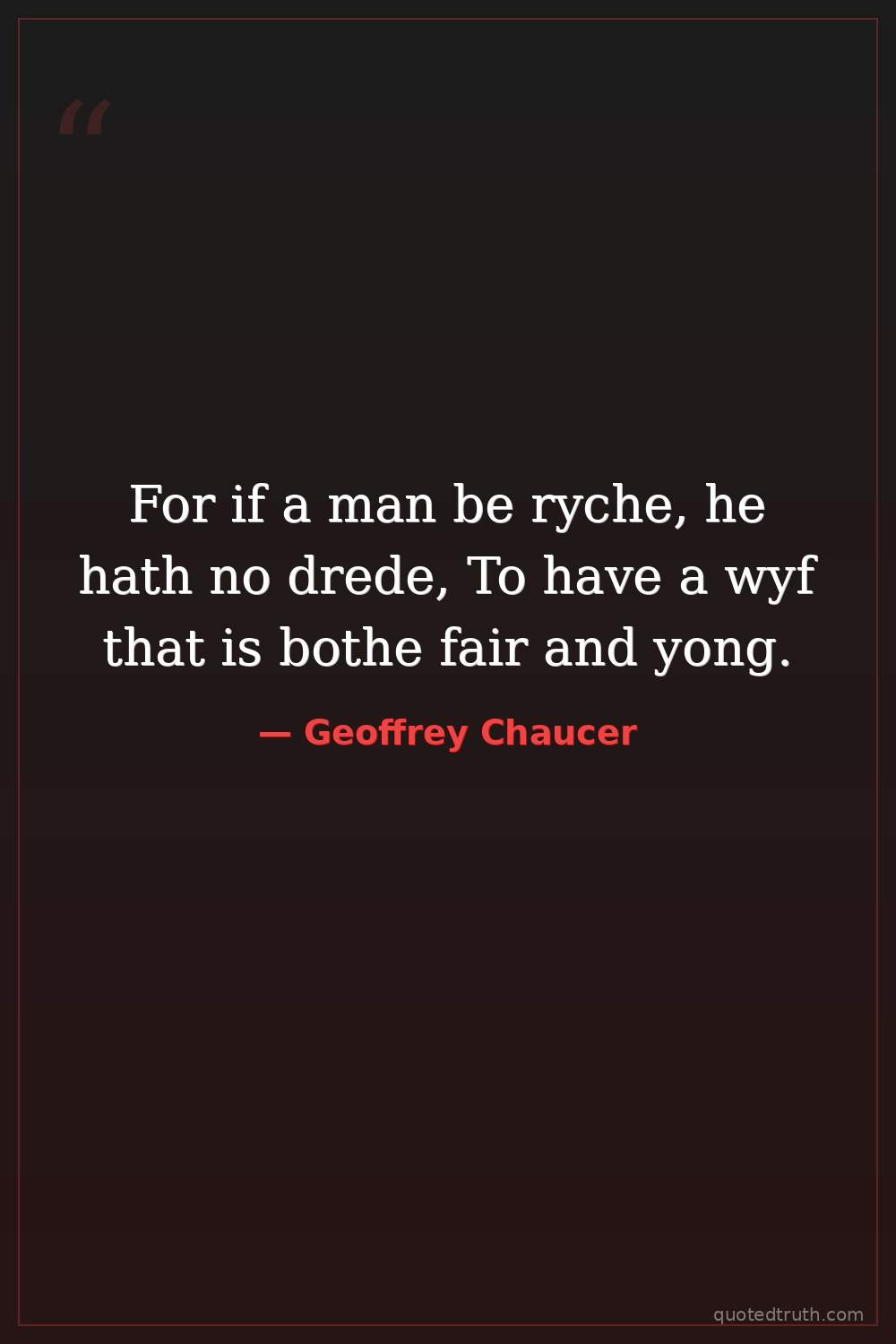
Geoffrey Chaucer — "For if a man be ryche, he hath no drede, To have a wyf that is bothe fair and yo…"
For if a man be ryche, he hath no drede, To have a wyf that is bothe fair and yong.
For if a man be ryche, he hath no drede, To have a wyf that is bothe fair and yong.
Click any product to generate a realistic preview. Up to 3 at a time.
* Initial load can take up to 90 seconds — revising the preview in another color is nearly instant.
"He wolde have the fyn for his concubyn, / A twelf-monthe, and excuse hym atte fulle."
"I trowe he were a geldyng or a mare."
"For he hadde yeve his lord, and that of grace, The pleyn felicitee of his richesse."
"For of his speche, which that he herde of old, / He was a verray Epicurien."
"Now, good men, God forgive you your trespass, and keep you from the Sin of avarice! Mine holy pardons will save you, if you do give me gold or silver, or else brooches, spoons or rings"
English poet, civil servant, and the father of English literature; The Canterbury Tales (~1387-1400) is the founding text of English-language storytelling. Closely associated with Giovanni Boccaccio (his Italian predecessor; the Decameron preceded the Canterbury Tales by ~40 years). For an intellectual contrast, see John Wycliffe, English theologian and Lollard reform-movement leader — Wycliffe and Chaucer were near-contemporaries in the same English Christian world — Chaucer's Wife of Bath and Pardoner are the canonical literary defense of fleshly humanity against the Lollard moral austerity that would later become English Puritanism. Earthy storytelling vs proto-Protestant moralism.
Your cart is empty