Isaac Newton — "For it is the property of true philosophy to deduce the causes of all natural ef…"
For it is the property of true philosophy to deduce the causes of all natural effects from the simplest possible principles.
For it is the property of true philosophy to deduce the causes of all natural effects from the simplest possible principles.
Click any product to generate a realistic preview. Up to 3 at a time.
* Initial load can take up to 90 seconds — revising the preview in another color is nearly instant.
"Can it be by accident that all birds beasts and men have their right side and left side alike shaped (except in their bowels) and just two eyes and no more on either side the face & just two ears on e…"
"The whole difficulty of philosophy seems to consist in this—from the phenomena of motions to investigate the forces of nature, and then from these forces to demonstrate the other phenomena."
"For the best and safest way of philosophizing seems to be, first to inquire diligently into the properties of things, and of establishing them by experiment, and then to proceed more slowly to hypothe…"
"If I have done the public any service, it is due to my patient thought."
"The way to chastity is not to struggle directly with incontinent thoughts but to avert the thoughts by some employment, or by reading, or by meditating on other things."
Found in 1 providers: grok
1 source checked
True science works by finding the fewest, simplest underlying principles that explain the widest range of natural events. Rather than inventing elaborate explanations for each phenomenon separately, good philosophy hunts for minimal root causes whose consequences ripple outward to account for everything. Complexity in nature is an illusion hiding deeper simplicity. The goal is parsimony: one unified framework, not a patchwork of ad hoc stories.
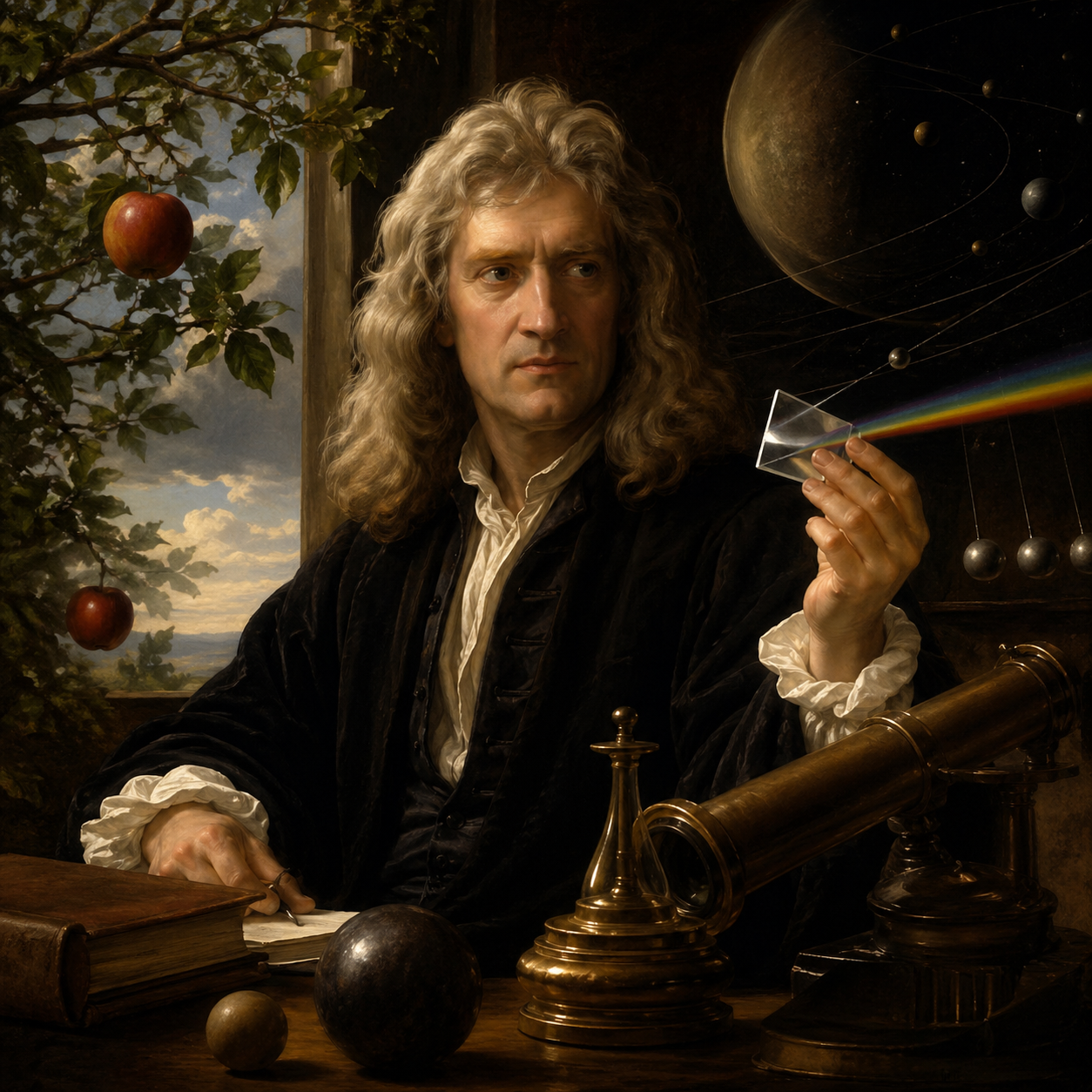
Newton lived this principle: his three laws of motion and one law of universal gravitation unified falling apples, ocean tides, orbiting planets, and pendulum swings into a single mathematical system. His Principia Mathematica (1687) achieved exactly what the quote describes — deriving an enormous range of natural effects from a compact set of axioms. He viewed God's creation as inherently orderly, believing simplicity in principle reflected divine rational design.
The 17th century was fracturing Aristotle's authority. Natural philosophers debated competing frameworks — Descartes' mechanical vortices, alchemical traditions, Leibniz's monads — each multiplying explanatory entities. Newton's era demanded a methodological revolution: replace qualitative, purpose-driven accounts with mathematical laws derivable from minimal assumptions. His quote was a manifesto against hypothesis-stacking, echoing Ockham's razor but weaponizing it for empirical science at the height of the Scientific Revolution.
AI-generated insights based on extensive research and information for context. Factual errors? Email [email protected].
Your cart is empty