Isaac Newton — "The greatest challenges to the truth of the Holy Scriptures are not the work of …"
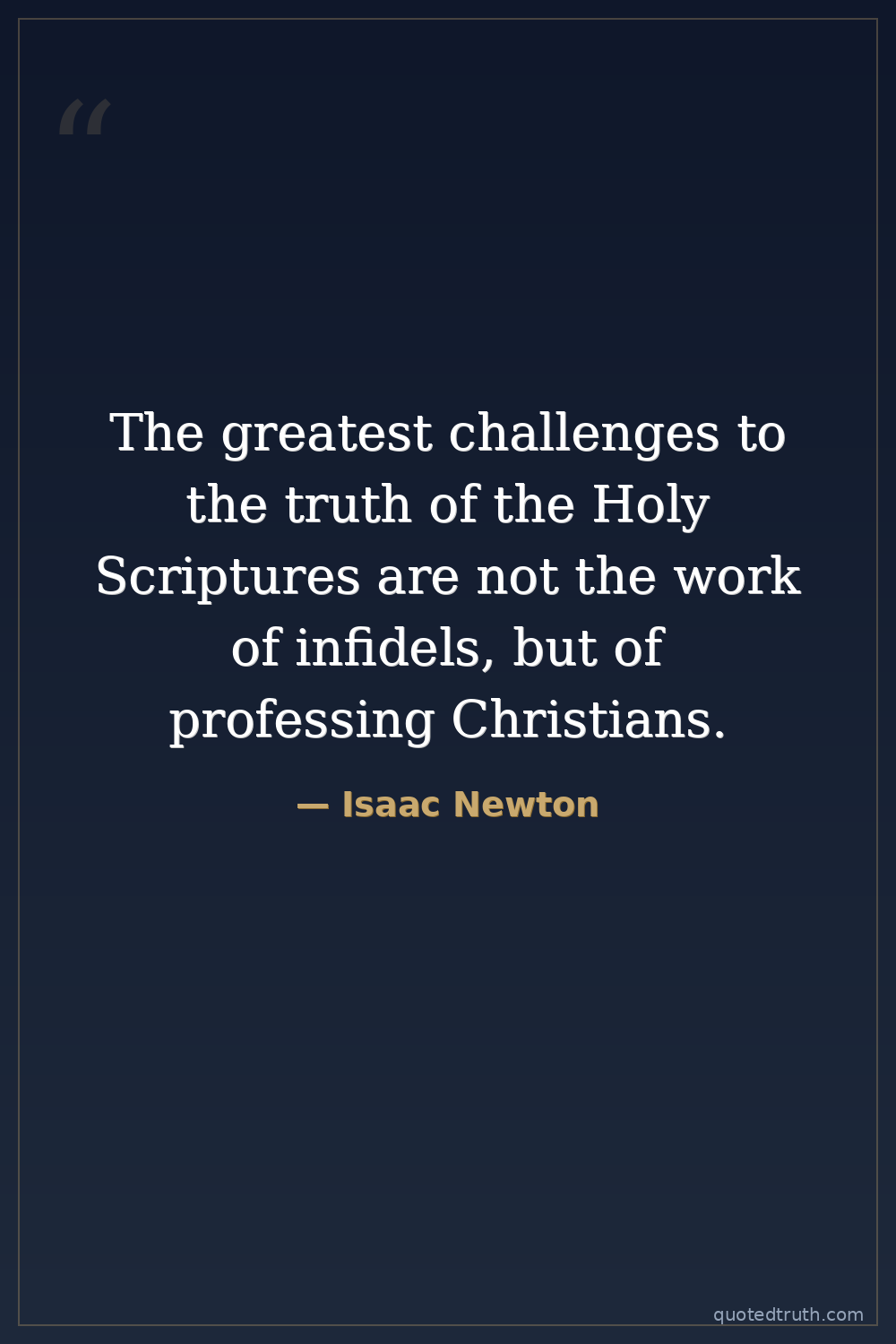
The greatest challenges to the truth of the Holy Scriptures are not the work of infidels, but of professing Christians.
The greatest challenges to the truth of the Holy Scriptures are not the work of infidels, but of professing Christians.
Click any product to generate a realistic preview. Up to 3 at a time.
* Initial load can take up to 90 seconds — revising the preview in another color is nearly instant.
"The changing of bodies into light, and light into bodies, is very conformable to the course of Nature."
"To explain all nature is too difficult a task for any one man or even for any one age. 'Tis much better to do a little with certainty, & leave the rest for others that come after you, than to explain …"
"The cause of gravity is what I do not pretend to know."
"Truth is ever to be found in simplicity, and not in the multiplicity and confusion of things."
"What is it that induces a man to be a philosopher? It is not the love of truth, but the love of fame, or the love of novelty, or the love of power."
Found in 1 providers: grok
1 source checked
The quote argues that the most dangerous threats to biblical truth come not from atheists or open critics, but from people who claim Christianity while distorting scripture. Insiders operating under the guise of faith and church authority can corrupt doctrine far more effectively than outside opponents, because congregations trust them and cannot easily identify the damage being done from within.
Newton was secretly an Arian heretic who rejected the Trinity, writing over a million unpublished words on theology. He believed Athanasius and fourth-century church councils had deliberately falsified scripture to insert Trinitarian doctrine. He taught himself Hebrew and Greek to access original texts. This quote directly expresses his private conviction that orthodox Trinitarian clergy — self-described Christians — were history's primary corruptors of God's authentic word.
Newton lived through England's Civil War, Interregnum, Restoration, and Glorious Revolution — each tied to competing Christian factions claiming scriptural authority. Protestant denominations fractured constantly, Socinian and Arian controversies challenged Trinitarian orthodoxy, and deism was rising among intellectuals. Biblical criticism emerged as a discipline. In this environment, rival 'professing Christians' weaponizing scripture for political and doctrinal ends made insider corruption a far more visible and immediate threat than any infidel critic.
AI-generated insights based on extensive research and information for context. Factual errors? Email [email protected].
Your cart is empty