John Milton — "For what is life, but the quintessence of pleasure, if we be not in a perpetual …"
For what is life, but the quintessence of pleasure, if we be not in a perpetual motion of enjoyment?
For what is life, but the quintessence of pleasure, if we be not in a perpetual motion of enjoyment?
Click any product to generate a realistic preview. Up to 3 at a time.
* Initial load can take up to 90 seconds — revising the preview in another color is nearly instant.
"Who overcomes by force, hath overcome but half his foe."
"To be more than man, is not to be man."
"The mind is its own place, and in itself Can make a Heav'n of Hell, a Hell of Heav'n."
"Peace hath her victories No less renown'd than war."
"Of Man's first disobedience, and the fruit Of that forbidden tree, whose mortal taste Brought death into the World, and all our woe, With loss of Eden, till one greater Man Restore us, and regain the …"
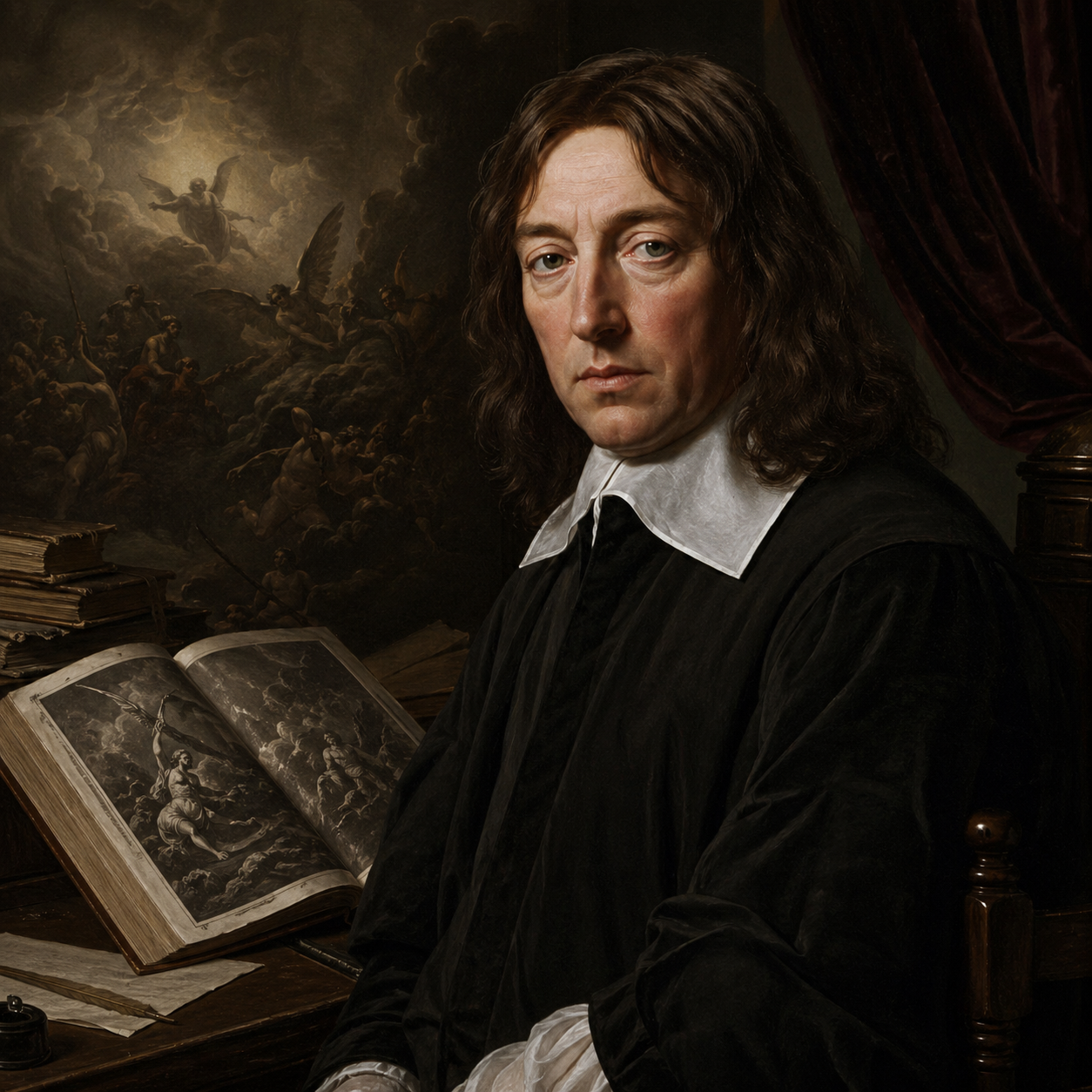
English poet whose Paradise Lost (1667) is the canonical English epic, written while blind during the Restoration after his service to Cromwell's Commonwealth. Closely associated with Andrew Marvell (Commonwealth poet and friend who protected Milton at the Restoration). For an intellectual contrast, see King Charles II's Restoration court, the courtly, sexually-libertine, theater-reopened world of 1660s London — Milton wrote Paradise Lost as a defeated Republican; the Restoration culture around him celebrated everything his Commonwealth had banned. The cleanest 'losing side writes the masterpiece' moment in English literature — Paradise Lost's Satan is freighted with the political defeat of the regicides Milton served.
Your cart is empty