Pope Urban II — "For your brethren who live in the East are in urgent need of your help... the Tu…"
For your brethren who live in the East are in urgent need of your help... the Turks and Arabs have attacked them.
For your brethren who live in the East are in urgent need of your help... the Turks and Arabs have attacked them.
Click any product to generate a realistic preview. Up to 3 at a time.
* Initial load can take up to 90 seconds — revising the preview in another color is nearly instant.
"The land of the Saracens is fertile and rich."
"It is Jesus Christ Himself who leaves His Sepulcher and presents to you His Cross. It will be the sign that will unite the dispersed children of Israel. Raise it to your shoulders and place it on your…"
"But if you are hindered by love of children, parents, or of wife, remember what the Lord says in the Gospel, 'He that loveth father or mother more than me is not worthy of me', 'Every one that hath fo…"
"If you must have blood, bathe in the blood of the infidels."
"For the land which you inhabit, shut in on all sides by the seas and surrounded by the mountain peaks, is too narrow for your large population."
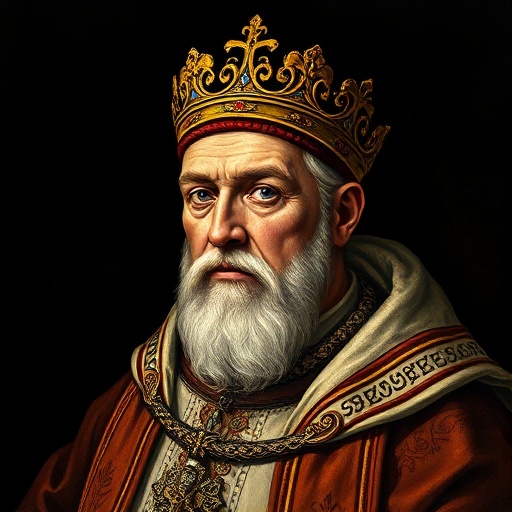
Pope (1088-1099) whose Council of Clermont speech (November 1095) launched the First Crusade — the founding event of nine centuries of Christian-Muslim military conflict. Closely associated with Pope Gregory VII (his predecessor on papal-imperial reform). For an intellectual contrast, see Saladin, Kurdish-Muslim Sultan of Egypt and Syria (1138-1193) — Saladin recaptured Jerusalem in 1187, undoing the First Crusade Urban II launched 92 years earlier. Saladin's chivalrous treatment of Christian prisoners became the canonical Muslim counter-image to Crusader brutality. The cleanest before/after pairing of the Crusades' moral arc.
Found in 1 providers: deepseek
1 source checked
Western Christians are called to militarily defend their Eastern Christian counterparts being overrun by Seljuk Turks and Arab forces. The appeal frames this as a family obligation—brethren in urgent danger—rather than political conquest. It positions warfare as a moral duty, a rescue mission for fellow believers. In modern terms: an urgent solidarity call, urging people to protect allied communities facing military attack before those communities are destroyed.
Urban II, a Cluniac monk turned pope, devoted his papacy to reforming the Church and asserting papal supremacy. This speech at Clermont (1095) was his defining act—strategically brilliant and personally sincere. His monastic training gave him the moral framework for holy war; his political instincts saw the Crusade as a way to reunite Rome with Constantinople after the 1054 Schism and redirect Europe's violent nobility toward a sanctified purpose.
In 1095, the Byzantine Empire had been shattered at Manzikert (1071) by Seljuk Turks, losing most of Anatolia. Emperor Alexios I Komnenos had begged Rome for mercenaries. Meanwhile, Seljuk control over the Holy Land made Christian pilgrimage increasingly dangerous. Feudal Europe had a surplus of armed knights with no sanctioned outlet for violence. Urban II's speech transformed these converging crises into a unified religious military movement that reshaped the medieval world.
AI-generated insights based on extensive research and information for context. Factual errors? Email [email protected].
Your cart is empty