Rachel Carson — "Future generations are not going to forgive us for the way we are destroying the…"
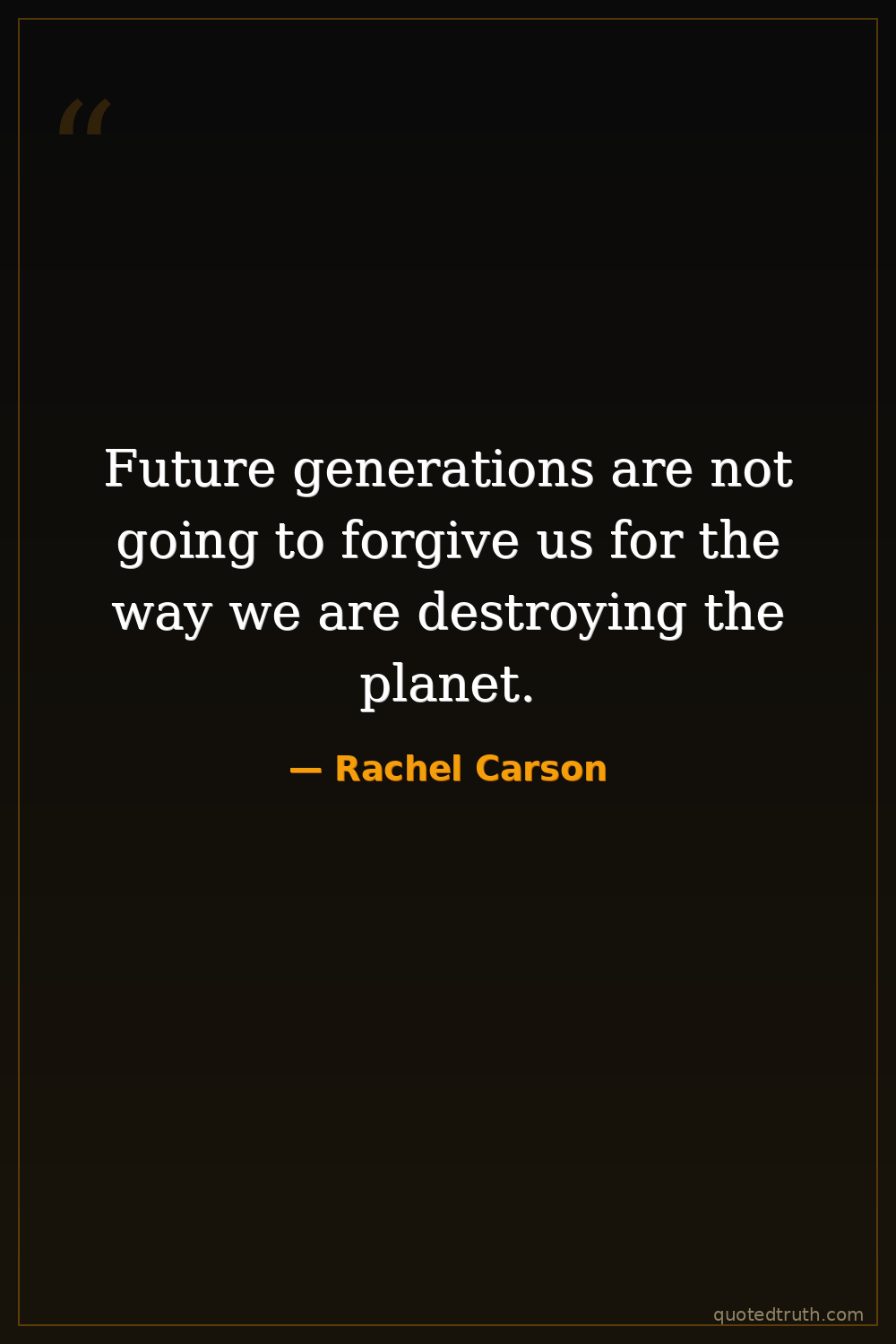
Future generations are not going to forgive us for the way we are destroying the planet.
Future generations are not going to forgive us for the way we are destroying the planet.
Click any product to generate a realistic preview. Up to 3 at a time.
* Initial load can take up to 90 seconds — revising the preview in another color is nearly instant.
"The most alarming of all man's assaults upon the environment is the contamination of air, earth, rivers, and sea with dangerous and even lethal materials."
"We stand now where two roads diverge. But unlike the roads in Robert Frost's familiar poem, they are not equally fair. The road we have long been traveling is deceptively easy, a smooth superhighway o…"
"As crude a weapon as the cave man's club, the chemical barrage has been hurled against the fabric of life—a fabric on the one hand delicate and destructible, on the other miraculously informed with po…"
"Are we to stand by while the people of the world are fed into a biological meat grinder? When we poison the air, the water, and the soil, we are poisoning ourselves."
"The most serious threat to mankind comes from within, from our own arrogance and ignorance."
Found in 1 providers: grok
1 source checked
We are making choices — burning fossil fuels, dumping pollutants, clearing forests — that will leave the natural world worse than we found it. People born decades from now will suffer the consequences of today's decisions and will judge us harshly for knowingly choosing short-term gain over long-term survival. It frames environmental destruction as a moral betrayal of people who have no voice in the decisions being made now.
Carson spent her career documenting nature's fragility — first as a marine biologist with works like The Sea Around Us, then as Silent Spring's author exposing how DDT decimated bird populations and contaminated food chains. She wrote against fierce opposition from the chemical industry, fully aware her findings would outlive her. The quote captures her core conviction that science carries moral weight, and that silence in the face of ecological harm is its own form of complicity.
The mid-20th century was an era of unchecked industrial optimism. Post-WWII America expanded chemical agriculture, synthetic manufacturing, and nuclear testing with minimal oversight. DDT was sprayed liberally on crops and suburbs. Rivers ran with industrial waste. There was no EPA, no Clean Air Act, no environmental regulation in any serious form. Carson published Silent Spring in 1962 into this vacuum, making her warning about future judgment both urgent and genuinely countercultural.
AI-generated insights based on extensive research and information for context. Factual errors? Email [email protected].
Your cart is empty