Isaac Newton — "God is the same God, always and everywhere. He is omnipresent not virtually only…"
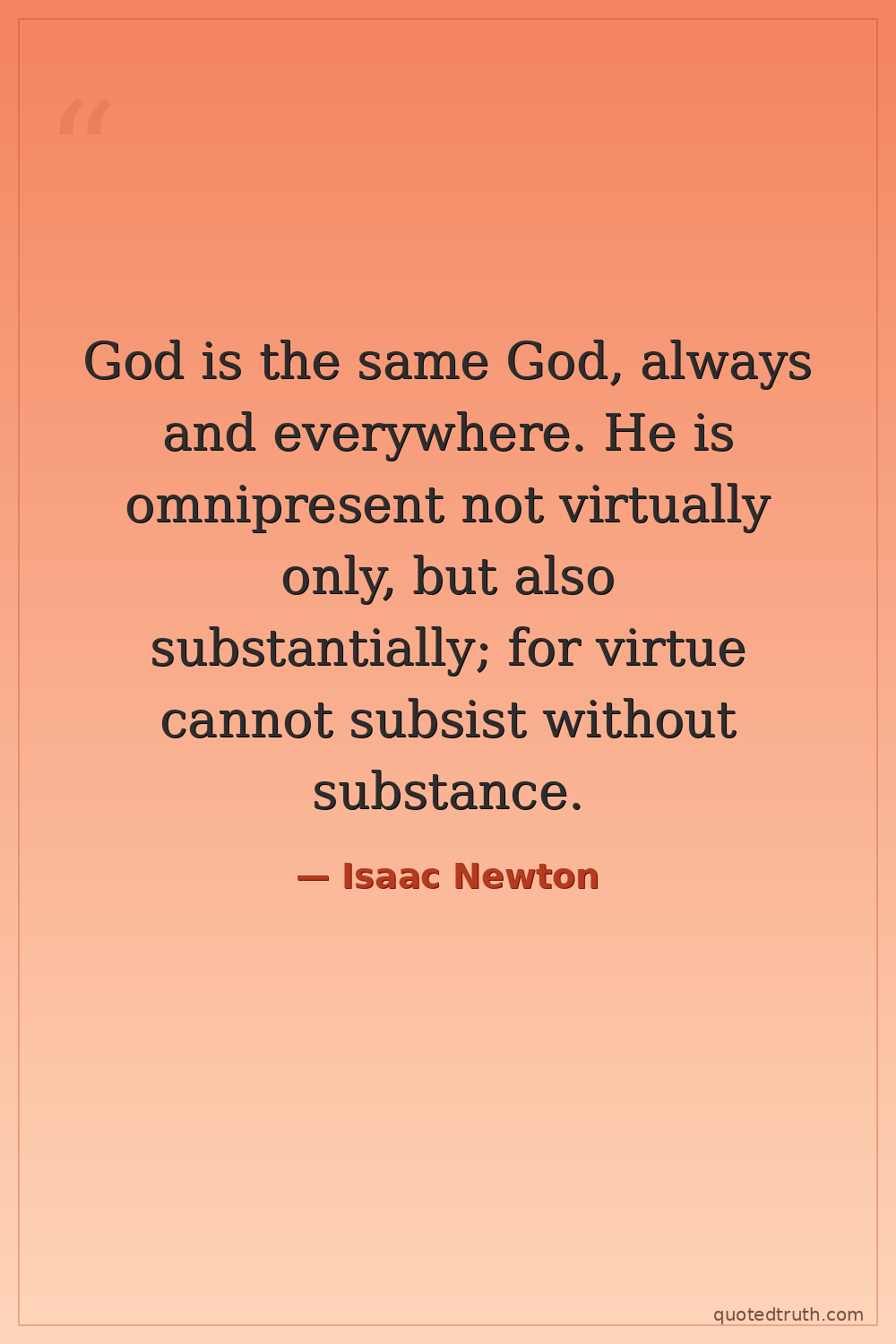
God is the same God, always and everywhere. He is omnipresent not virtually only, but also substantially; for virtue cannot subsist without substance.
God is the same God, always and everywhere. He is omnipresent not virtually only, but also substantially; for virtue cannot subsist without substance.
Click any product to generate a realistic preview. Up to 3 at a time.
* Initial load can take up to 90 seconds — revising the preview in another color is nearly instant.
"For it is the property of true philosophy to deduce the causes of all natural effects from the simplest possible principles."
"Tact is the art of making a point without making an enemy."
"I do not know what I may appear to the world, but to myself I seem to have been only like a boy playing on the seashore, and diverting myself in now and then finding a smoother pebble or a prettier sh…"
"To explain all nature is too difficult a task for any one man or even for any one age. 'Tis much better to do a little with certainty, & leave the rest for others that come after you, than to explain …"
"Oh, Diamond! Diamond! thou little knowest what mischief thou hast done!"
Found in 1 providers: grok
1 source checked
God exists uniformly across all space and time without exception. He is not merely present through His power or influence — He actually exists as a real substance at every location simultaneously. The argument: a power or quality cannot exist independently; it requires a material foundation. God's omnipresence is therefore literal and physical, not just metaphorical or felt only through His effects on the world.
Newton wrote more theology than physics — his unpublished manuscripts fill millions of words on scripture and prophecy. This quote appears in the General Scholium of Principia Mathematica, directly linking his physics to his faith. His concept of absolute space — infinite, homogeneous, eternal — provided the framework for God's omnipresence. For Newton, natural philosophy was not separate from religion but the primary means of understanding God's creation and nature.
The 17th-century Scientific Revolution destabilized traditional religious cosmology, raising fears that mechanistic science eliminated God's role in nature. Newton's era saw fierce debate between materialist atheists like Hobbes and Spinoza and defenders of divine providence. Continental theology debated whether God acted directly or through secondary causes. Newton deliberately countered deists and mechanical philosophers who reduced God to a distant first mover with no ongoing physical presence in the universe.
AI-generated insights based on extensive research and information for context. Factual errors? Email [email protected].
Your cart is empty