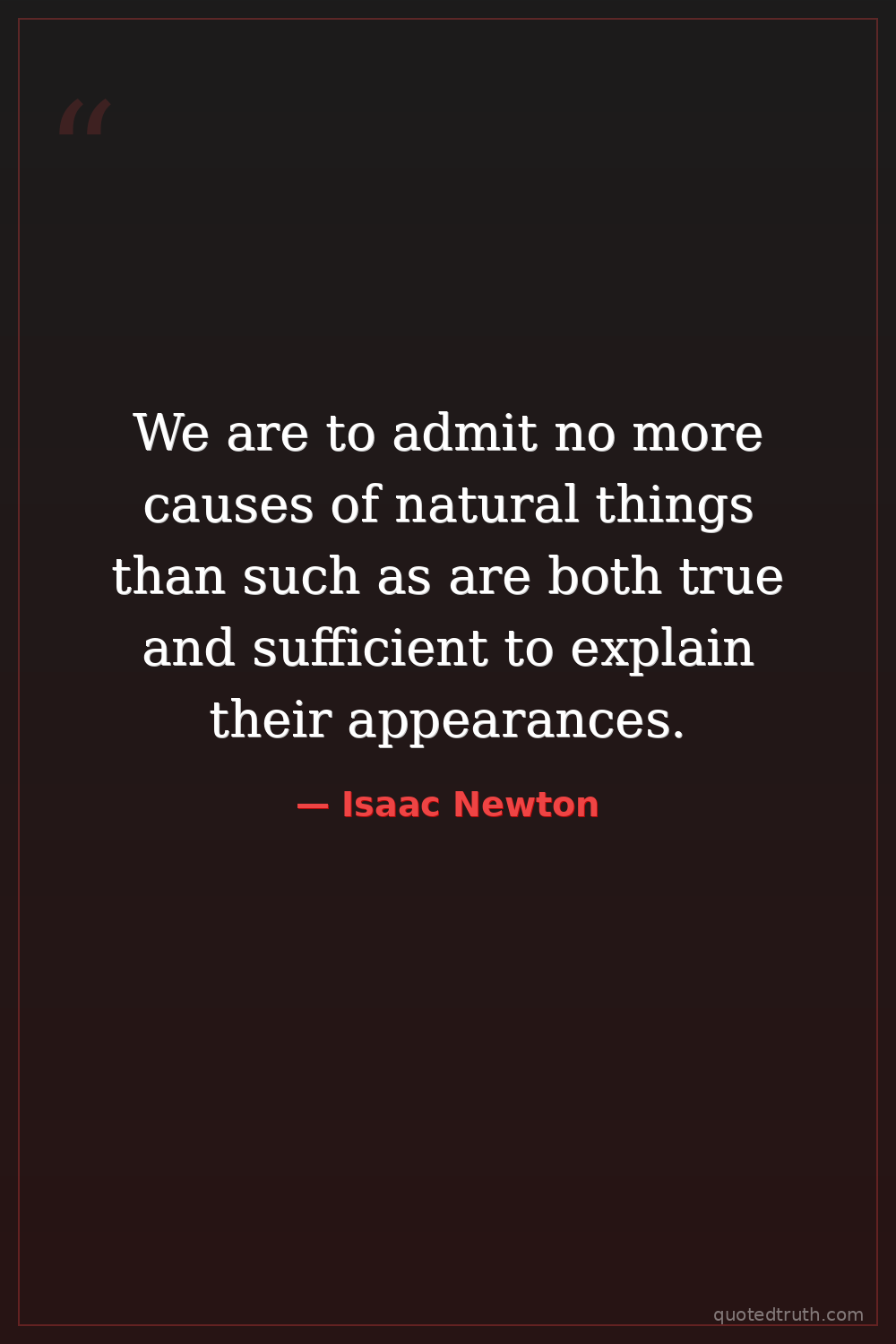
Isaac Newton — "We are to admit no more causes of natural things than such as are both true and …"
We are to admit no more causes of natural things than such as are both true and sufficient to explain their appearances.
We are to admit no more causes of natural things than such as are both true and sufficient to explain their appearances.
Click any product to generate a realistic preview. Up to 3 at a time.
* Initial load can take up to 90 seconds — revising the preview in another color is nearly instant.
"It is the perfection of God's works that they are all done with the greatest simplicity."
"He who thinks half-heartedly will not believe in God; but he who thinks seriously will believe in God."
"To explain all nature is too difficult a task for any one man or even for any one age."
"I keep the subject constantly before me and wait till the first dawnings open slowly, by little and little, into a full and clear light."
"Every body continues in its state of rest, or of uniform motion in a right line, unless it is compelled to change that state by forces impressed upon it."
Found in 1 providers: deepseek
1 source checked
Only invoke causes that are real and genuinely necessary to account for what you observe. Do not invent extra explanations when fewer will do. If one mechanism fully explains a phenomenon, adding more is dishonest and muddies understanding. It is science's economy principle: strip away speculative causes until only what the evidence demands remains. This makes theories testable, falsifiable, and honest—a foundation of modern scientific thinking.
Newton lived this principle: his law of universal gravitation collapsed centuries of separate celestial and terrestrial theories into one cause—gravity. He famously refused to hypothesize beyond evidence ('Hypotheses non fingo'). His three laws of motion reduced endless mechanical complexity to bare essentials. Newton saw simplicity as revealing God's design. He distrusted Descartes' elaborate vortex theory precisely because it invented unnecessary mechanisms that evidence never demanded.
The early modern era was escaping Aristotle's four causes and scholasticism's layered metaphysical explanations for natural events. Competing systems—Descartes' vortices, occult forces, spiritual intermediaries—cluttered natural philosophy with unverifiable causes. Newton wrote this rule in Principia (1687) to discipline a field drowning in speculation. The Royal Society's empiricist culture ('Nullius in verba') demanded evidence-grounded claims. Newton's parsimony rule became a cornerstone of what we now call the scientific method.
AI-generated insights based on extensive research and information for context. Factual errors? Email [email protected].
Your cart is empty