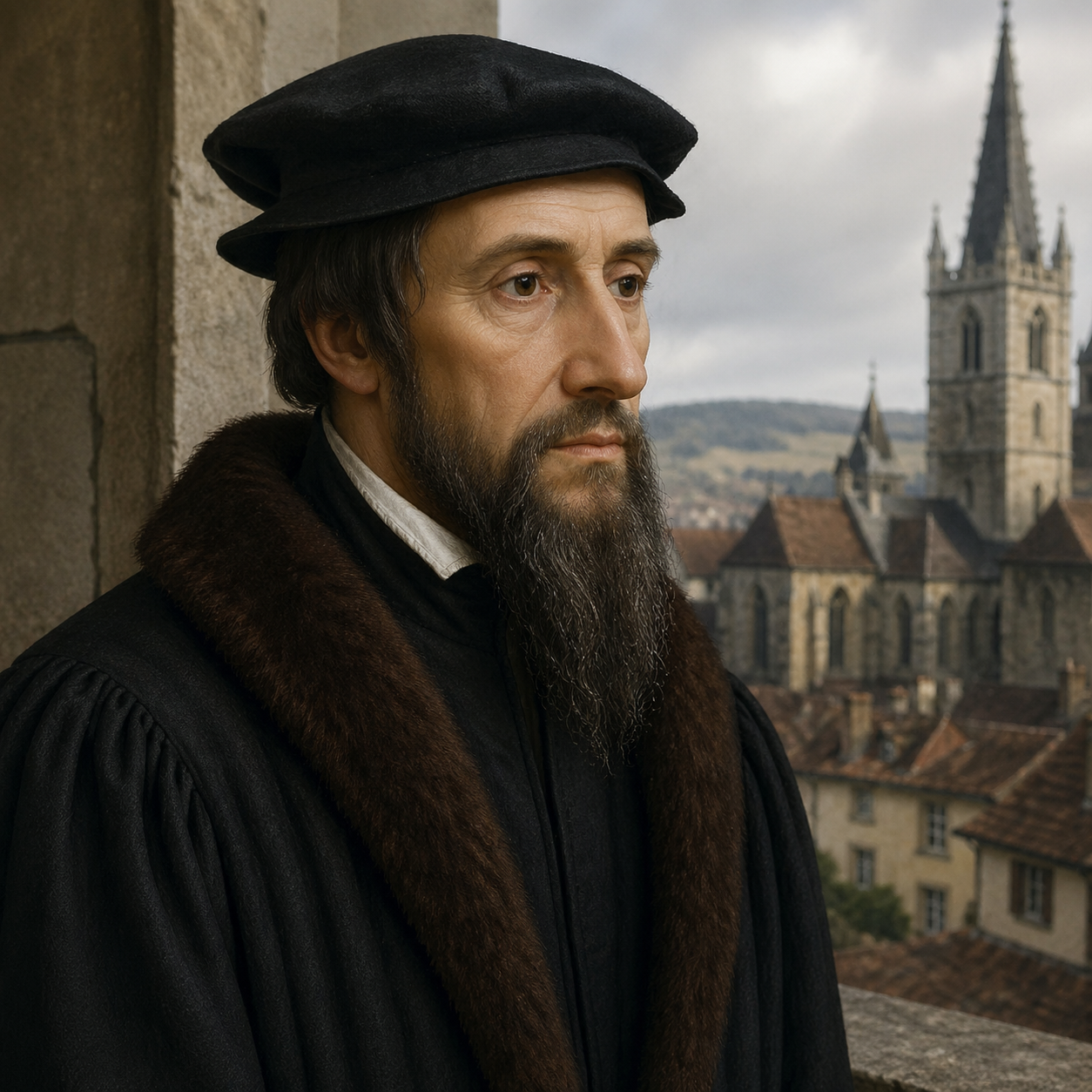
John Calvin — "God will not suffer his truth to be obscured, but will always raise up some to m…"
God will not suffer his truth to be obscured, but will always raise up some to maintain it.
God will not suffer his truth to be obscured, but will always raise up some to maintain it.
Click any product to generate a realistic preview. Up to 3 at a time.
* Initial load can take up to 90 seconds — revising the preview in another color is nearly instant.
"Whence it is sufficiently plain that they are not chosen for their own merit, but because God has gratuitously chosen them."
"Our salvation depends on the free election of God."
"Our hearts are so prone to idolatry that we cannot but be continually forging new gods for ourselves."
"The elect are saved by grace, and the reprobate are damned by justice."
"We are not our own: let not our reason nor our will, therefore, sway our plans and deeds. We are not our own: let us therefore not set it as our goal to seek what is expedient for us according to the …"
French theologian whose Institutes of the Christian Religion (1536) systematized Protestant Reformed doctrine, including predestination. Closely associated with Martin Luther (Reformation founder, Calvin's predecessor). For an intellectual contrast, see Jacobus Arminius, Dutch Reformed theologian (1560-1609) — Arminius's rejection of strict double-predestination founded Arminianism — the theological tradition modern Methodism, most evangelicalism, and Pentecostalism descend from. The Calvinist-Arminian debate has divided Protestantism for 400 years.
Found in 1 providers: grok
1 source checked
God actively protects his truth from being permanently hidden or suppressed. Even in the darkest periods, he will ensure that faithful people rise up to defend and proclaim it. Truth cannot be permanently buried — divine providence guarantees that someone will always stand to uphold it, no matter how powerful the forces working against it.
Calvin spent his life doing exactly what this quote describes — rising up to maintain truth as he understood it. Exiled from France for his Reformed beliefs, he rebuilt his entire ministry in Geneva, enduring fierce opposition from city councils, rival theologians, and Catholic authorities. His Institutes of the Christian Religion was written precisely to defend Protestant doctrine from extinction.
The Protestant Reformation was a battle over who controlled religious truth. The Catholic Church wielded enormous institutional power to suppress heresy through the Inquisition, Index of Forbidden Books, and excommunication. Reformed thinkers like Calvin were genuinely at risk of execution. This conviction that God preserves truth gave reformers courage to keep publishing, preaching, and organizing despite constant persecution throughout the 16th century.
AI-generated insights based on extensive research and information for context. Factual errors? Email [email protected].
Your cart is empty