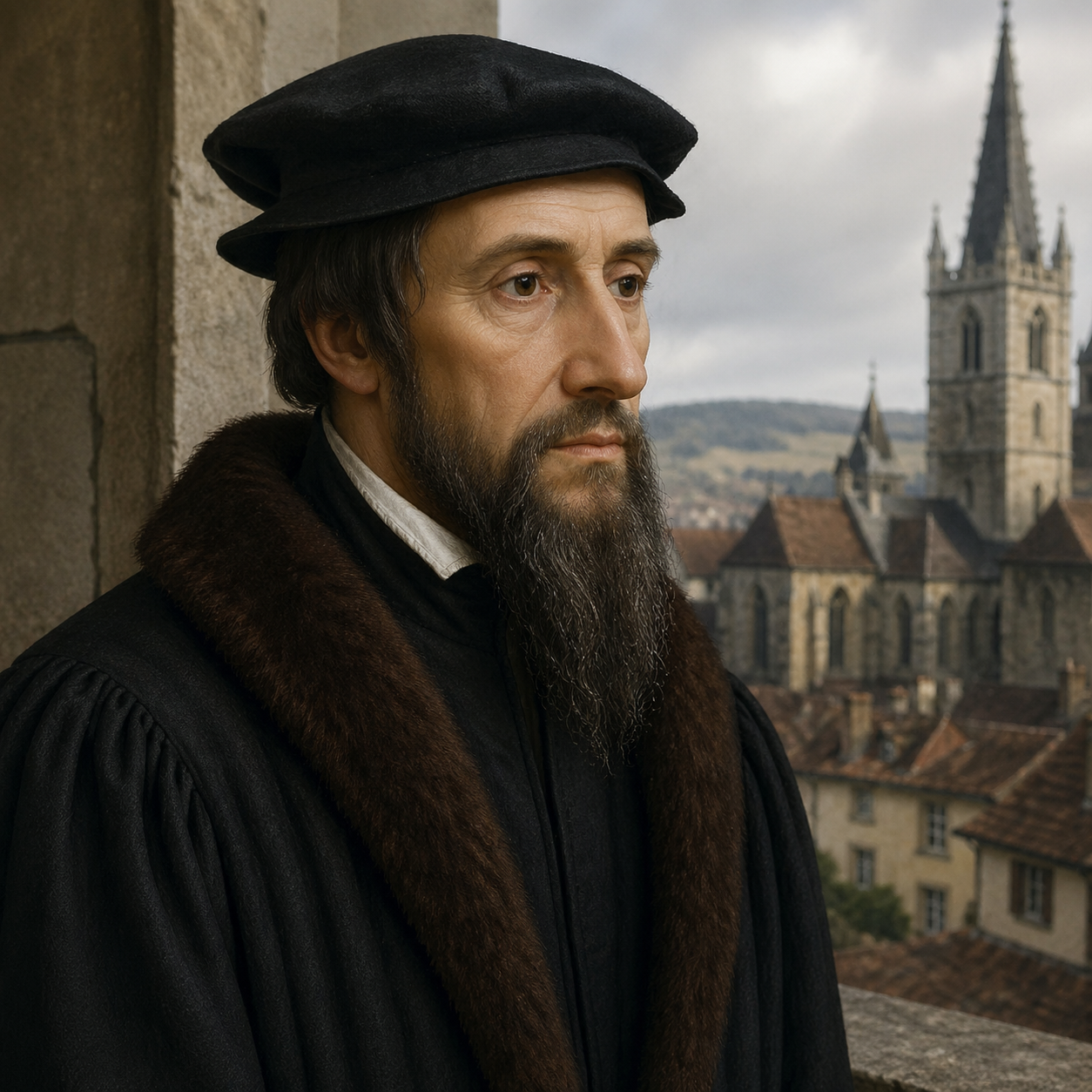
John Calvin — "Whence it is sufficiently plain that they are not chosen for their own merit, bu…"
Whence it is sufficiently plain that they are not chosen for their own merit, but because God has gratuitously chosen them.
Whence it is sufficiently plain that they are not chosen for their own merit, but because God has gratuitously chosen them.
Click any product to generate a realistic preview. Up to 3 at a time.
* Initial load can take up to 90 seconds — revising the preview in another color is nearly instant.
"When God chooses a man, he does not consider what he is, but what he will make him."
"It is a horrible decree, I confess, but no one can deny that God foreknew what the end of man was to be before he created him, and that he foreknew it because he had so ordained it."
"God's providence is not only general, but extends to all the particular facts of life."
"Our salvation depends on the free election of God."
"The reprobate are those whom God has determined to leave in their sins, and consequently to deliver to eternal perdition."
French theologian whose Institutes of the Christian Religion (1536) systematized Protestant Reformed doctrine, including predestination. Closely associated with Martin Luther (Reformation founder, Calvin's predecessor). For an intellectual contrast, see Jacobus Arminius, Dutch Reformed theologian (1560-1609) — Arminius's rejection of strict double-predestination founded Arminianism — the theological tradition modern Methodism, most evangelicalism, and Pentecostalism descend from. The Calvinist-Arminian debate has divided Protestantism for 400 years.
Found in 1 providers: grok
1 source checked
This quote asserts unconditional election: those God saves are not selected because of personal virtue, moral achievement, or any earned quality. Selection flows entirely from God's free, sovereign choice — 'gratuitously' meaning without cause in the recipient. It removes human accomplishment from the equation of salvation entirely, placing the source of being chosen solely in divine will. No one earns favor; all salvation is pure, unmerited gift from God alone.
Calvin's entire theological system centered on God's absolute sovereignty. His Institutes of the Christian Religion devoted extensive chapters to predestination, and he defended unconditional election throughout his decades pastoring Geneva's St. Pierre Cathedral against critics who called it arbitrary or unjust. Having fled Catholic France as a convert risking everything, Calvin personally understood being 'chosen' outside institutional merit systems. His life's work was systematizing exactly this: grace operates entirely independently of human deserving.
The 16th-century Reformation erupted precisely over the question of merit. The Catholic Church taught sacraments and good works contributed to salvation, and indulgences literally sold merit certificates. Luther's challenge sparked the crisis; Calvin pushed further, arguing God's election precedes any human action whatsoever. Amid religious wars, excommunications, and the Council of Trent's counter-response formally defending merit theology, Calvin's doctrine of unconditional election was a direct, destabilizing challenge to the entire medieval Christian framework.
AI-generated insights based on extensive research and information for context. Factual errors? Email [email protected].
Your cart is empty