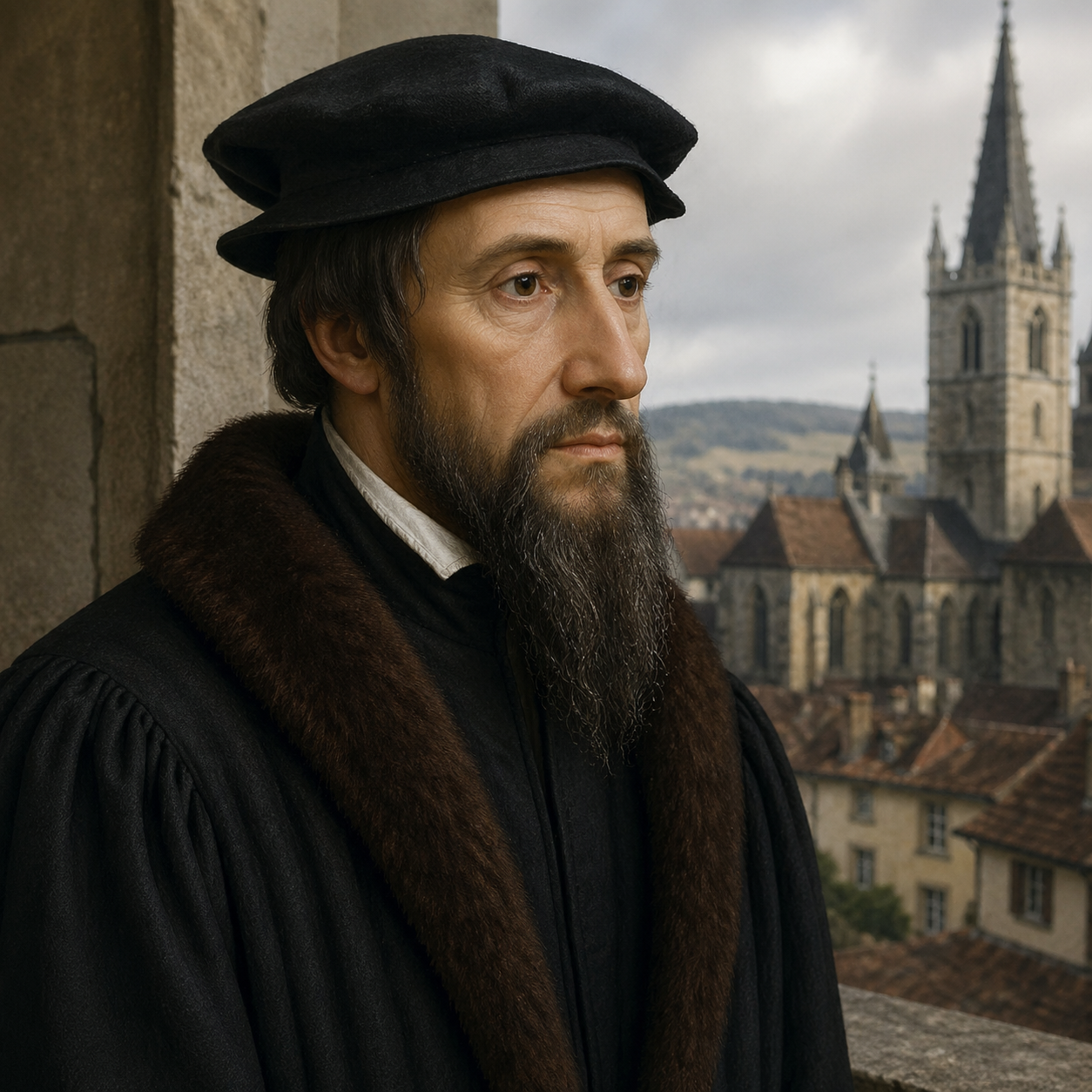
John Calvin — "God's providence is not only general, but extends to all the particular facts of…"
God's providence is not only general, but extends to all the particular facts of life.
God's providence is not only general, but extends to all the particular facts of life.
Click any product to generate a realistic preview. Up to 3 at a time.
* Initial load can take up to 90 seconds — revising the preview in another color is nearly instant.
"The human mind is, so to speak, a perpetual forge of idols."
"There is no more dangerous illusion than to believe that we are not tempted."
"The seed of the Word of God takes root and grows fruitful only in those whom the Lord, by his eternal election, has predestined to be his children and heirs of the heavenly kingdom. To all others who,…"
"The Word of God is the scepter by which he governs his church."
"For the mind of man is so entirely alienated from the righteousness of God that it can neither conceive, desire, nor design anything but what is vicious, perverted, impure, and iniquitous."
French theologian whose Institutes of the Christian Religion (1536) systematized Protestant Reformed doctrine, including predestination. Closely associated with Martin Luther (Reformation founder, Calvin's predecessor). For an intellectual contrast, see Jacobus Arminius, Dutch Reformed theologian (1560-1609) — Arminius's rejection of strict double-predestination founded Arminianism — the theological tradition modern Methodism, most evangelicalism, and Pentecostalism descend from. The Calvinist-Arminian debate has divided Protestantism for 400 years.
Found in 1 providers: grok
1 source checked
God isn't just a distant force who set the universe in motion and stepped back. This quote asserts that divine oversight reaches into every specific moment, decision, and circumstance of everyday life — nothing is accidental or outside God's active care. Whether in large historical events or small personal details, everything falls within God's purposeful governance. It rejects the idea of a hands-off deity, affirming one who is personally and continuously engaged in all things.
Calvin built his entire theological system — codified in the Institutes of the Christian Religion — around God's absolute sovereignty, including his doctrine of predestination. His own turbulent life, marked by exile from France and years of political struggle reforming Geneva, reinforced his conviction that nothing happened by chance. Providence wasn't merely abstract for Calvin; it was pastoral comfort under persecution. This quote distills his career-defining belief that God's will operates at every level of existence, not just cosmically.
The 16th-century Reformation shattered Europe's religious unity, sparking wars, executions, and mass displacement. Early mechanistic natural philosophy was beginning to describe a universe governed by impersonal laws, raising questions about divine involvement. Calvin's insistence on particular providence pushed back against both this emerging tendency and Catholic sacramentalism. For people enduring plague, famine, and religious violence, a theology placing every specific event under God's deliberate governance offered meaning — and explained why suffering did not signal divine indifference or absence.
AI-generated insights based on extensive research and information for context. Factual errors? Email [email protected].
Your cart is empty