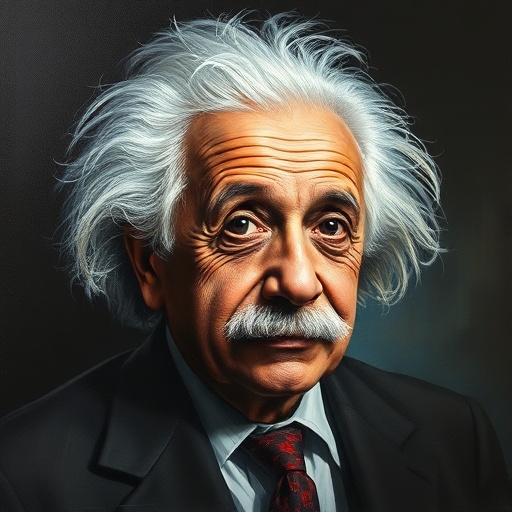
Albert Einstein — "Great spirits have always encountered violent opposition from mediocre minds."
Great spirits have always encountered violent opposition from mediocre minds.
Great spirits have always encountered violent opposition from mediocre minds.
Click any product to generate a realistic preview. Up to 3 at a time.
* Initial load can take up to 90 seconds — revising the preview in another color is nearly instant.
"The value of a man should be seen in what he gives and not in what he is able to receive."
"The human mind has first to construct forms, independently, before we can find them in things."
"Imagination is more important than knowledge. For knowledge is limited, whereas imagination embraces the entire world, stimulating progress, giving birth to evolution."
"Marriage is the unsuccessful attempt to make something lasting out of an incident."
"I am almost ashamed to be living in such peace while all the rest struggle and suffer."
Found in 1 providers: grok
1 source checked
When someone thinks or creates far beyond the norm, those operating at average levels often react with hostility rather than curiosity. Genuine breakthroughs—in science, art, or ideas—threaten the comfortable assumptions of conventional thinkers. The opposition isn't mere skepticism; it's active resistance, sometimes personal attacks. The quote acknowledges a recurring pattern: the bigger the idea, the fiercer the pushback from those most invested in preserving the status quo rather than questioning it.
Einstein lived this truth directly. His theories of special and general relativity overturned centuries of Newtonian physics, earning derision from establishment scientists who dismissed them as 'Jewish physics.' Unable to secure an academic post early on, he worked in a Swiss patent office while developing world-changing ideas. When the Nazis rose to power, his books were burned and his citizenship revoked. His experience of transformative ideas meeting institutional hostility gave this observation the unmistakable weight of lived experience.
Einstein published his relativity theories between 1905 and 1915, during rigid academic hierarchies and entrenched scientific orthodoxy. WWI shattered European stability, and rising nationalism bred deep suspicion of unconventional thinkers—especially Jewish intellectuals. The interwar period saw scientific communities fracture along nationalist lines, and Nazi Germany institutionalized the rejection of so-called non-Aryan science. Meanwhile, quantum mechanics was simultaneously upending physics itself, making resistance to radical ideas both intellectually defensive and ideologically charged across Europe.
AI-generated insights based on extensive research and information for context. Factual errors? Email [email protected].
Your cart is empty