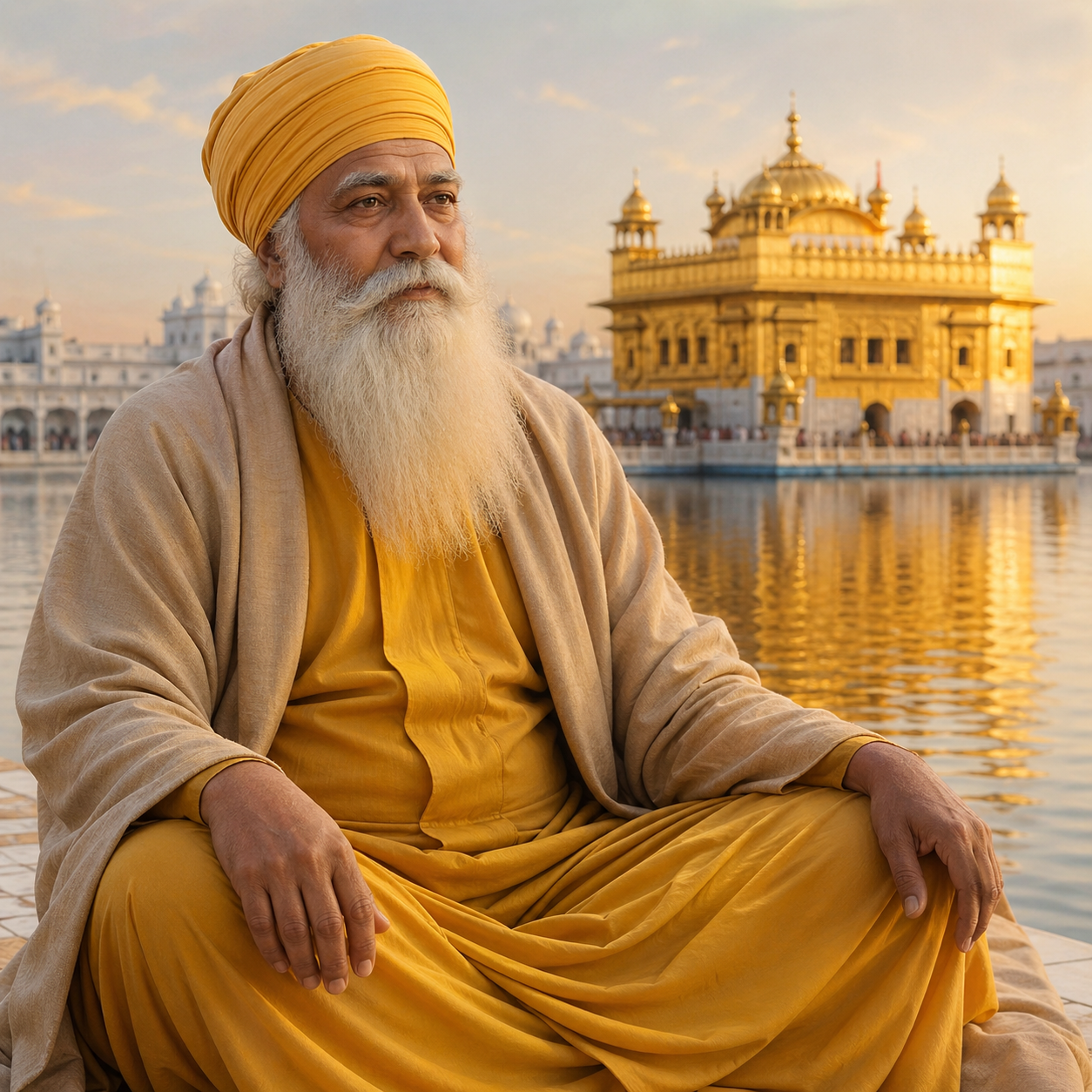
Guru Nanak — "He who practices truth, contentment, and kindness, and who is free from ego, he …"
He who practices truth, contentment, and kindness, and who is free from ego, he is truly a Brahmin.
He who practices truth, contentment, and kindness, and who is free from ego, he is truly a Brahmin.
Click any product to generate a realistic preview. Up to 3 at a time.
* Initial load can take up to 90 seconds — revising the preview in another color is nearly instant.
"There is but One God. His Name is Truth; He is the Creator, Sustainer of all, Free from fear and hate, Immortal, Unborn, Self-existent, Realized by the Guru's Grace."
"When the corn is ripe, it is cut down; when the mortal becomes old, death dances over his head."
"The Guru is the ladder, the boat, the raft, the ferryman, the ship, and the captain."
"Through suffering, one learns to love God."
"The greatest pilgrimage is to the temple of one's own heart. And sometimes, that temple needs a good cleaning."
Founder of Sikhism and the first of the Ten Sikh Gurus, whose teachings of one universal God and rejection of caste shaped Punjab. Closely associated with Kabir (mystical poet whose verses appear in the Sikh Guru Granth Sahib). For an intellectual contrast, see Brahmanical orthodoxy, the Hindu caste-and-ritual establishment of his era — Sikhism was founded as a deliberate alternative to both Hindu ritual hierarchy and Islamic exclusivism — Nanak's universalism was a structural rejection of caste and priestly mediation.
Found in 1 providers: grok
1 source checked
True nobility and spiritual standing come from how you live, not the family you were born into. A genuinely virtuous person is honest, satisfied with what they have, treats others with compassion, and has let go of pride and self-importance. Those inner qualities are what actually make someone worthy of respect, regardless of any title, caste, or social rank they may hold or claim.
Guru Nanak founded Sikhism in the Punjab region and directly rejected the rigid caste hierarchy of his time. He preached one universal God, human equality, and honest living. He challenged Brahmin priests who claimed spiritual authority by birth, insisting instead that inner virtue defined a true holy person. He also instituted langar, the free communal meal where all castes ate together, embodying this exact teaching.
Guru Nanak lived from 1469 to 1539 in South Asia, where the caste system dictated every social interaction and Brahmins held religious monopoly. Hindu-Muslim tensions were rising under early Mughal rule, and ritualism, pilgrimage fees, and priestly gatekeeping defined popular religion. Redefining 'Brahmin' as a moral category rather than a hereditary one was a radical social challenge that threatened entrenched clerical power and offered a unifying spiritual alternative.
AI-generated insights based on extensive research and information for context. Factual errors? Email [email protected].
Your cart is empty