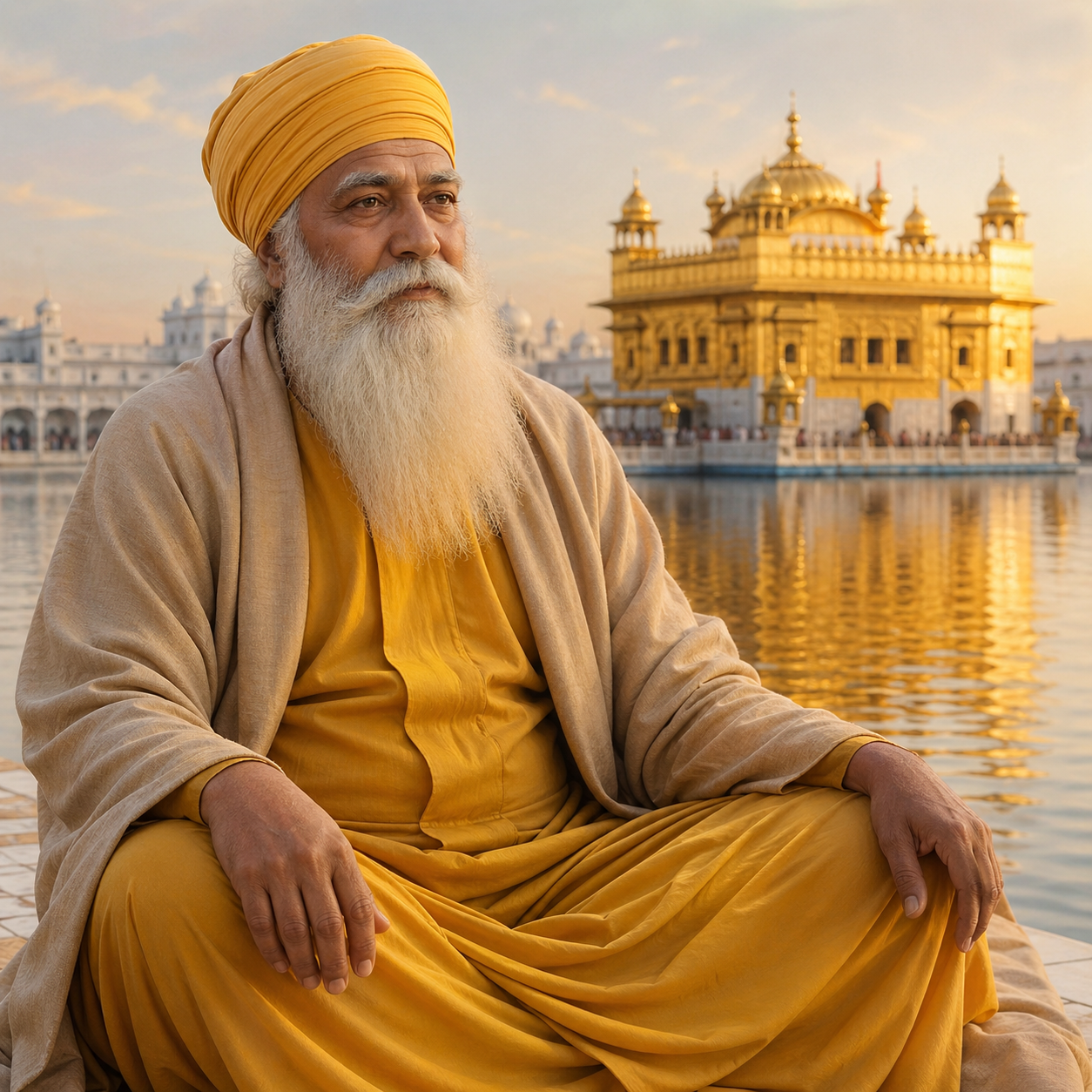
Guru Nanak — "Through suffering, one learns to love God."
Through suffering, one learns to love God.
Through suffering, one learns to love God.
Click any product to generate a realistic preview. Up to 3 at a time.
* Initial load can take up to 90 seconds — revising the preview in another color is nearly instant.
"There is no Hindu, there is no Muslim."
"Your Mercy is my social status."
"False is the body that leads to lust and anger, and false are the clothes that lead to pride."
"The Lord is the ocean, and we are the fish in it."
"Required prayers alone would be ineffective if those who offered them had their minds on worldly problems, instead of on God."
Founder of Sikhism and the first of the Ten Sikh Gurus, whose teachings of one universal God and rejection of caste shaped Punjab. Closely associated with Kabir (mystical poet whose verses appear in the Sikh Guru Granth Sahib). For an intellectual contrast, see Brahmanical orthodoxy, the Hindu caste-and-ritual establishment of his era — Sikhism was founded as a deliberate alternative to both Hindu ritual hierarchy and Islamic exclusivism — Nanak's universalism was a structural rejection of caste and priestly mediation.
Found in 1 providers: gemini
1 source checked
Pain and hardship are not punishments but teachers. When life goes smoothly, people coast on comfort and rarely look beyond themselves. But grief, loss, and struggle crack that surface open and push a person to reach for something larger than their own situation. In that reaching, a deeper devotion takes root. Suffering strips away distraction and ego, leaving the soul exposed enough to recognize and actually love the divine rather than merely acknowledge it.
Guru Nanak walked thousands of miles across South Asia, the Middle East, and Tibet, witnessing famine, caste cruelty, and the violence of Babur's invasions firsthand. He was briefly imprisoned and put to forced labor during that invasion. Rather than treating hardship as evidence of divine absence, he taught that remembrance of God (naam simran) deepens through trial. His hymns in the Guru Granth Sahib repeatedly frame pain as a refining fire that burns away ego and draws the seeker toward Waheguru.
Nanak lived 1469-1539 in Punjab, a contested frontier between the crumbling Delhi Sultanate and the incoming Mughals under Babur. Ordinary people endured invasion, heavy taxation, forced conversion pressure, rigid Hindu caste hierarchy, and Hindu-Muslim sectarian tension. Religious life was dominated by ritualism, pilgrimage fees, and Brahmin gatekeeping. In that climate of real physical suffering and spiritual exploitation, a message that hardship itself could be a direct path to God, bypassing priests and temples, was genuinely radical.
AI-generated insights based on extensive research and information for context. Factual errors? Email [email protected].
Your cart is empty