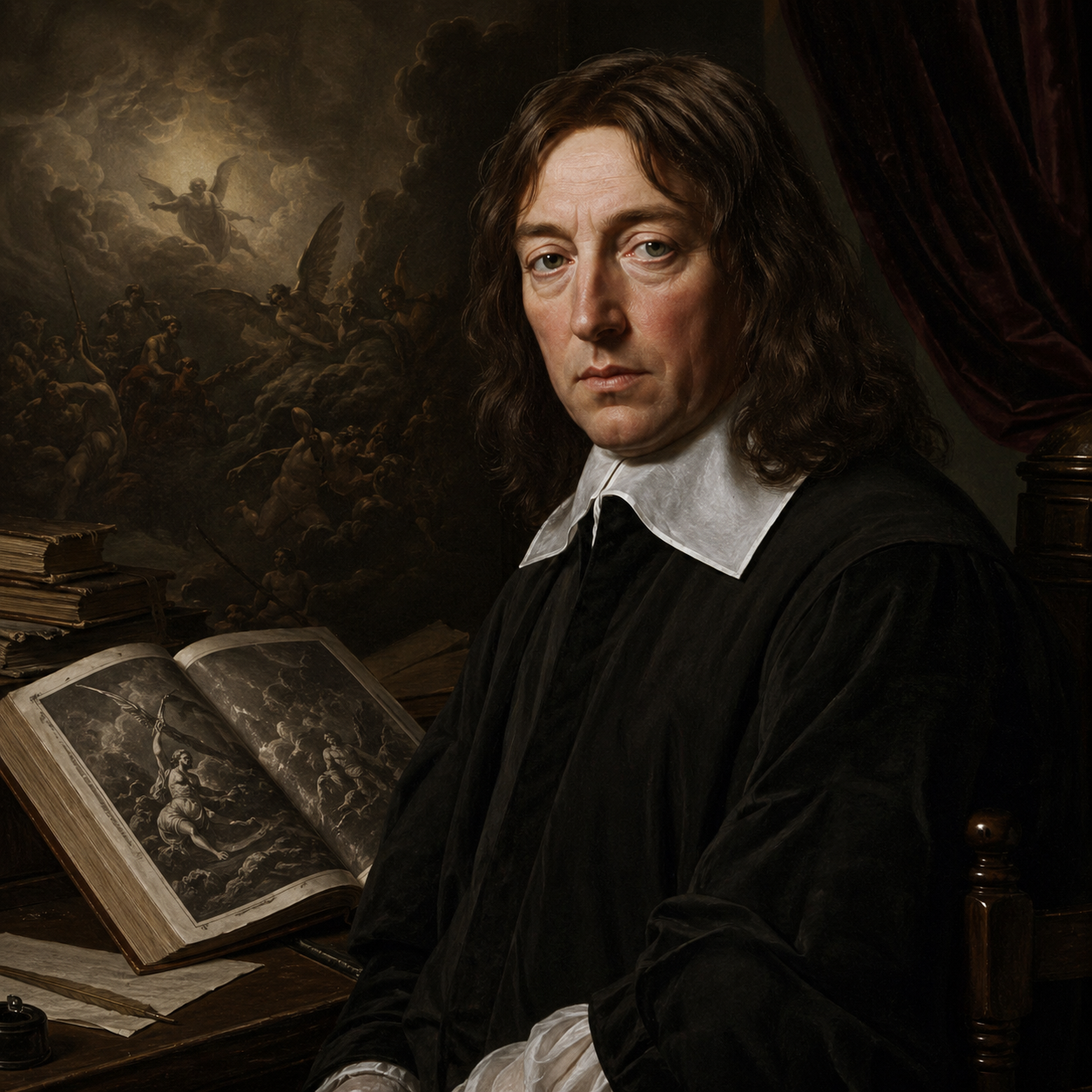
John Milton — "He who reigns within himself, and rules passions, desires, and fears, is more th…"
He who reigns within himself, and rules passions, desires, and fears, is more than a king.
He who reigns within himself, and rules passions, desires, and fears, is more than a king.
Click any product to generate a realistic preview. Up to 3 at a time.
* Initial load can take up to 90 seconds — revising the preview in another color is nearly instant.
"He who would be a great man, must be a great judge."
"They also serve who only stand and wait."
"For God, when he gave the command to multiply, did not mean that it should be a perpetual or a forced generation, but a free and voluntary one."
"When a man hath been labouring the hardest labour in the deep mines of knowledge, hath furnished out his mind through the whole cyclopædia, hath read the choicest authors, ancient and modern, cannot b…"
"For what is liberty without wisdom, and without virtue? It is the greatest of all evils; for it is folly, vice, and madness, without tuition or restraint."
English poet whose Paradise Lost (1667) is the canonical English epic, written while blind during the Restoration after his service to Cromwell's Commonwealth. Closely associated with Andrew Marvell (Commonwealth poet and friend who protected Milton at the Restoration). For an intellectual contrast, see King Charles II's Restoration court, the courtly, sexually-libertine, theater-reopened world of 1660s London — Milton wrote Paradise Lost as a defeated Republican; the Restoration culture around him celebrated everything his Commonwealth had banned. The cleanest 'losing side writes the masterpiece' moment in English literature — Paradise Lost's Satan is freighted with the political defeat of the regicides Milton served.
Found in 2 providers: grok,gemini
2 sources checked
Your cart is empty