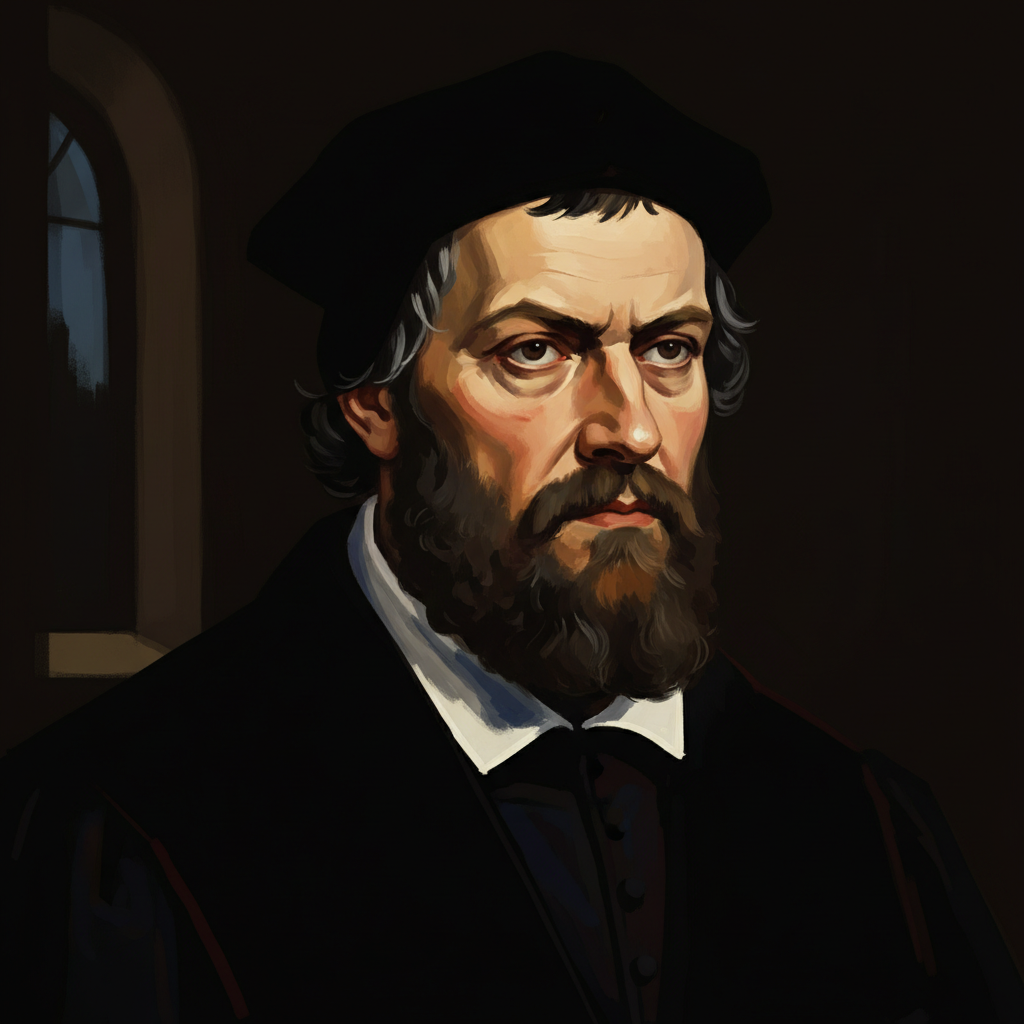
Martin Luther — "He who would be a Christian must be a Jew."
He who would be a Christian must be a Jew.
He who would be a Christian must be a Jew.
Click any product to generate a realistic preview. Up to 3 at a time.
* Initial load can take up to 90 seconds — revising the preview in another color is nearly instant.
"Those who despise these, or treat them with contempt, are worthy of purchasing, adoring, and praising the pope's excrement as balsam."
"The greatest gift of God is a pious, cheerful, God-fearing wife."
"I confess that I am a man, and that I have erred."
"GOD OFTEN ACTS LIKE A MADMAN ... I look upon God no better than a scoundrel."
"The ass needs to be beaten, and the populace needs to be ruled by force. God knew this well, and therefore he gave the ruler not a fox's tail, but a sword."
German theologian whose 95 Theses (1517) launched the Protestant Reformation and broke the Catholic Church's monopoly on Western Christianity. Closely associated with Philipp Melanchthon (Lutheran systematizer) and John Calvin (later Reformer who built on Luther's break). For an intellectual contrast, see Pope Leo X, Renaissance pope (1513-1521) — Leo X's indulgence sales triggered Luther's break and Leo excommunicated him in 1521 — Luther's entire Reformation is structured as a direct answer to the indulgence-funded Vatican Leo represented.
Found in 1 providers: grok
1 source checked
Christianity cannot be understood apart from its Jewish roots. The faith grew directly out of Hebrew scripture, covenant, and messianic expectation, so anyone claiming to follow Christ must first grasp the Old Testament prophets, the Law, and the promises made to Israel. Stripping away that heritage leaves a hollow religion. To truly be Christian means owning the Jewish spiritual inheritance that produced Jesus and the apostles.
Luther, an Augustinian monk and biblical scholar, translated the Hebrew Old Testament into German and lectured extensively on Psalms, Genesis, and the prophets. Early in his career he urged Christians to embrace Jewish scriptural heritage, believing Scripture alone (sola scriptura) grounded faith. Ironically, his later writings turned viciously antisemitic when Jews refused conversion, but this earlier sentiment reflects his conviction that Christianity was rooted in, and inseparable from, Hebrew revelation.
The early 16th century saw Renaissance humanists rediscovering original Hebrew and Greek texts, challenging the Latin Vulgate's monopoly. Luther's 1517 Reformation pushed Scripture back to its source languages, and Christian Hebraists like Reuchlin defended Jewish learning against church inquisitors. Yet Jews faced ghettos, expulsions, and blood libels across Europe. Luther's statement emerged from this tension between humanist scriptural revival and deep-rooted medieval antisemitism still shaping Christian society.
AI-generated insights based on extensive research and information for context. Factual errors? Email [email protected].
Your cart is empty