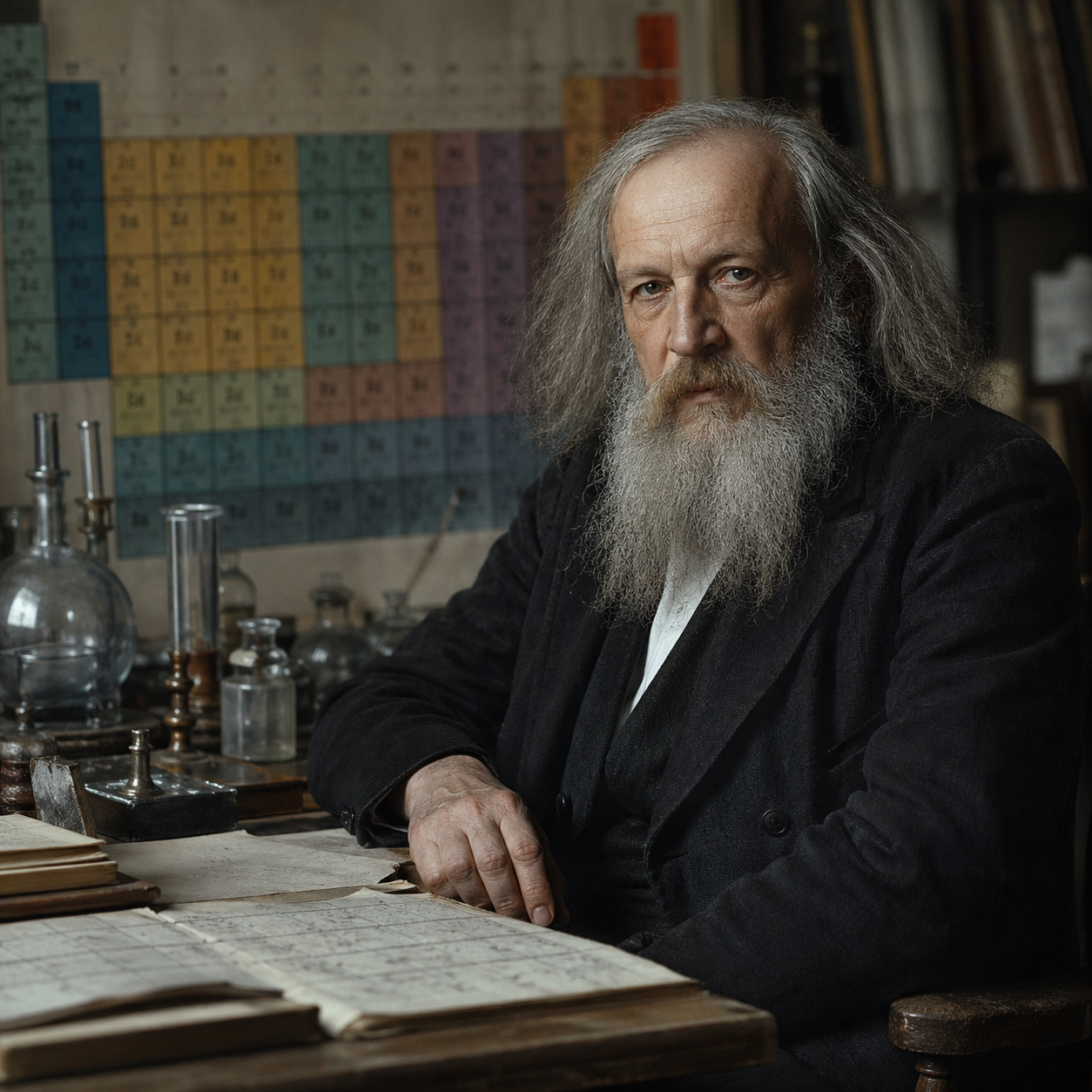
Dmitri Mendeleev — "Hypotheses help and guide scientific work — the search for truth — as the tiller…"
Hypotheses help and guide scientific work — the search for truth — as the tiller's plough helps the cultivation of useful plants.
Hypotheses help and guide scientific work — the search for truth — as the tiller's plough helps the cultivation of useful plants.
Click any product to generate a realistic preview. Up to 3 at a time.
* Initial load can take up to 90 seconds — revising the preview in another color is nearly instant.
"No law of nature, however general, has been established without a multitude of experiments and observations."
"The periodic law is one of the most important generalizations in chemistry."
"One day, all elements will be discovered and their properties understood."
"It was clear that in the United States there was a development not of the best, but of the middle and worst sides of European civilization; the notorious general voting, the tendency to politics... al…"
"No law of nature, however general, has been established all at once; its recognition has always been preceded by many presentiments."
Explaining the essential role of hypotheses in scientific progress.
Date: Undated
PhilosophicalFound in 1 providers: gemini
1 source checked
Hypotheses are practical tools that direct scientific inquiry, much like a plough prepares soil for growing useful crops. A good guess doesn't need to be the final answer; it breaks up hard ground, turns over ideas, and makes it possible to plant and harvest real knowledge. Without that initial framing, researchers wander aimlessly. The hypothesis clears the way so that careful observation and experiment can produce something genuinely useful.
Mendeleev built the periodic table by hypothesizing that elements followed a repeating pattern based on atomic weight, then boldly predicted undiscovered elements like gallium and germanium to fill gaps. His leap of faith was later confirmed by experiment. The plough metaphor fits a chemist raised on a Siberian estate who valued agriculture, practical science, and Russian industry; he saw theory as labor that prepares the field for discovery, not as abstract speculation detached from real work.
Mendeleev worked in the late 19th century, when chemistry was shifting from descriptive cataloging to systematic theory. Atoms were still debated, spectroscopy was young, and Europe raced to identify new elements. Russia was industrializing under Alexander II's reforms, and Mendeleev advised on oil, agriculture, and tariffs. Positivism pushed scientists to ground ideas in observation, yet the boldest advances, like his table, came from speculative patterns that experiment later confirmed, legitimizing hypothesis as a core scientific tool.
AI-generated insights based on extensive research and information for context. Factual errors? Email [email protected].
Your cart is empty