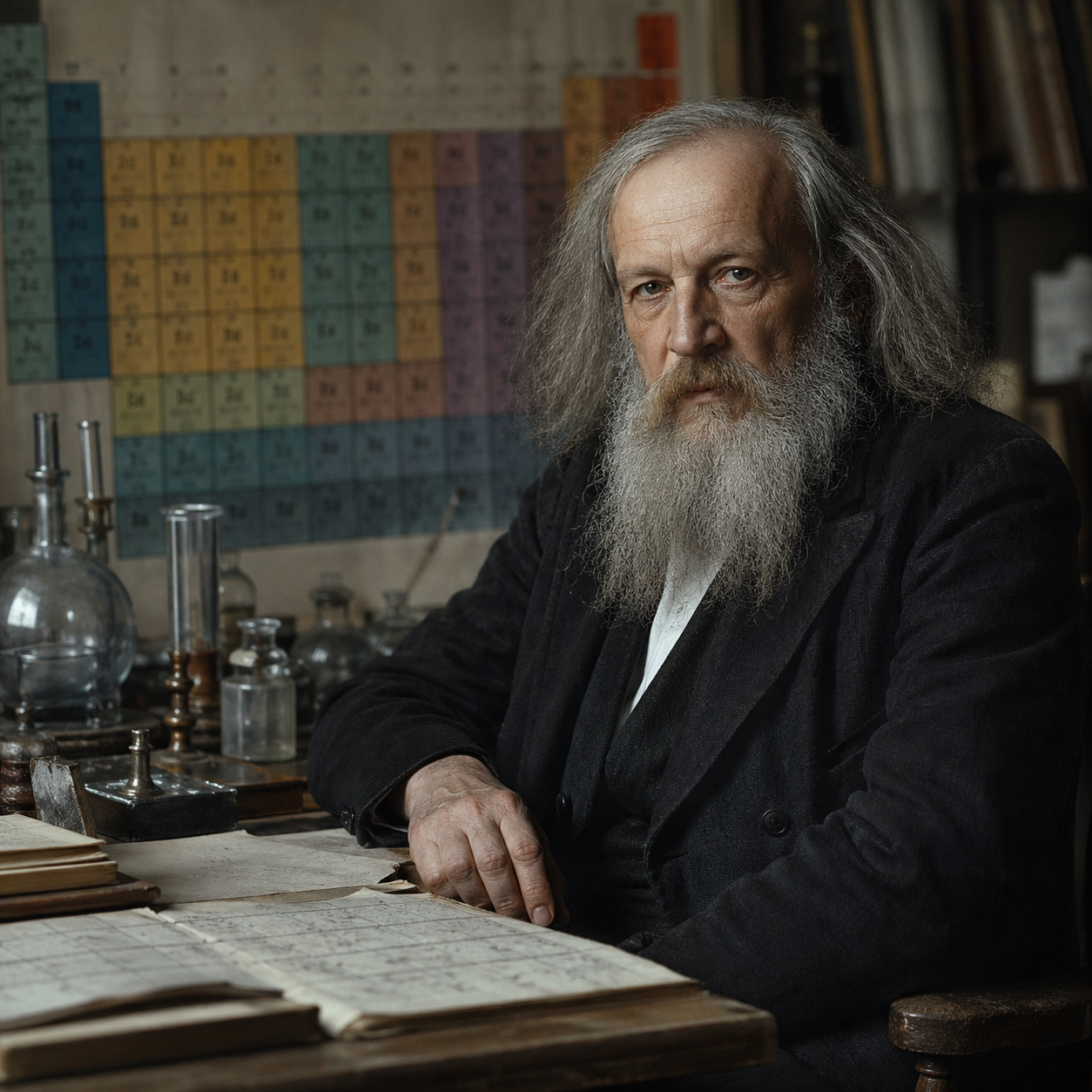
Dmitri Mendeleev — "The universe is a vast chemical laboratory."
The universe is a vast chemical laboratory.
The universe is a vast chemical laboratory.
Click any product to generate a realistic preview. Up to 3 at a time.
* Initial load can take up to 90 seconds — revising the preview in another color is nearly instant.
"The whole essence of science is to make predictions."
"Atomic weight belongs not to coal or diamond but carbon."
"The spirit of scientific inquiry must be cultivated in all children."
"No one nor anything can silence me."
"The weight of the atom is not the only criterion; there are other considerations."
Found in 1 providers: grok
1 source checked
Everything that exists operates through chemical processes and transformations. The cosmos isn't just physics or mystery; it's matter reacting, combining, and changing according to discoverable rules. Stars forge elements, planets cook compounds, life runs on molecular exchanges. Viewing the universe as a laboratory means treating all of nature as an ongoing experiment where the same principles apply everywhere, from a test tube on a bench to the farthest galaxy.
Mendeleev built his career on the conviction that chemistry underlies reality. By arranging the elements into the periodic table in 1869, he showed matter follows a predictable pattern, even predicting undiscovered elements like gallium and germanium from gaps. He studied petroleum, gases, and solutions across wildly different scales, always seeking unifying chemical law. Treating the universe as one enormous laboratory matches exactly how he approached every problem throughout his scientific life.
Mendeleev worked in late 19th-century Russia during a golden age of chemistry, when atomic theory was maturing and industrial chemistry was transforming Europe. Scientists were isolating new elements yearly, Darwin had recently reframed biology, and thermodynamics was unifying physics. Russia was rapidly industrializing, and Mendeleev personally advised the tsarist government on oil, agriculture, and tariffs. The era believed nature's laws were knowable through systematic investigation, making a laboratory-universe metaphor both fashionable and philosophically serious.
AI-generated insights based on extensive research and information for context. Factual errors? Email [email protected].
Your cart is empty