Grace Hopper — "I'm still learning. I'm always learning. I hope I never stop learning."
I'm still learning. I'm always learning. I hope I never stop learning.
I'm still learning. I'm always learning. I hope I never stop learning.
Click any product to generate a realistic preview. Up to 3 at a time.
* Initial load can take up to 90 seconds — revising the preview in another color is nearly instant.
"I'm very much interested in people doing things, not just talking about them."
"I had a running compiler and nobody would touch it. They told me computers could only do arithmetic."
"If it isn't bolted down, bring it home."
"I'm not a computer scientist. I'm a mathematician. I just happen to work with computers."
"You manage things, you lead people. We went overboard on management and forgot about leadership. It might help if we ran the MBAs out of Washington."
Found in 1 providers: grok
1 source checked
Knowledge and expertise are not finish lines. No matter how accomplished you become, there is always more to understand. Choosing to remain a perpetual student keeps curiosity alive, prevents intellectual stagnation, and turns continuous growth into a core identity rather than a burden. The desire to never stop learning is presented here not as a shortcoming but as the highest aspiration a thinking person can hold.
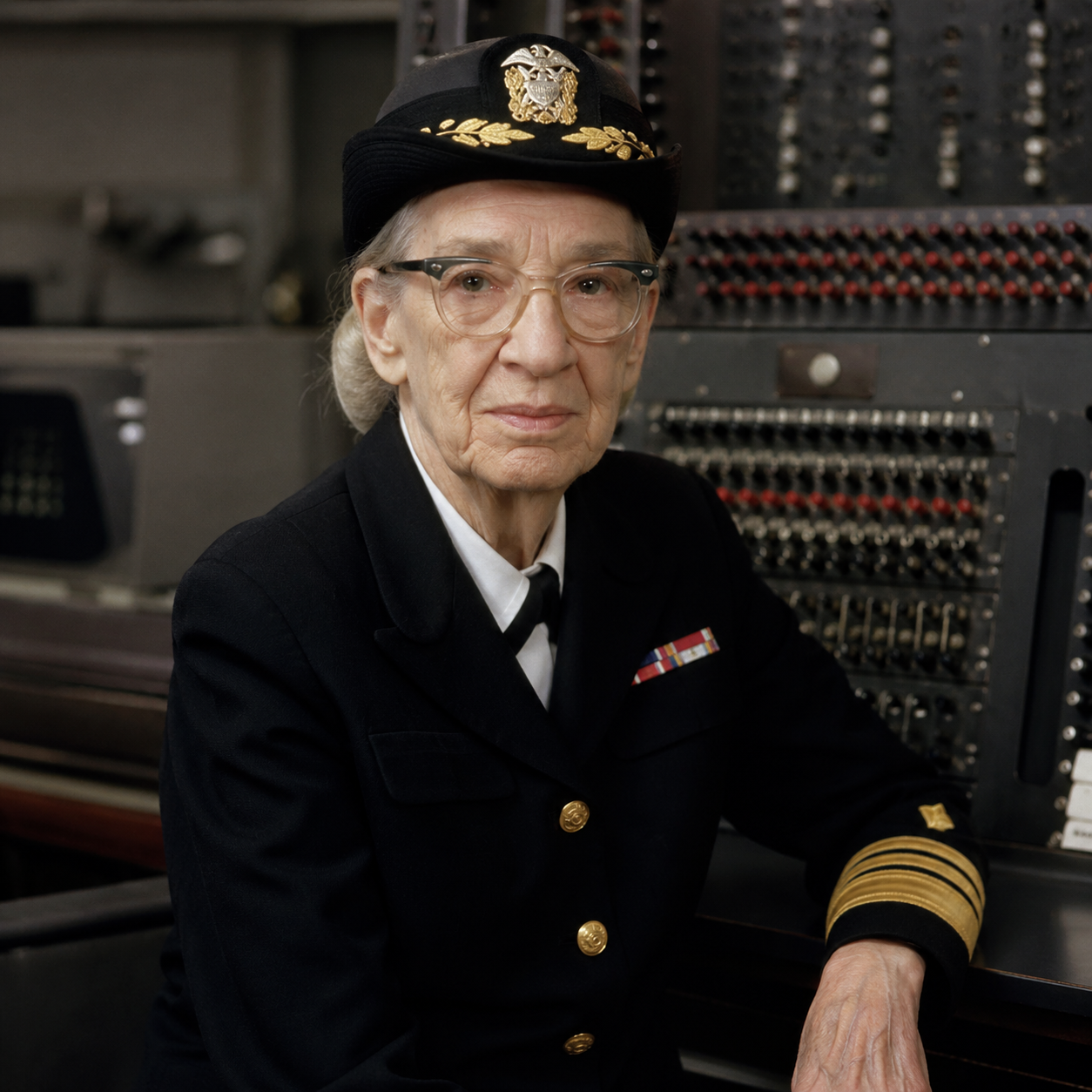
Grace Hopper joined the Navy and entered computing in the 1940s when the field barely existed, then spent four decades adapting as it transformed entirely multiple times. She invented the first compiler, co-developed COBOL, and kept teaching and working until age 79. Famous for handing out nanosecond wire demonstrations to explain computing speeds, she embodied the belief that understanding — not just doing — mattered throughout a career defined by constant reinvention.
Hopper's career spanned the 1940s through the 1980s, a period when computing reinvented itself completely every decade. Vacuum tubes gave way to transistors, then integrated circuits and microprocessors. Software engineering as a discipline didn't exist when she started. Women in STEM faced routine institutional exclusion, requiring double the effort to stay current. Continuous learning wasn't a career philosophy — it was a survival requirement in a field changing faster than any textbook could track.
AI-generated insights based on extensive research and information for context. Factual errors? Email [email protected].
Your cart is empty