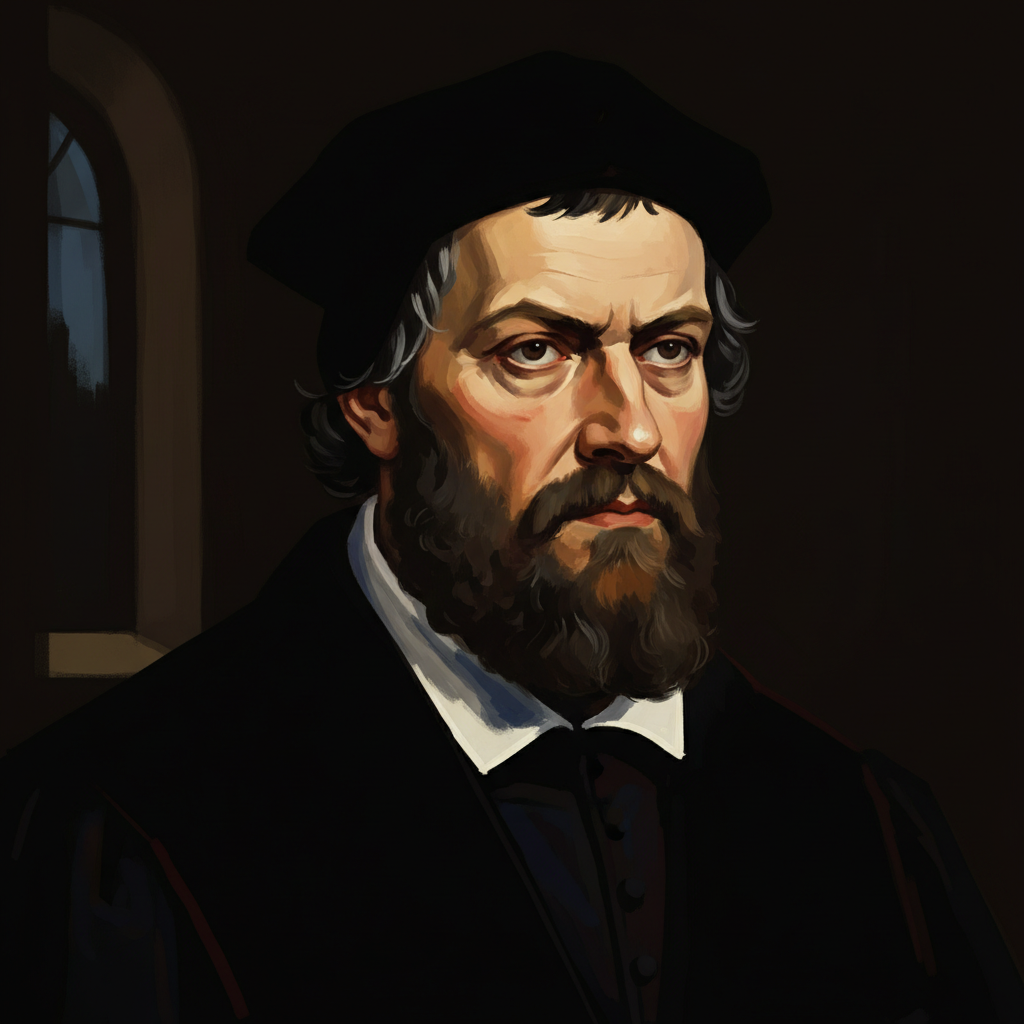
Martin Luther — "I am a man of contention, and I thank God for it."
I am a man of contention, and I thank God for it.
I am a man of contention, and I thank God for it.
Click any product to generate a realistic preview. Up to 3 at a time.
* Initial load can take up to 90 seconds — revising the preview in another color is nearly instant.
"A man who has no wife is only half a man."
"If you want to change the world, pick up your pen."
"If I profess with the loudest voice and clearest exposition every portion of the truth of God except precisely that little point which the world and the devil are at that moment attacking, I am not co…"
"Whenever the devil harasses you, seek the company of men or drink more, or joke and talk nonsense, or do some other merry thing. Sometimes we must drink more, sport, recreate ourselves, and even sin a…"
"Where God builds a church, the Devil builds a chapel."
German theologian whose 95 Theses (1517) launched the Protestant Reformation and broke the Catholic Church's monopoly on Western Christianity. Closely associated with Philipp Melanchthon (Lutheran systematizer) and John Calvin (later Reformer who built on Luther's break). For an intellectual contrast, see Pope Leo X, Renaissance pope (1513-1521) — Leo X's indulgence sales triggered Luther's break and Leo excommunicated him in 1521 — Luther's entire Reformation is structured as a direct answer to the indulgence-funded Vatican Leo represented.
Found in 1 providers: grok
1 source checked
Luther openly embraces being a fighter and troublemaker, treating his argumentative nature as a gift rather than a flaw. He refuses to apologize for conflict when he believes truth is at stake, and credits God for giving him the stomach to keep disputing rather than seeking an easy peace. In plain terms: I was built to argue for what matters, and I am grateful for that wiring.
Luther spent his life in open combat, nailing the Ninety-Five Theses to the Wittenberg church door in 1517, defying Pope Leo X, burning the papal bull, and refusing to recant at the Diet of Worms in 1521. He feuded with Erasmus, Zwingli, and the peasants who misread his message. Contention was his vocation, not an accident, and he repeatedly framed his combativeness as divine calling rather than personal temperament.
Early modern Europe was fracturing: the printing press spread dissent faster than Rome could silence it, Holy Roman Emperor Charles V held fragile authority, and indulgence sales funded St. Peter's Basilica while peasants starved. Theological disagreement was punishable by excommunication or execution, as Jan Hus learned a century earlier. In that climate, publicly thanking God for being argumentative was not self-deprecation but a defiant theological stance against an institution demanding silent obedience.
AI-generated insights based on extensive research and information for context. Factual errors? Email [email protected].
Your cart is empty