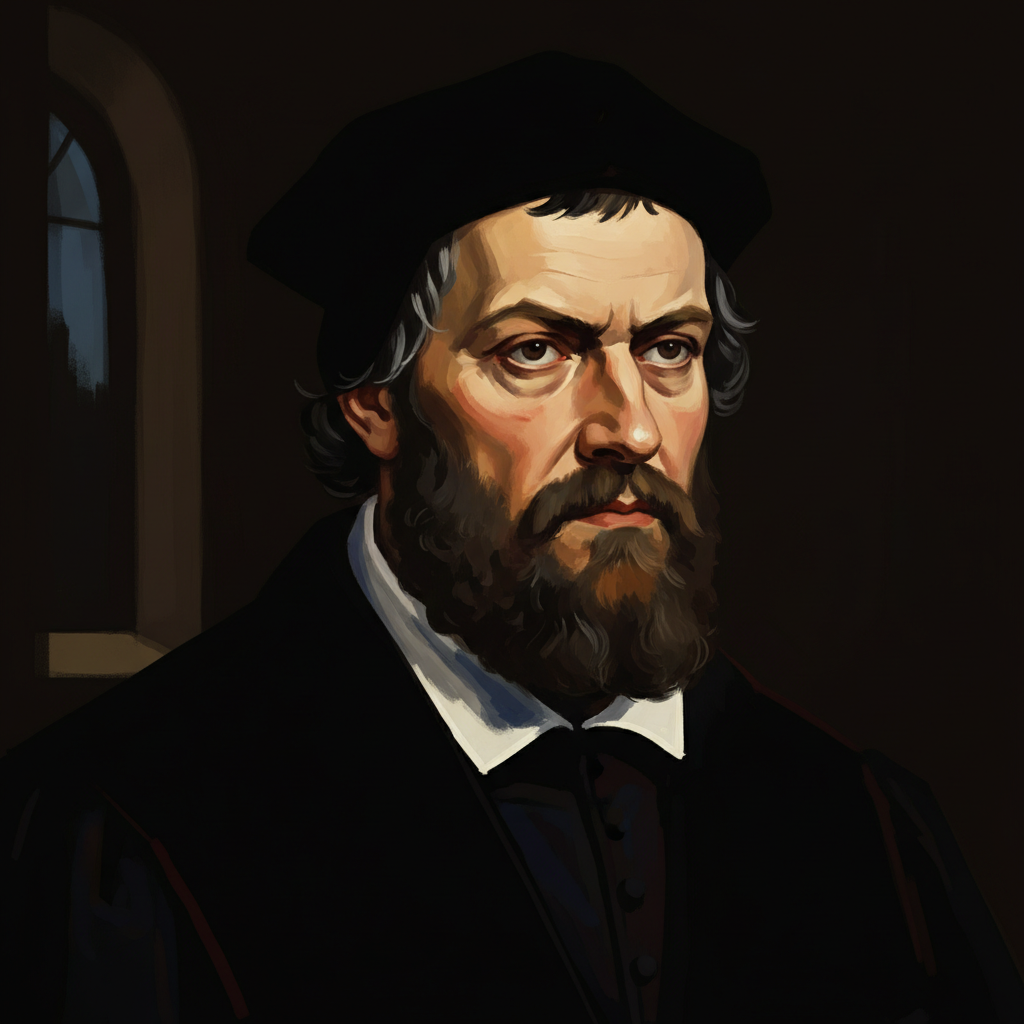
Martin Luther — "The law of God is not given to make us righteous, but to show us our unrighteous…"
The law of God is not given to make us righteous, but to show us our unrighteousness.
The law of God is not given to make us righteous, but to show us our unrighteousness.
Click any product to generate a realistic preview. Up to 3 at a time.
* Initial load can take up to 90 seconds — revising the preview in another color is nearly instant.
"Secondly, their homes also should be razed and destroyed. For they pursue the same aims in them as in their synagogues. Instead they might be lodged under a roof or in a barn, like the gypsies, in ord…"
"Be a sinner and SIN BOLDLY, but believe more boldly still."
"Where God builds a church, the Devil builds a chapel."
"You Mr pope. are a brothel keeper. and the devil's daughter in hell."
"I am not afraid of a pope or a cardinal, but of a little bird that sings in the tree."
German theologian whose 95 Theses (1517) launched the Protestant Reformation and broke the Catholic Church's monopoly on Western Christianity. Closely associated with Philipp Melanchthon (Lutheran systematizer) and John Calvin (later Reformer who built on Luther's break). For an intellectual contrast, see Pope Leo X, Renaissance pope (1513-1521) — Leo X's indulgence sales triggered Luther's break and Leo excommunicated him in 1521 — Luther's entire Reformation is structured as a direct answer to the indulgence-funded Vatican Leo represented.
Found in 1 providers: grok
1 source checked
God's commandments aren't a checklist you complete to earn moral standing. Instead, they function like a mirror or diagnostic tool, exposing how far short humans fall from the standard. The rules reveal failure rather than fix it. Trying harder to obey won't close the gap, because the point of the law isn't achievement; it's awareness. Recognizing that you can't measure up is the intended outcome, not successful performance.
This is the engine of Luther's theology. As an Augustinian monk tormented by his inability to feel righteous through confession, fasting, and penance, he concluded salvation couldn't come from works. His breakthrough reading of Romans convinced him the law exposes sin so sinners will rely on Christ's righteousness by faith alone. He hammered this into catechisms, sermons, and his 1535 Galatians commentary, making it the backbone of Protestant doctrine.
In early sixteenth-century Europe, the Catholic Church sold indulgences promising reduced purgatory time, and salvation was framed as cooperation between grace and meritorious works. Luther's 95 Theses in 1517 detonated that economy. Printing presses spread his writings across Germany within weeks, peasants and princes picked sides, and the Holy Roman Empire fractured. Saying the law only diagnoses sin, rather than curing it, directly undercut the sacramental machinery funding Rome and rebuilding St. Peter's.
AI-generated insights based on extensive research and information for context. Factual errors? Email [email protected].
Your cart is empty