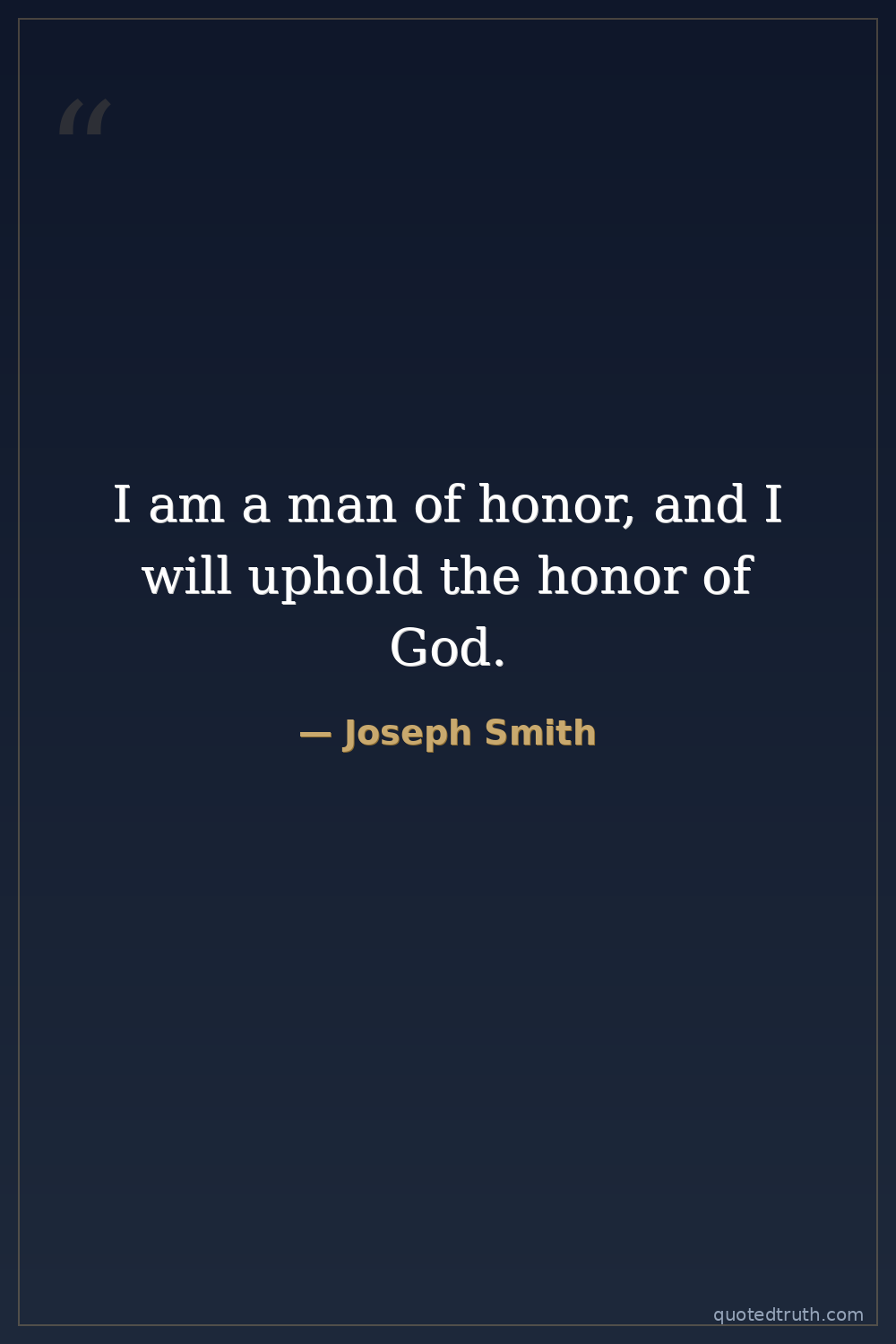
Joseph Smith — "I am a man of honor, and I will uphold the honor of God."
I am a man of honor, and I will uphold the honor of God.
I am a man of honor, and I will uphold the honor of God.
Click any product to generate a realistic preview. Up to 3 at a time.
* Initial load can take up to 90 seconds — revising the preview in another color is nearly instant.
"It is our divine destiny to be heirs of eternal life, to become 'priests and kings . . . [and] gods, even the sons of God . . . [and to] dwell in the presence of God . . . forever and ever.'"
"Any man that does not receive revelation must be damned."
"For behold, the Lord shall curse the land with much heat, and the barrenness thereof shall go forth forever; and there was a blackness came upon all the children of Canaan, that they were despised amo…"
"I am not afraid of man, nor of devils."
"I am a man of temperance, and I will be temperate in all things."
Found in 1 providers: grok
1 source checked
Personal integrity and devotion to God are treated as inseparable. To be honorable means living in a way that reflects well on God himself — your conduct becomes an extension of your faith. It is a declaration that ethical standards are not self-serving but sacred obligations. Keeping your own reputation clean is how you represent and protect something larger than yourself: your God, your mission, your community's trust in both.
Smith faced relentless accusations of fraud, false prophecy, and criminal conduct throughout his life. Defending his personal honor was structurally identical to defending his prophetic calling — to discredit Smith was to discredit God's revelation. His entire church rested on his personal testimony, making his integrity its foundation. This quote captures his lifelong posture: self-defense as sacred duty, personal reputation as living evidence of divine authenticity and legitimacy.
Smith lived during America's Second Great Awakening — explosive religious experimentation, frontier revivalism, and fierce rivalry among competing sects. In 1830s antebellum America, personal honor was a social contract; a man's reputation determined standing in law, commerce, and community. New religious claimants faced immediate suspicion and mob violence. Invoking honor — a concept his contemporaries held near-sacred — was a deliberate rhetorical move to anchor prophetic credibility in a value his culture already respected.
AI-generated insights based on extensive research and information for context. Factual errors? Email [email protected].
Your cart is empty