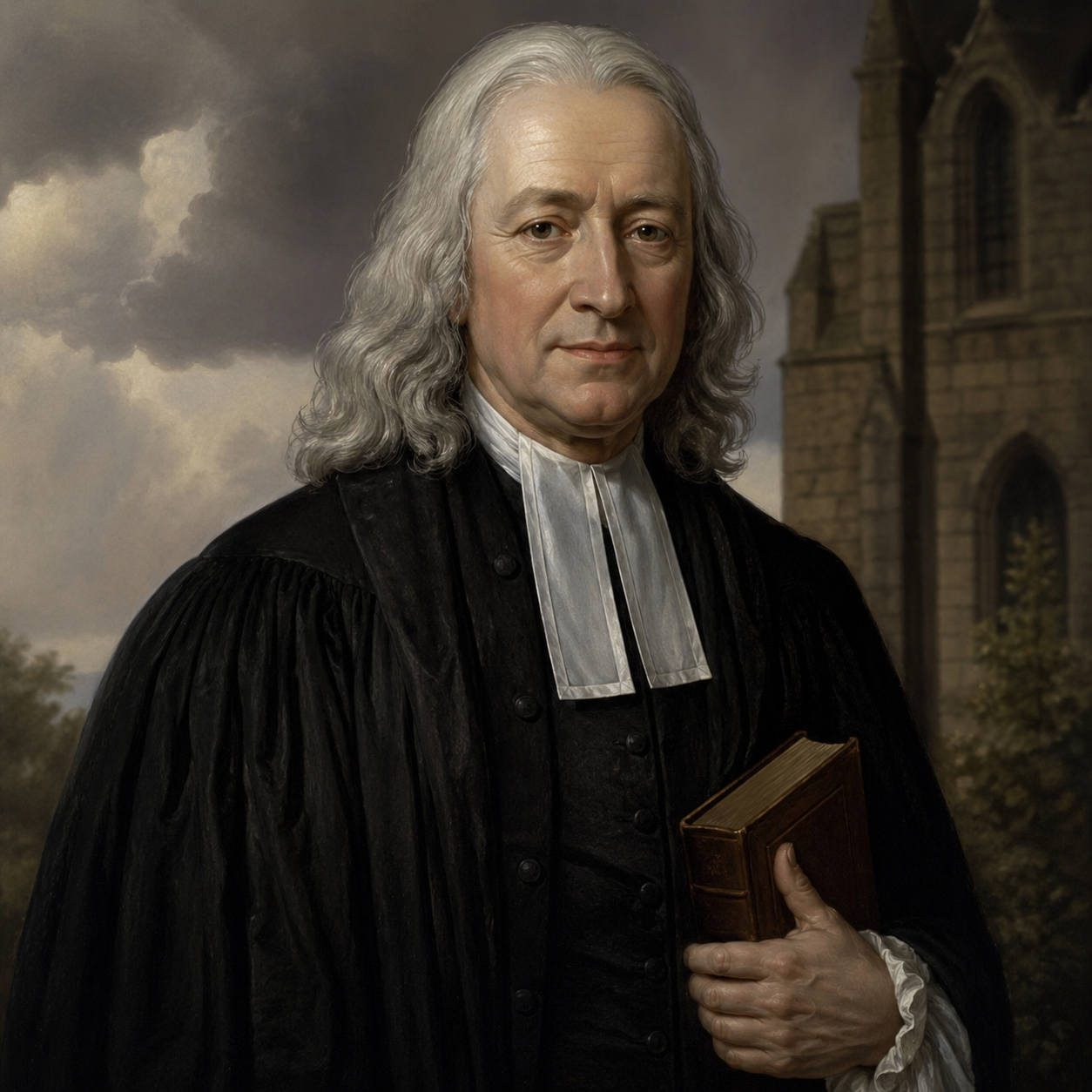
John Wesley — "I am a very little man, and I have a very little heart."
I am a very little man, and I have a very little heart.
I am a very little man, and I have a very little heart.
Click any product to generate a realistic preview. Up to 3 at a time.
* Initial load can take up to 90 seconds — revising the preview in another color is nearly instant.
"I have learned to suffer in silence, and not to make my complaints known to any but God."
"I have often thought that the reason why so few are saved, is, because so few are willing to be saved."
"I am a debtor to all the world, to do all the good I can, in every place, to every soul."
"Holiness of heart and life is the one great end of all our preaching."
"I have been in this city for over a year, yet I have not seen one instance of a truly awakened soul."
English Anglican cleric and founder of Methodism, whose open-air preaching and class-meeting structure created the largest 18th-century evangelical revival. Closely associated with Charles Wesley (his hymn-writing brother) and George Whitefield (early co-revivalist, later doctrinal opponent). For an intellectual contrast, see George Whitefield, Calvinist evangelical revivalist — Whitefield's predestinarian Calvinism vs Wesley's free-grace Arminian theology split the early Methodist movement permanently in the 1739-41 break. The founding evangelical Calvinist-Arminian schism — the two parallel evangelical traditions American Christianity descends from.
Found in 1 providers: grok
1 source checked
The speaker frankly admits he is small in stature and limited in emotional depth — in his capacity for love, compassion, and generosity. Rather than projecting authority or greatness, he confesses personal inadequacy honestly. This is radical humility: acknowledging that one's heart, one's inner moral capacity, is insufficient on its own. Such self-awareness is the necessary foundation for genuine transformation, suggesting that recognizing limitation is more honest and more useful than pretending to wholeness.
Wesley was physically short — roughly 5'3" — but this confession runs far deeper. His Methodist theology centered on sanctification: the lifelong pursuit of 'perfect love' toward God and neighbor. His journals repeatedly document spiritual failures measured against that demanding ideal. Calling his heart 'little' wasn't self-pity but honest theology — Wesley believed only God's transforming grace could enlarge human capacity for love, and clear-eyed self-knowledge was the necessary first step toward that enlargement.
In 18th-century England, the established Church was entangled with wealth, class, and social prestige while largely ignoring the urban poor flooding industrial cities. Enlightenment culture prized human reason and moral self-sufficiency. Amid this confidence, admitting personal smallness was countercultural. Wesley's Methodism arose as a grassroots corrective, insisting human nature required divine transformation — making this humble confession not just personal piety but a pointed theological challenge to an age that celebrated self-made authority and institutional pride.
AI-generated insights based on extensive research and information for context. Factual errors? Email [email protected].
Your cart is empty