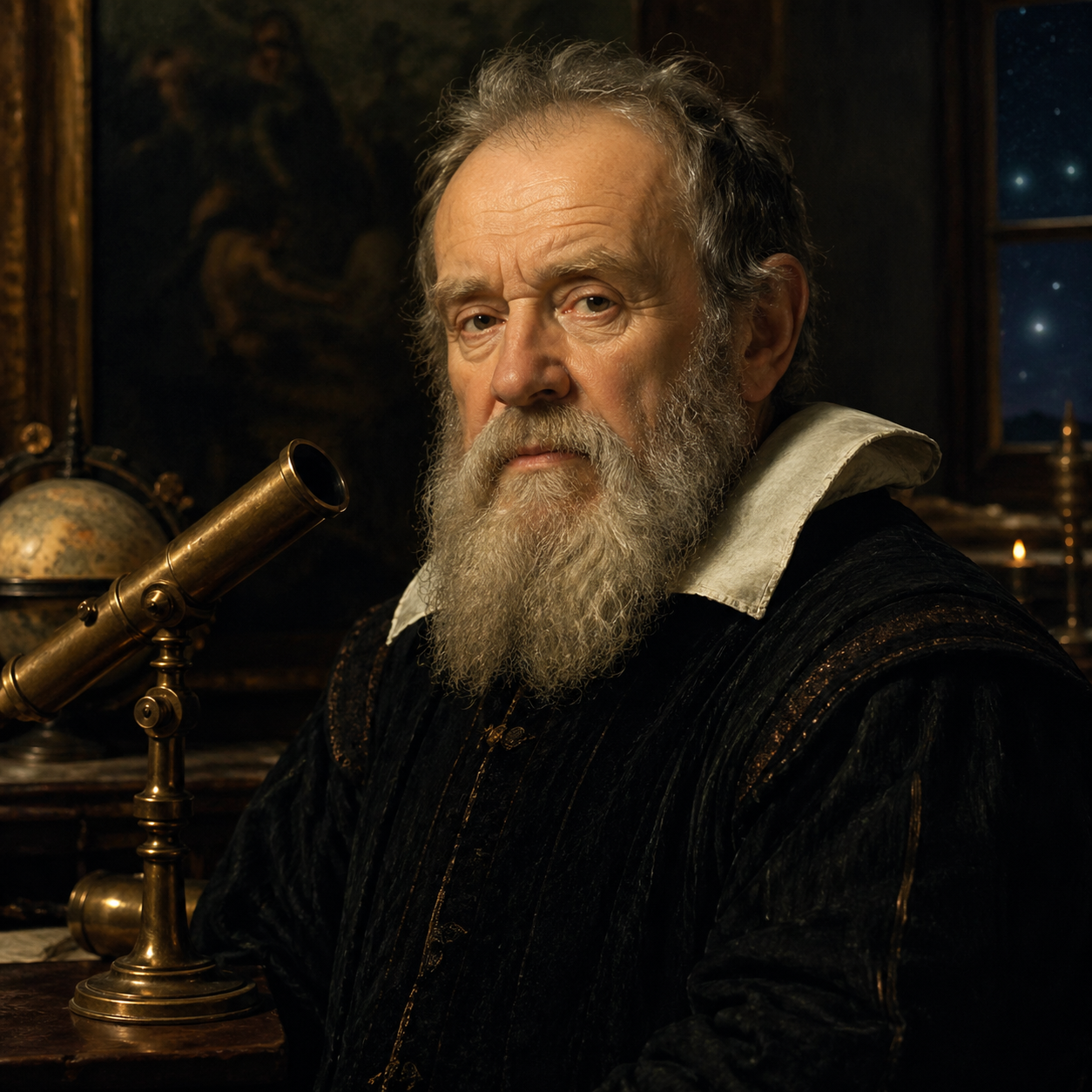
Galileo Galilei — "I am about to take leave of this earth, and I can say that I have seen more wond…"
I am about to take leave of this earth, and I can say that I have seen more wonders than any man before me.
I am about to take leave of this earth, and I can say that I have seen more wonders than any man before me.
Click any product to generate a realistic preview. Up to 3 at a time.
* Initial load can take up to 90 seconds — revising the preview in another color is nearly instant.
"The purpose of science is not to open the door to infinite wisdom, but to set a limit to infinite error."
"Truly, if there were no other way to demonstrate the motion of the Earth, the tides alone would suffice."
"The universe is a grand book which cannot be understood unless one first learns to comprehend the language and interpret the characters in which it is written."
"The more I study nature, the more I stand amazed at the work of the Creator."
"The senses, being the interpreters of natural effects, are the only door to scientific knowledge."
Attributed as a deathbed reflection, but exact source is elusive.
Date: 1642 (approx)
Nature & WorldFound in 1 providers: grok
1 source checked
Standing at life's end, the speaker reflects on having witnessed extraordinary things no human had ever seen before. It conveys profound satisfaction mixed with awe — a life spent pushing the boundaries of human perception, seeing truths about the universe that were previously invisible, hidden, or simply unimaginable to all who came before.
Galileo spent decades pointing his improved telescope at the heavens, becoming the first to observe Jupiter's moons, Saturn's rings, sunspots, and lunar craters. He overturned millennia of cosmological assumption through direct observation. His dying words capture genuine pride in having personally expanded what humanity could see and know about the cosmos.
The early 17th century was the dawn of the Scientific Revolution, when Europe shifted from inherited Aristotelian authority to empirical inquiry. The Church still controlled cosmological orthodoxy — Galileo was tried by the Inquisition for heliocentrism. His claim to have seen 'wonders' was both triumphant and quietly defiant against an age that punished such discoveries.
AI-generated insights based on extensive research and information for context. Factual errors? Email [email protected].
Your cart is empty