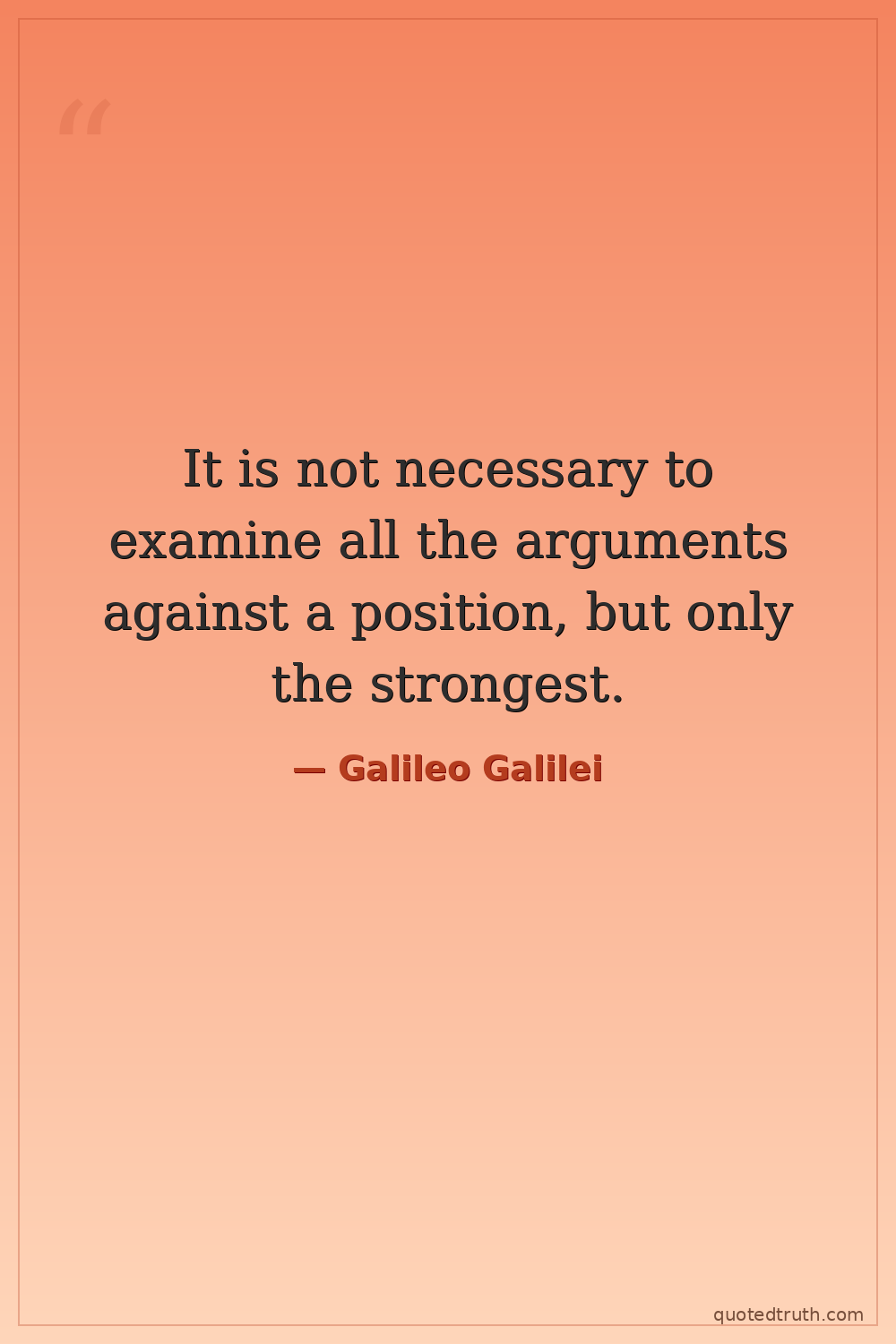
Galileo Galilei — "It is not necessary to examine all the arguments against a position, but only th…"
It is not necessary to examine all the arguments against a position, but only the strongest.
It is not necessary to examine all the arguments against a position, but only the strongest.
Click any product to generate a realistic preview. Up to 3 at a time.
* Initial load can take up to 90 seconds — revising the preview in another color is nearly instant.
"To deny the evidence of one's own eyes, and to prefer to believe a doctrine which is contrary to all experience, shows a mind that is either very dull or very prejudiced."
"I have loved the stars too fondly to be fearful of the night."
"The senses, though they are sometimes deceived, are not always so."
"In questions of science, the authority of a thousand is not worth the humble reasoning of a single individual."
"Measure what is measurable, and make measurable what is not so."
Found in 1 providers: grok
1 source checked
When evaluating any position, focus on the most powerful counterargument, not every objection imaginable. If your stance survives the strongest challenge, weaker objections collapse on their own. This is intellectual economy: spend critical energy where it actually matters. Debating trivial objections wastes time and can obscure whether the core claim holds up. A position's strength is proven by surviving its hardest test, not by outlasting the easiest ones.
Galileo spent decades defending heliocentrism against the Church, Aristotelian scholars, and the Inquisition. His Dialogue Concerning the Two Chief World Systems deliberately staged the strongest opposing arguments through the character Simplicio, then dismantled them. He didn't scatter energy on trivial objections—he found the hardest challenges to Copernican theory and met them directly. His 1633 trial before the Inquisition became the ultimate, painful test of this very principle.
In early modern Europe, Aristotelian scholasticism still dominated universities, and the Catholic Church wielded authority over natural philosophy. The Counter-Reformation made challenging received doctrine genuinely dangerous—heresy charges carried real consequences. Academic disputation, a formal debate method, often buried positions under piles of objections. Galileo's era demanded knowing which arguments to prioritize: tackling the strongest challenge head-on cut through rhetorical noise and forced the actual question into the open.
AI-generated insights based on extensive research and information for context. Factual errors? Email [email protected].
Your cart is empty