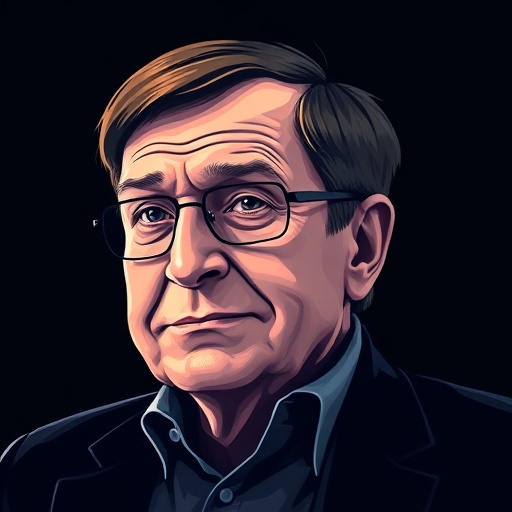
Stephen Hawking — "I am an optimist, but I am a realist who understands that science is a slow proc…"
I am an optimist, but I am a realist who understands that science is a slow process.
I am an optimist, but I am a realist who understands that science is a slow process.
Click any product to generate a realistic preview. Up to 3 at a time.
* Initial load can take up to 90 seconds — revising the preview in another color is nearly instant.
"I believe that there is no heaven or afterlife. That is a fairy story for people afraid of the dark."
"So next time someone complains that you made a mistake, tell him that may be a good thing. Because without imperfection, neither you nor I would exist."
"Both of us."
"I have spent my life traveling across the universe, inside my mind."
"We are all time-travelers, heading into the future at the rate of one second per second."
British theoretical physicist whose Hawking radiation work and A Brief History of Time (1988) brought black-hole physics to a mass audience while he lived with ALS for 55 years. Closely associated with Roger Penrose (his collaborator on singularity theorems) and Carl Sagan (fellow popularizer who wrote Brief History's foreword). For an intellectual contrast, see William Lane Craig, American philosopher of religion — Craig's Kalam cosmological argument depends on the Big Bang requiring a divine first cause; Hawking's no-boundary proposal was specifically designed to remove the moment that would require one — the cleanest cosmology-vs-natural-theology contrast in modern thought.
Found in 1 providers: grok
1 source checked
Genuine optimism isn't naive cheerfulness — it's grounded in honest expectation. Progress is real, but it demands patience, iteration, and time. Being both optimist and realist means believing things can and will improve while accepting that breakthroughs don't arrive overnight. Science especially requires sustained effort, failed hypotheses, and incremental advances before any major discovery lands. Hope without realism is wishful thinking; realism without hope is paralysis. The two together drive actual progress.
Hawking was diagnosed with ALS at 21 and given two years to live, yet worked productively for another 55 years. He knew firsthand that his landmark contributions — like Hawking radiation — took decades to gain full experimental confirmation. His optimism was tested daily against physical paralysis; his realism shaped a career built on incremental mathematical insight rather than quick breakthroughs. He personally embodied the paradox of radical long-term hope married to methodical, patient scientific work.
Hawking's career spanned the Cold War space race through the 2015 detection of gravitational waves. Public expectations for science accelerated faster than results — fusion energy, cancer cures, and ALS treatments were repeatedly promised but delayed. The late 20th century saw dramatic computational advances alongside frustrating stagnation in fundamental physics experiments. This gap between scientific hype and actual discovery pace was a defining cultural tension of his era, making his measured optimism both necessary and quietly countercultural.
AI-generated insights based on extensive research and information for context. Factual errors? Email [email protected].
Your cart is empty