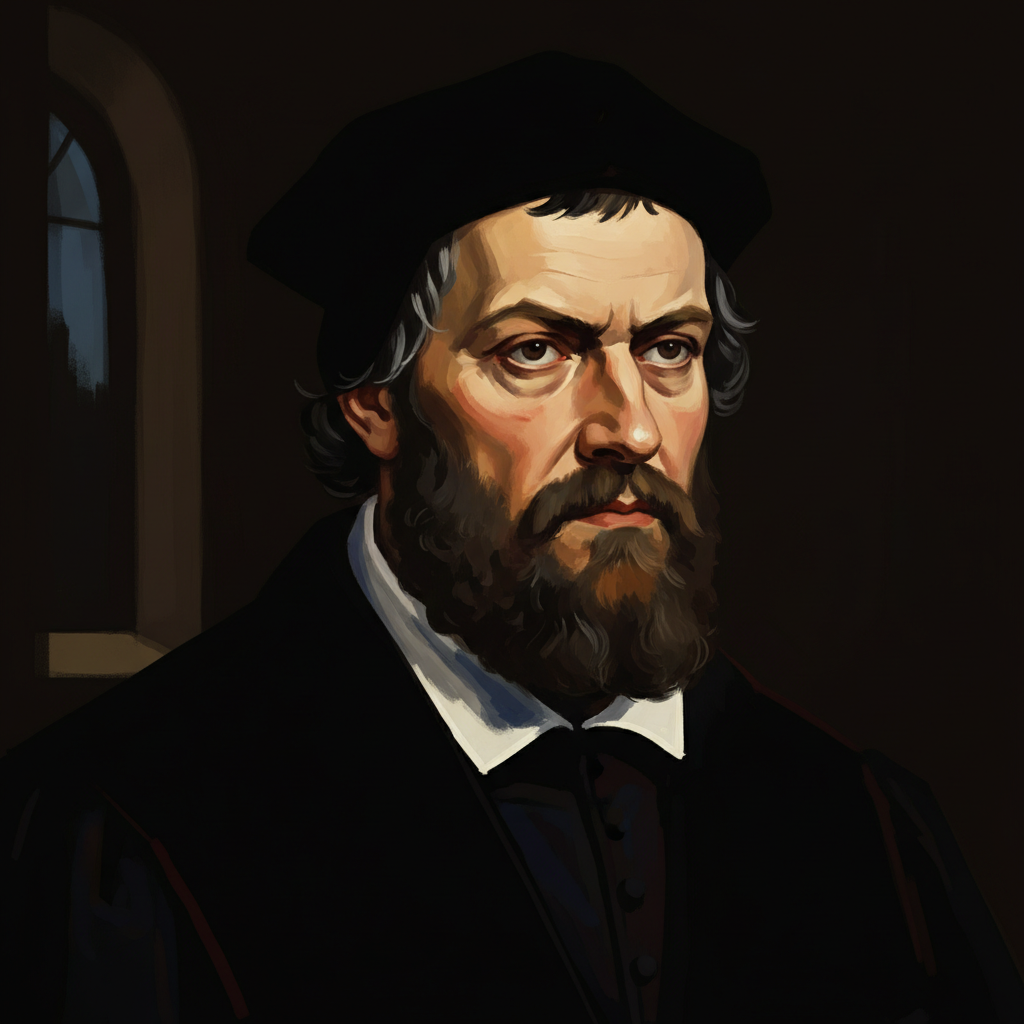
Martin Luther — "I am fed up with the world, and the world is fed up with me."
I am fed up with the world, and the world is fed up with me.
I am fed up with the world, and the world is fed up with me.
Click any product to generate a realistic preview. Up to 3 at a time.
* Initial load can take up to 90 seconds — revising the preview in another color is nearly instant.
"Again, the Lord wills that whoever confesses his sins and believes the absolution should be forgiven. 'No,' says ass-pope fart, 'faith does nothing; but your own repentance and atonement do, as well a…"
"What is worse, the Jews, in their synagogues, curse our Lord Jesus Christ and Mary His mother, and call her a whore, and Christ a mamzer [bastard], that is, a son of a whore."
"To gather with God's people in united adoration of the Father is as necessary to the Christian life as prayer."
"What God wills is not right because he ought, or was bound, so to will; on the contrary, what takes place must be right, because he so wills it."
"The whole being of any Christian is faith and love."
German theologian whose 95 Theses (1517) launched the Protestant Reformation and broke the Catholic Church's monopoly on Western Christianity. Closely associated with Philipp Melanchthon (Lutheran systematizer) and John Calvin (later Reformer who built on Luther's break). For an intellectual contrast, see Pope Leo X, Renaissance pope (1513-1521) — Leo X's indulgence sales triggered Luther's break and Leo excommunicated him in 1521 — Luther's entire Reformation is structured as a direct answer to the indulgence-funded Vatican Leo represented.
Found in 1 providers: grok
1 source checked
The speaker voices mutual exhaustion between himself and the world around him. He feels worn out by the demands, conflicts, and disappointments of life, and senses that others are equally tired of dealing with him. It captures the weariness of someone who has fought long battles, grown disillusioned with people and institutions, and now feels ready to withdraw or move on entirely.
Luther spent decades battling the papacy, princes, rival reformers, and peasant revolts, all while suffering chronic kidney stones, constipation, vertigo, and depression. By his final years he was physically broken and emotionally raw, lashing out in harsh polemics against Jews, Catholics, and fellow Protestants. This line, spoken near his 1546 death, captures the exhaustion of a man who had ignited a religious revolution and paid for it with his health and peace.
The early modern period was convulsed by the Reformation Luther himself launched in 1517. Europe was splintering along confessional lines, with peasant wars, princely power grabs, and the looming Schmalkaldic War. Plague, poor medicine, and religious persecution made life grim and short. Theologians wrote with apocalyptic urgency, believing the end times were near, and public figures expressed raw emotion and bodily complaints openly, without modern reserve.
AI-generated insights based on extensive research and information for context. Factual errors? Email [email protected].
Your cart is empty