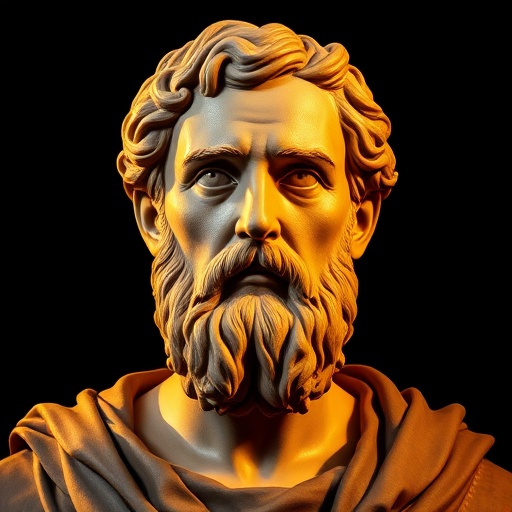
Saint Paul — "I am made all things to all men, that I might by all means save some."
I am made all things to all men, that I might by all means save some.
I am made all things to all men, that I might by all means save some.
Click any product to generate a realistic preview. Up to 3 at a time.
* Initial load can take up to 90 seconds — revising the preview in another color is nearly instant.
"For the kingdom of God is not a matter of eating and drinking, but of righteousness, peace and joy in the Holy Spirit."
"For it is better to marry than to burn with passion."
"O foolish Galatians, who hath bewitched you, that ye should not obey the truth, before whose eyes Jesus Christ hath been evidently set forth, crucified among you?"
"I can do all things through him who strengthens me."
"For to me to live is Christ, and to die is gain."
Found in 1 providers: grok
1 source checked
Paul describes adapting his approach to match whoever he's trying to reach. With Jewish audiences he followed Jewish customs; with Gentiles he set those aside. He adjusted language, behavior, and cultural references so the core message could land, without compromising what he believed. The point isn't chameleon-like people-pleasing but strategic flexibility in service of persuasion. Meet people where they are, speak their vocabulary, and accept that you won't reach everyone, only some.
Paul was uniquely built for this approach. Born Saul, a Roman citizen from Tarsus, trained as a Pharisee under Gamaliel yet fluent in Greek philosophy and Hellenistic culture, he could code-switch between synagogue and Athenian marketplace. After his Damascus road conversion, he traveled thousands of miles across the Roman Empire planting churches. His letters show him quoting Greek poets to pagans and Torah to Jews, exactly the cross-cultural fluency this verse prescribes.
The first-century Mediterranean was a patchwork of Jewish diaspora synagogues, Greek-speaking cities, Roman colonies, and mystery cults, all connected by imperial roads and trade routes. Early Christianity was a tiny Jewish sect trying to cross ethnic and religious boundaries that mattered intensely, circumcision, dietary law, emperor worship. Paul's missionary work during roughly 47 to 62 CE happened in this friction zone, and his adaptive strategy was the practical answer to spreading a Jewish messianic faith through a pluralistic pagan world.
AI-generated insights based on extensive research and information for context. Factual errors? Email [email protected].
Your cart is empty