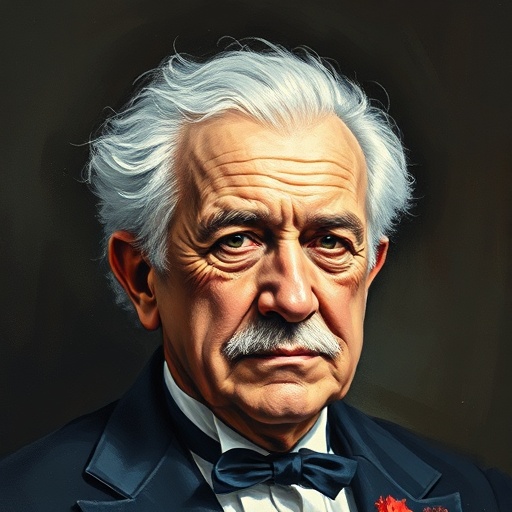
Thomas Edison — "I am more of a sponge than a scientist."
I am more of a sponge than a scientist.
I am more of a sponge than a scientist.
Click any product to generate a realistic preview. Up to 3 at a time.
* Initial load can take up to 90 seconds — revising the preview in another color is nearly instant.
"I owe my success to the fact that I never had a watch or a clock in my laboratory."
"I don't care how many inventions I make. I want to make one that will benefit humanity."
"I have friends in the other world. I have had very pleasant conversations with them. I am rather unorthodox in this matter. I believe that they are still alive and that we can communicate with them."
"I am proud of the fact that I never invented weapons to kill."
"There will be more women than men inventors in the future."
Reported in 'Edison: His Life and Inventions' by Frank Lewis Dyer and Thomas Commerford Martin
Date: 1910
GeneralFound in 1 providers: grok
1 source checked
Edison is saying he succeeds by absorbing ideas, observations, and techniques from everything and everyone around him rather than by pure original genius or formal scientific theory. He positions himself as a tireless collector and adapter of knowledge, soaking up what works, wringing out what doesn't, and recombining fragments into useful inventions. Learning by absorption, not by credentialed expertise, is his real method.
Edison held only three months of formal schooling and was largely self-taught through voracious reading and hands-on tinkering. His Menlo Park lab ran on collaborative absorption: he hired chemists, machinists, and glassblowers, pulled from their expertise, and iterated relentlessly. The phonograph, light bulb, and motion picture camera were refinements of prior work he studied obsessively. Calling himself a sponge fits his 1,093 patents built on synthesis rather than theoretical breakthroughs like Tesla's or Maxwell's.
Edison worked from the 1870s through the 1920s, the Second Industrial Revolution, when practical tinkerers competed with university-trained scientists for legitimacy. Germany was producing PhD chemists; America still celebrated the self-made inventor. Patent wars, electrification, and industrial research labs were reshaping innovation. Edison's sponge framing was a deliberate populist stance against the rising credentialism of European-style academic science, aligning him with a Gilded Age public that trusted grit and application over formal theory.
AI-generated insights based on extensive research and information for context. Factual errors? Email [email protected].
Your cart is empty