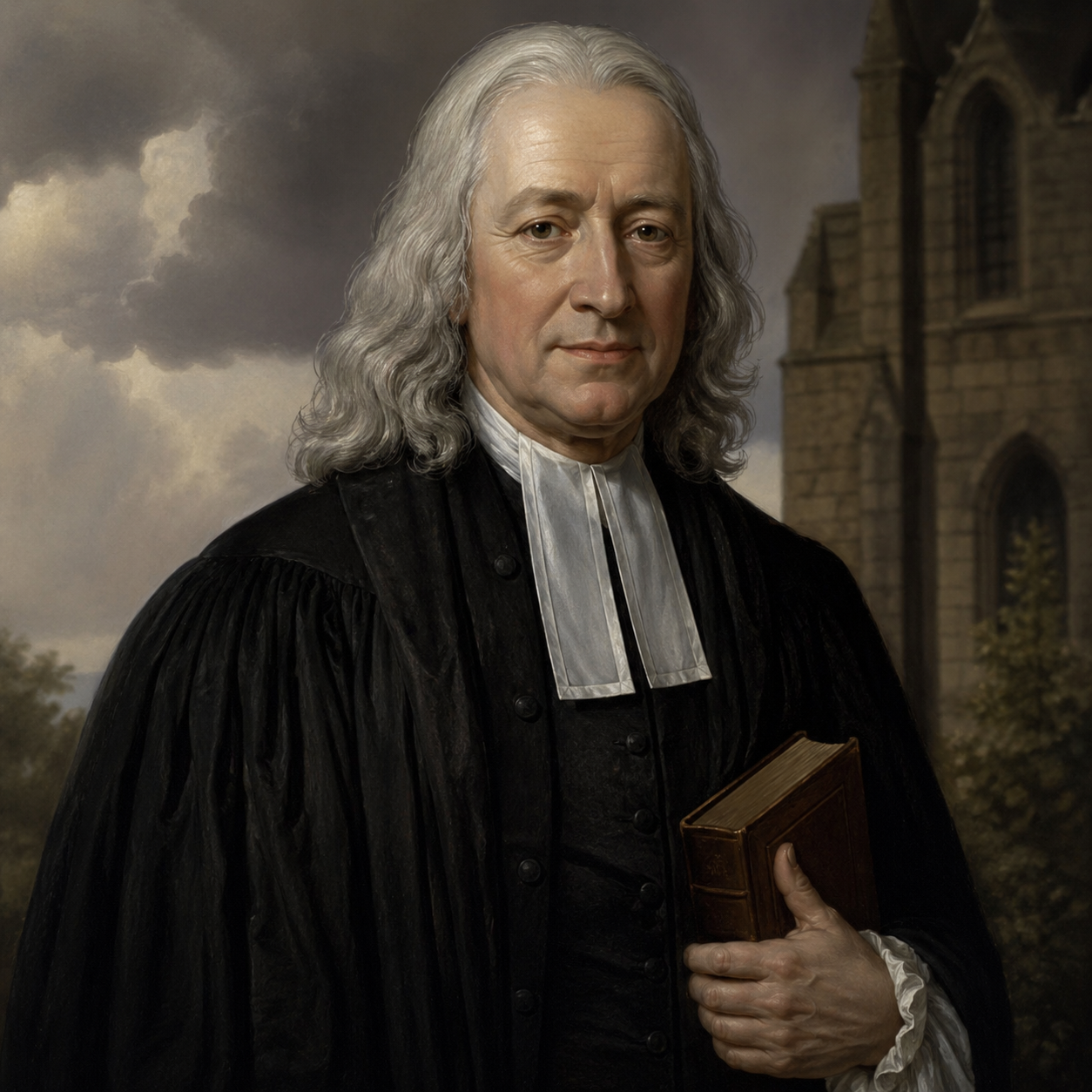
John Wesley — "I am no more afraid of the devil than I am of a fly."
I am no more afraid of the devil than I am of a fly.
I am no more afraid of the devil than I am of a fly.
Click any product to generate a realistic preview. Up to 3 at a time.
* Initial load can take up to 90 seconds — revising the preview in another color is nearly instant.
"Diseases are the instruments of God to punish men for their sins."
"I am a debtor to all the world, to do all the good I can, in every place, to every soul."
"I am not afraid of dying. I have no more fear of death than I have of lying down to sleep."
"Beware you be not swallowed up in books! An ounce of love is worth a pound of knowledge."
"I have often wondered that any man, who has tasted of the pleasures of retirement, can ever be prevailed upon to quit them."
English Anglican cleric and founder of Methodism, whose open-air preaching and class-meeting structure created the largest 18th-century evangelical revival. Closely associated with Charles Wesley (his hymn-writing brother) and George Whitefield (early co-revivalist, later doctrinal opponent). For an intellectual contrast, see George Whitefield, Calvinist evangelical revivalist — Whitefield's predestinarian Calvinism vs Wesley's free-grace Arminian theology split the early Methodist movement permanently in the 1739-41 break. The founding evangelical Calvinist-Arminian schism — the two parallel evangelical traditions American Christianity descends from.
Found in 1 providers: grok
1 source checked
The speaker claims complete fearlessness toward evil and temptation, treating the devil as a trivial, powerless nuisance rather than a terrifying force. This expresses supreme spiritual confidence rooted in faith — the idea that divine protection makes demonic influence utterly insignificant. It's a declaration that fear has no grip on someone anchored in God, and that evil's apparent power dissolves entirely when met with genuine conviction.
Wesley's entire ministry was built on confronting darkness head-on — preaching in dangerous open fields, entering slums, facing hostile mobs who pelted him with stones. He believed sanctification could deliver complete freedom from sin's dominion. His Methodist movement challenged both spiritual complacency and superstitious fear, emphasizing that personal holiness and God's grace rendered evil genuinely powerless over the committed believer.
In 18th-century Britain, folk belief in demonic activity, witchcraft, and supernatural evil remained widespread across all social classes. Wesley himself believed in supernatural phenomena, yet here he inverts popular fear culture. During a period when Enlightenment rationalism clashed with evangelical revival, this statement boldly asserted experiential faith over both superstitious dread and cold intellectual detachment, positioning spiritual courage as the Methodist ideal.
AI-generated insights based on extensive research and information for context. Factual errors? Email [email protected].
Your cart is empty