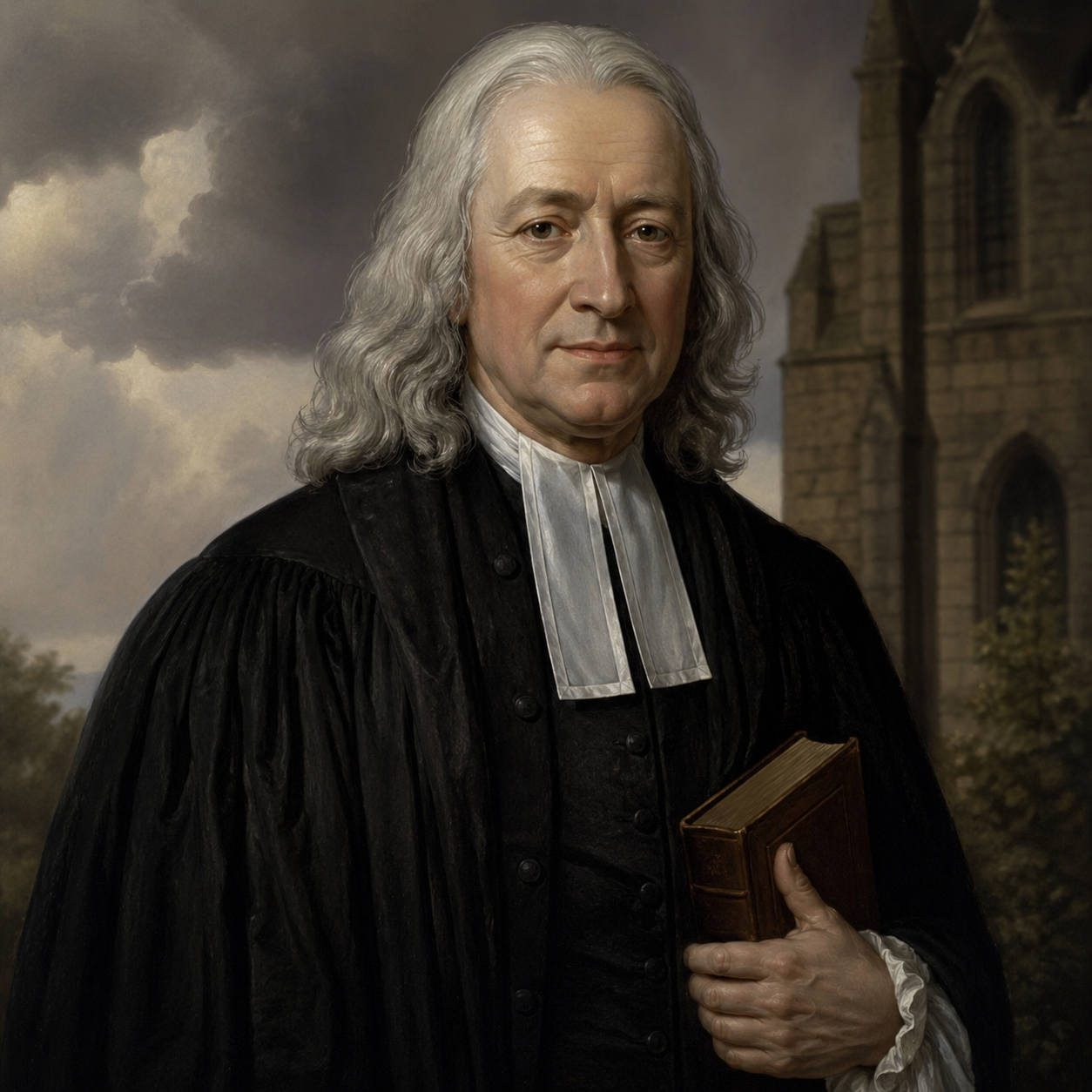
John Wesley — "I have often wondered that any man, who has tasted of the pleasures of retiremen…"
I have often wondered that any man, who has tasted of the pleasures of retirement, can ever be prevailed upon to quit them.
I have often wondered that any man, who has tasted of the pleasures of retirement, can ever be prevailed upon to quit them.
Click any product to generate a realistic preview. Up to 3 at a time.
* Initial load can take up to 90 seconds — revising the preview in another color is nearly instant.
"I have been writing a sermon on the use of money. Oh, what a flat, unprofitable subject it is!"
"By Methodists, I mean such as profess to pursue a Christian life by Scriptural rules and methods."
"I will not speak to you as a Methodist, but as a man of common sense."
"The greatest enemy to human happiness is the love of money."
"What is the Lord’s Supper? It is a feast upon a sacrifice."
English Anglican cleric and founder of Methodism, whose open-air preaching and class-meeting structure created the largest 18th-century evangelical revival. Closely associated with Charles Wesley (his hymn-writing brother) and George Whitefield (early co-revivalist, later doctrinal opponent). For an intellectual contrast, see George Whitefield, Calvinist evangelical revivalist — Whitefield's predestinarian Calvinism vs Wesley's free-grace Arminian theology split the early Methodist movement permanently in the 1739-41 break. The founding evangelical Calvinist-Arminian schism — the two parallel evangelical traditions American Christianity descends from.
Found in 1 providers: grok
1 source checked
Quiet withdrawal from public life—solitude, reading, and personal reflection—offers such profound satisfaction that it seems nearly incomprehensible why anyone who experienced it would willingly return to society's demands. Wesley is noting the powerful pull of peaceful, contemplative existence over the noise and obligation of active engagement. Once tasted, private life has a magnetism that makes choosing to re-enter the world feel genuinely puzzling.
Wesley rode over 250,000 miles and delivered roughly 40,000 sermons across Britain, embodying the antithesis of retirement. Yet he read voraciously on horseback and treasured study and prayer. This quote reveals a private tension: Wesley genuinely loved contemplative solitude but subordinated that pleasure to his evangelical mission. The wonder he expresses is partly self-directed—he kept choosing active ministry over the quiet pleasures he clearly valued.
In 18th-century Britain, retirement signified cultivated withdrawal—scholars, clergymen, and gentlemen idealized seclusion for reading, writing, and prayer, drawing on the classical ideal of otium. As industrialization and urban poverty accelerated, this genteel contemplative life grew increasingly tempting even as social conditions demanded active reform. Wesley's Methodist Revival specifically challenged retreat by insisting that authentic faith required visible public action among Britain's laboring poor.
AI-generated insights based on extensive research and information for context. Factual errors? Email [email protected].
Your cart is empty