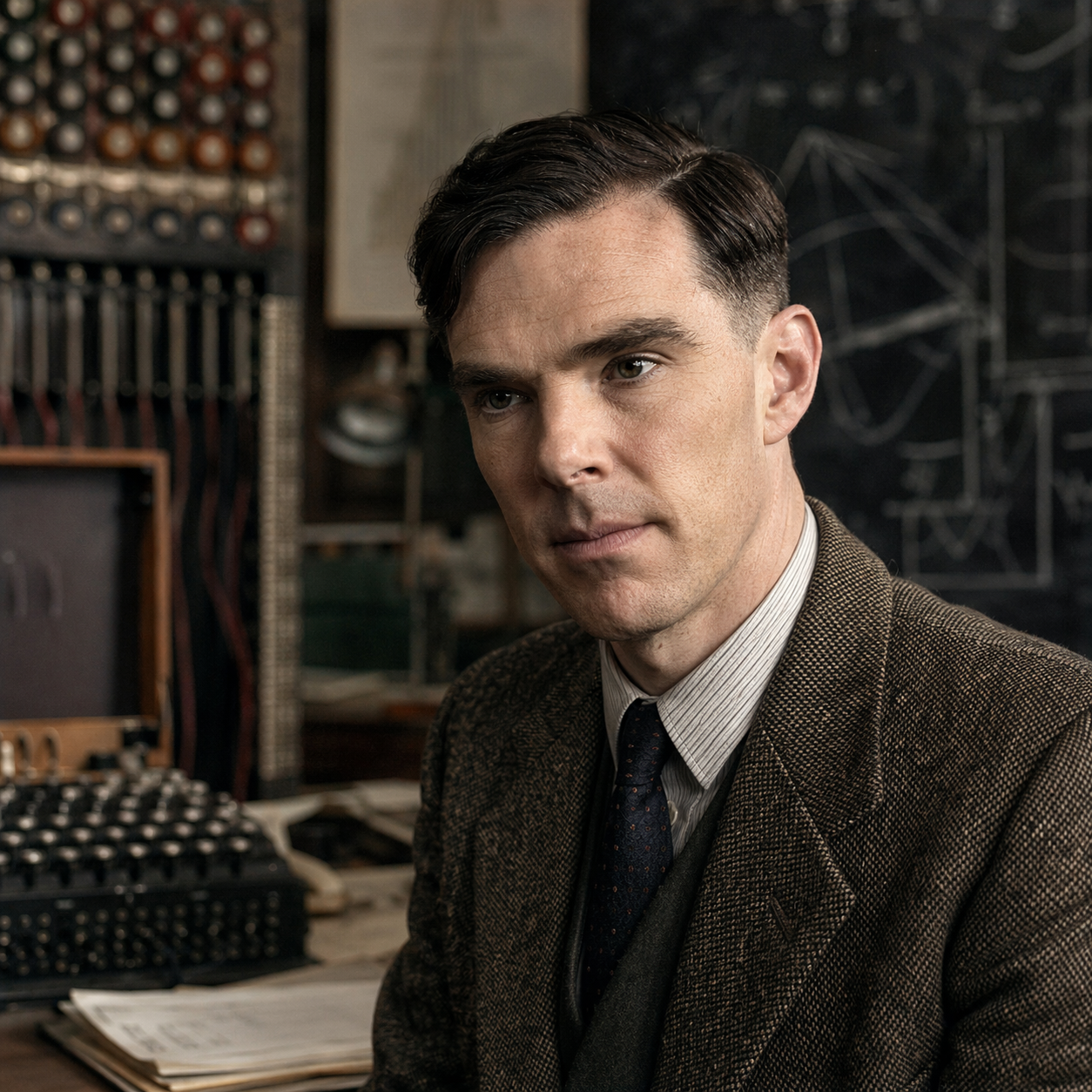
Alan Turing — "I am not a believer in the idea that the human mind is something supernatural."
I am not a believer in the idea that the human mind is something supernatural.
I am not a believer in the idea that the human mind is something supernatural.
Click any product to generate a realistic preview. Up to 3 at a time.
* Initial load can take up to 90 seconds — revising the preview in another color is nearly instant.
"I believe that in about fifty years' time it will be possible to programme computers, with a storage capacity of about 10^9, to make them play the imitation game so well that an average interrogator w…"
"The digital computer is a universal machine, capable of performing any computable task."
"The computer is a universal machine."
"The machine has a definite state at any moment, which is determined by the instructions it has received and by the results of its previous operations."
"It is not easy to devise a game which is fair in this respect between the machine and the man."
Attributed, general philosophical stance, hard to pin down exact wording/source.
Date: Approx. 1950s
ShockingFound in 1 providers: grok
1 source checked
The human mind works by natural, physical processes—not divine intervention, spiritual forces, or anything beyond ordinary matter and causation. Intelligence, reasoning, and consciousness emerge from mechanics that can be studied, modeled, and potentially replicated. No ghost, soul, or mystical element separates human thought from other natural phenomena. If we understand the brain's rules well enough, we can reproduce its outputs—in theory, on paper, or inside a machine.
Turing spent his career formalizing thinking itself. His 1936 universal machine showed computation could simulate any mental process, and his 1950 paper 'Computing Machinery and Intelligence' proposed the Turing Test because he believed intelligence was behavior, not essence. A committed materialist, he saw no principled barrier between brain and machine. His later morphogenesis work applied the same logic to biology: complex patterns arise from chemistry alone, not from any directing spirit.
Mid-twentieth-century Britain remained deeply Christian; the Church of England shaped public morality, and theology held that the soul was uniquely human and immaterial. Simultaneously, computing was emerging as a field that threatened that specialness—if a machine could mimic thought, what remained sacred about consciousness? Cold War science raced to explain everything mechanistically. Debates about mind, free will, and machine intelligence were urgent and unsettled, making Turing's flat denial of the supernatural quietly radical.
AI-generated insights based on extensive research and information for context. Factual errors? Email [email protected].
Your cart is empty