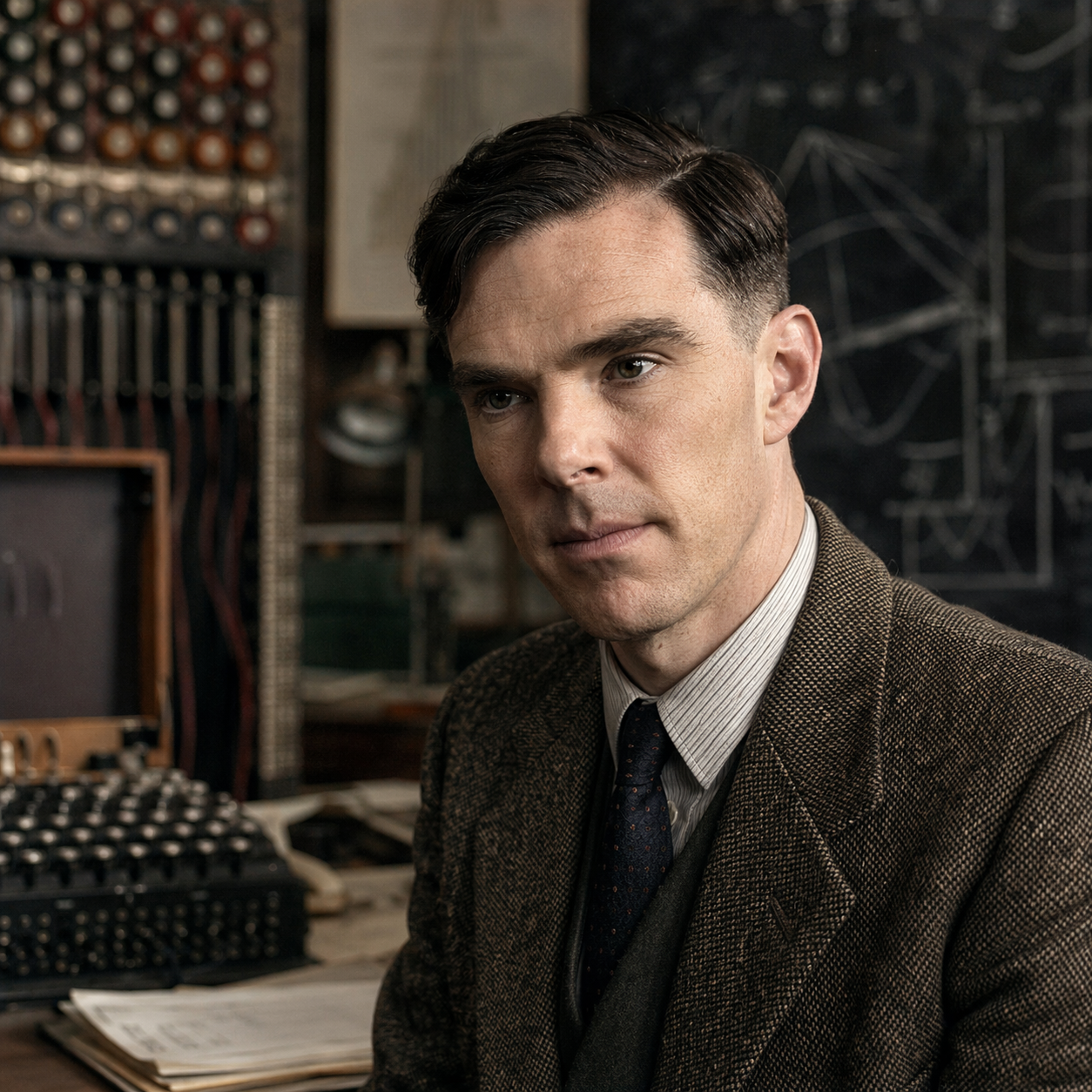
Alan Turing — "I am not afraid of computers. I am afraid of the people who program them."
I am not afraid of computers. I am afraid of the people who program them.
I am not afraid of computers. I am afraid of the people who program them.
Click any product to generate a realistic preview. Up to 3 at a time.
* Initial load can take up to 90 seconds — revising the preview in another color is nearly instant.
"The machine can only do what we tell it to do. But what if we tell it to learn?"
"We are not interested in the fact that the machine can do well, but in the fact that it can do badly."
"The problem of creating intelligent machines is one of the most challenging and exciting problems in all of science."
"In the time of Galileo it was argued that the texts, 'And the sun stood still ... and hasted not to go down about a whole day' (Joshua x. 13) and 'He laid the foundations of the earth, that it should …"
"The true nature of intelligence is not to be found in the ability to solve problems, but in the ability to ask the right questions."
Found in 1 providers: grok
1 source checked
Technology itself holds no moral weight — computers simply execute instructions. The real threat lies in the humans who write those instructions: their biases, ambitions, and intentions become embedded in systems that then act at scale. This warns against misplacing fear onto machines while ignoring human accountability. The programmer's values, whether benevolent or malicious, ultimately shape what computing actually does in the world.
Turing founded theoretical computing and broke Nazi Enigma codes, witnessing firsthand how human decisions — not machines — determined whether technology served liberation or destruction. Yet the British government later prosecuted him for homosexuality, subjecting him to chemical castration. His own life proved that institutions wield technology as a weapon against individuals. He understood machines as neutral; it was the powerful humans directing them that posed existential danger.
The 1940s and 1950s saw computing emerge directly from wartime military programs — codebreaking, weapons calculations, nuclear targeting. These machines were immediately deployed by states with enormous coercive power. The Cold War then intensified surveillance and arms races, making computational tools instruments of geopolitical control. Who programmed these systems and toward what ends was a live political question, as governments and militaries became computing's earliest and most powerful patrons.
AI-generated insights based on extensive research and information for context. Factual errors? Email [email protected].
Your cart is empty