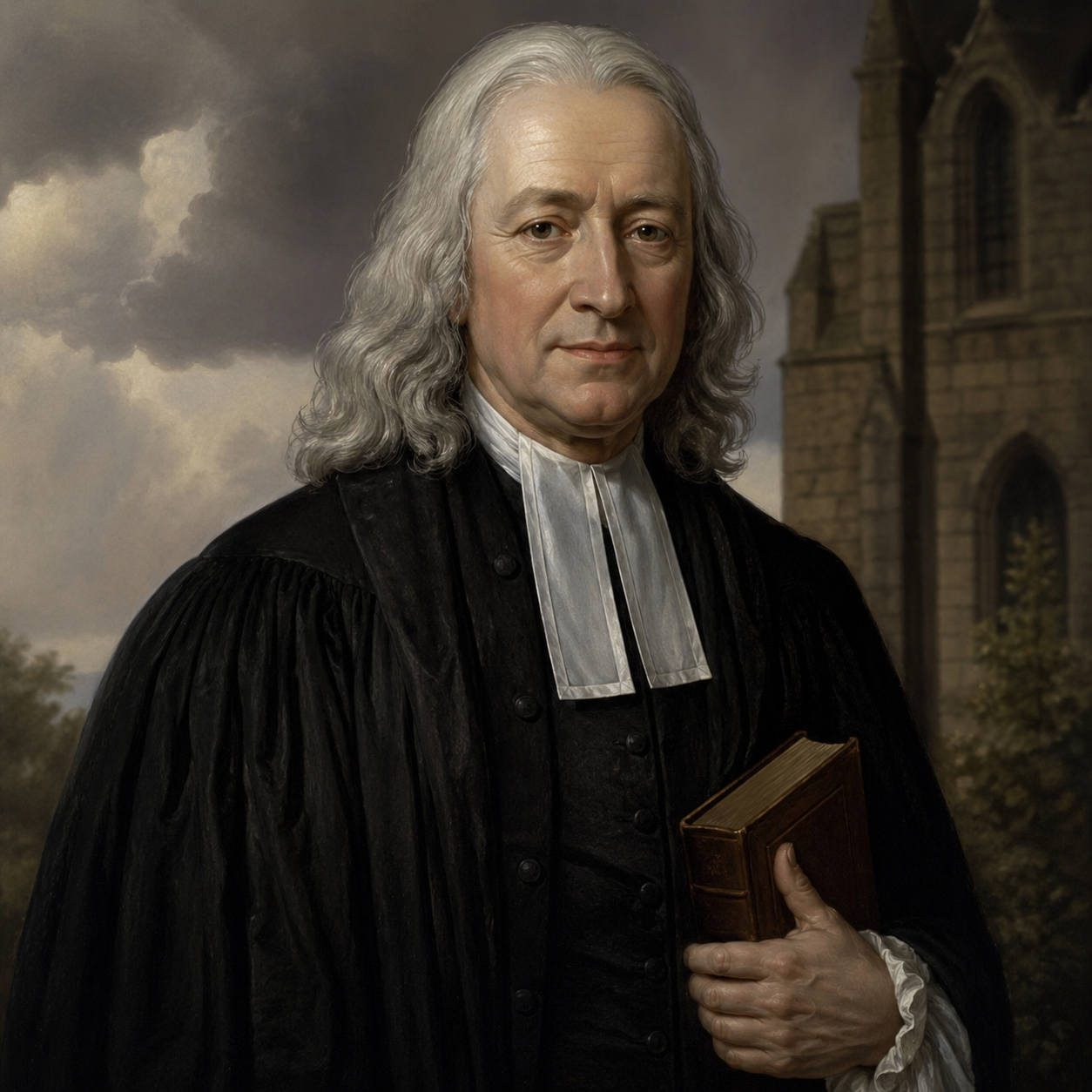
John Wesley — "I am not careful about my life or my death. I know that I am in the hands of God…"
I am not careful about my life or my death. I know that I am in the hands of God.
I am not careful about my life or my death. I know that I am in the hands of God.
Click any product to generate a realistic preview. Up to 3 at a time.
* Initial load can take up to 90 seconds — revising the preview in another color is nearly instant.
"I am as much a High-Churchman as ever I was."
"Give me one hundred men who fear nothing but God, hate nothing but sin, and are determined to know nothing among men but Jesus Christ, and I will shake the gates of hell."
"I am not afraid of dying. I have no fear of death."
"What a work has God wrought in our day!"
"I have no time to be little."
English Anglican cleric and founder of Methodism, whose open-air preaching and class-meeting structure created the largest 18th-century evangelical revival. Closely associated with Charles Wesley (his hymn-writing brother) and George Whitefield (early co-revivalist, later doctrinal opponent). For an intellectual contrast, see George Whitefield, Calvinist evangelical revivalist — Whitefield's predestinarian Calvinism vs Wesley's free-grace Arminian theology split the early Methodist movement permanently in the 1739-41 break. The founding evangelical Calvinist-Arminian schism — the two parallel evangelical traditions American Christianity descends from.
Found in 1 providers: grok
1 source checked
I don't anxiously guard my physical survival or fear dying. My life belongs entirely to God, and that certainty frees me from worry. Trusting divine providence means surrendering control over outcomes — whether I live or die, I'm held by something greater than myself, so daily fear and self-preservation anxiety become unnecessary burdens I no longer need to carry.
Wesley rode over 250,000 miles on horseback preaching across Britain and America, facing hostile mobs, riots, and brutal weather throughout his ministry. He was physically attacked multiple times and frequently threatened. This wasn't bravado — he recorded near-death experiences in his journals with calm detachment, genuinely believing his survival was God's business, not his own careful management.
Eighteenth-century England offered no guaranteed safety for itinerant preachers challenging the established Anglican church. Wesley preached during a period of religious persecution, class upheaval, and the raw dangers of pre-modern travel. Smallpox, typhus, and road violence killed routinely. Against this backdrop, publicly declaring indifference to death was theologically radical and practically demonstrated through Wesley's tireless, dangerous field preaching.
AI-generated insights based on extensive research and information for context. Factual errors? Email [email protected].
Your cart is empty