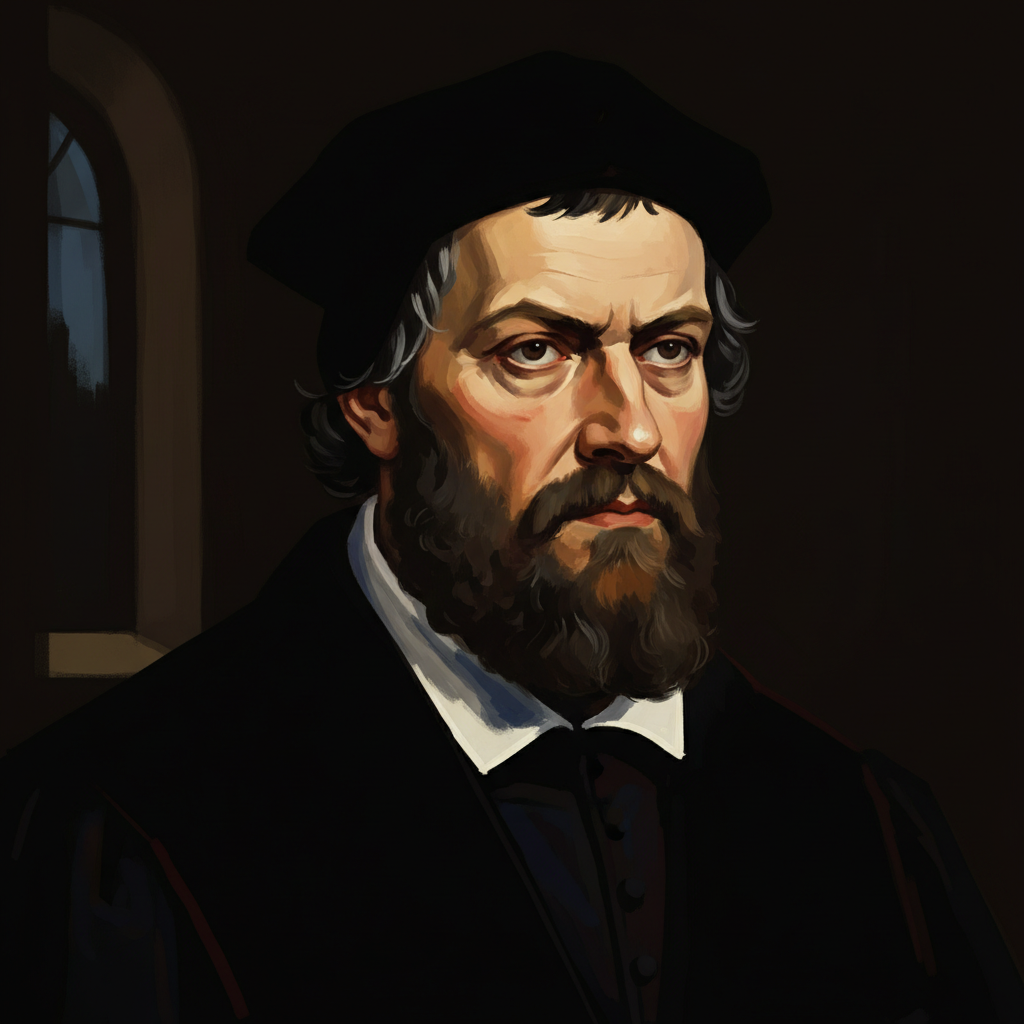
Martin Luther — "I am not mad, but I am a prophet."
I am not mad, but I am a prophet.
I am not mad, but I am a prophet.
Click any product to generate a realistic preview. Up to 3 at a time.
* Initial load can take up to 90 seconds — revising the preview in another color is nearly instant.
"Seventhly, let the young and strong Jews and Jewesses be given flail, axe, spade, and spindle, and let them earn their bread in the sweat of their brow, as was imposed on Adam's children."
"If God has no sense of humor, I don't want to go to Heaven."
"The Christian's life is not a bed of roses, but a cross."
"The greatest gift of God is a pious, cheerful, God-fearing, home-loving wife, to whom you can entrust your property, and your children, and your all."
"I would rather be ruled by a wise Turk than by a foolish Christian."
German theologian whose 95 Theses (1517) launched the Protestant Reformation and broke the Catholic Church's monopoly on Western Christianity. Closely associated with Philipp Melanchthon (Lutheran systematizer) and John Calvin (later Reformer who built on Luther's break). For an intellectual contrast, see Pope Leo X, Renaissance pope (1513-1521) — Leo X's indulgence sales triggered Luther's break and Leo excommunicated him in 1521 — Luther's entire Reformation is structured as a direct answer to the indulgence-funded Vatican Leo represented.
Found in 1 providers: grok
1 source checked
Luther rejects the charge that he is deranged or unstable and instead claims a higher role: someone speaking uncomfortable truths on behalf of God. He acknowledges his words sound extreme, but insists the extremity comes from divine commission, not mental imbalance. In modern terms, he is saying his critics mistake conviction and urgent warning for insanity, when in fact he sees himself as a messenger exposing corruption others refuse to face.
Luther repeatedly faced accusations of being crazed, possessed, or heretical after posting the 95 Theses in 1517 and defying both Pope and Emperor at Worms in 1521. An Augustinian monk and theology professor at Wittenberg, he framed his mission in prophetic terms, comparing himself to Old Testament prophets denouncing a corrupt priesthood. This line captures his self-understanding: not a rebel for its own sake, but a reluctant voice raised against indulgences, papal authority, and clerical abuse.
In early-modern Europe, the Catholic Church dominated spiritual and political life, and dissent risked excommunication or execution—Jan Hus had been burned a century earlier. The printing press was spreading ideas faster than Rome could suppress them, and apocalyptic expectation ran high. Calling oneself a prophet was both a serious theological claim and a dangerous one. Luther's era blurred lines between reformer, heretic, and madman, making his insistence on prophetic sanity a direct challenge to ecclesiastical authority to define truth.
AI-generated insights based on extensive research and information for context. Factual errors? Email [email protected].
Your cart is empty