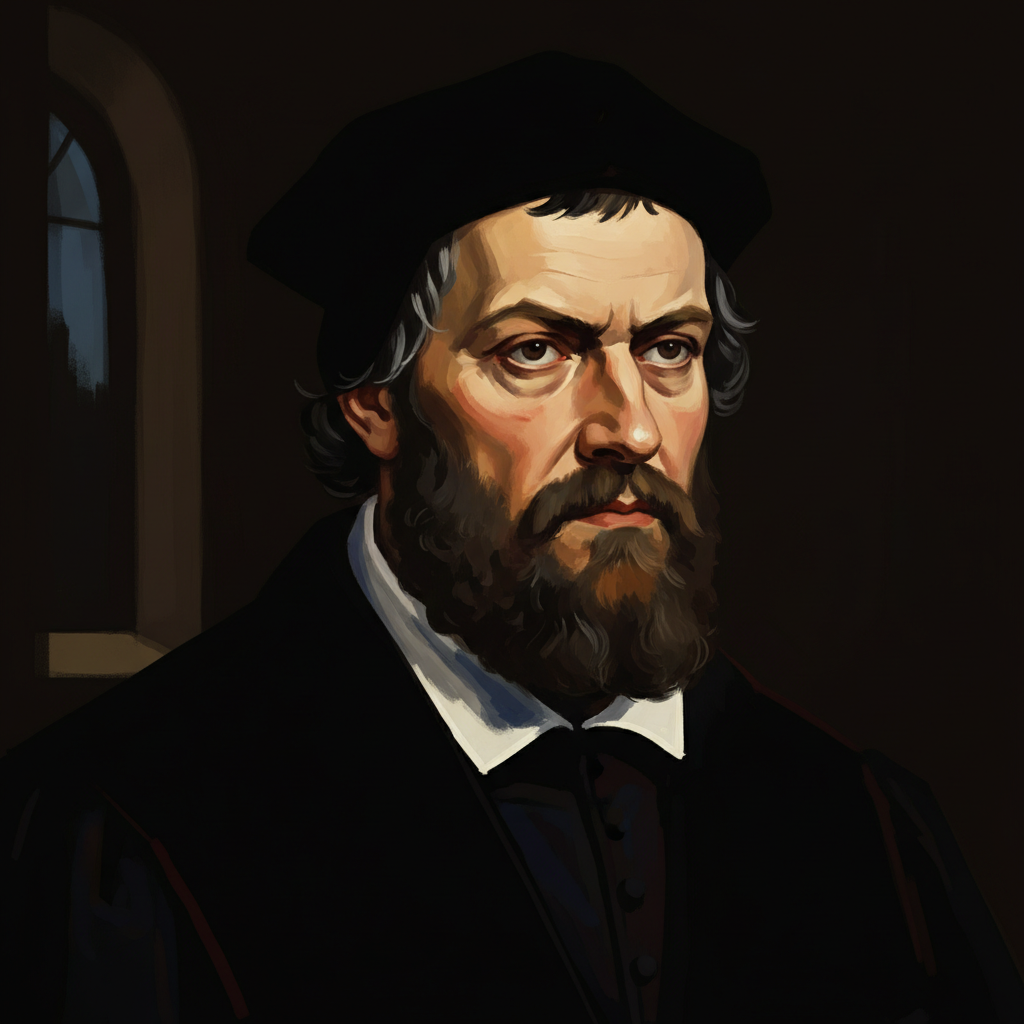
Martin Luther — "I am nothing but a poor, stinking bag of worms."
I am nothing but a poor, stinking bag of worms.
I am nothing but a poor, stinking bag of worms.
Click any product to generate a realistic preview. Up to 3 at a time.
* Initial load can take up to 90 seconds — revising the preview in another color is nearly instant.
"My conscience is captive to the Word of God. I cannot and I will not recant anything, for to go against conscience is neither right nor safe. Here I stand, I can do no other. God help me. Amen."
"The whole being of any Christian is faith and love."
"Next to the Word of God, the noble art of music is the greatest treasure in the world."
"Women should remain at home, sit still, keep house, and bear and bring up children...If a woman grows weary and, at last, dies from childbearing, it matters not. Let her die from bearing - she is ther…"
"If I am to be a Christian, I must be a Jew."
German theologian whose 95 Theses (1517) launched the Protestant Reformation and broke the Catholic Church's monopoly on Western Christianity. Closely associated with Philipp Melanchthon (Lutheran systematizer) and John Calvin (later Reformer who built on Luther's break). For an intellectual contrast, see Pope Leo X, Renaissance pope (1513-1521) — Leo X's indulgence sales triggered Luther's break and Leo excommunicated him in 1521 — Luther's entire Reformation is structured as a direct answer to the indulgence-funded Vatican Leo represented.
Found in 1 providers: grok
1 source checked
Luther is declaring his own worthlessness and mortality in stark, physical terms. He sees himself as decaying flesh, destined for the grave, with nothing in himself worth boasting about. The statement strips away ego, status, and achievement, reducing a human being to rotting matter. It's a brutal reminder that whatever dignity or worth a person possesses does not come from themselves but must be received from somewhere outside their own corrupt nature.
This captures the core of Luther's theology: humans are utterly unable to earn salvation and stand before God only as undeserving sinners saved by grace alone. Despite toppling the medieval church, translating the Bible into German, and reshaping Europe, Luther constantly emphasized his own unworthiness. His writings are full of such self-abasement, reflecting his monastic training, his terror of divine judgment, and his conviction that pride was the root sin.
In early modern Europe, the late medieval preoccupation with death, plague, and judgment shaped spirituality. Memento mori imagery, danse macabre art, and graphic sermons on decay were widespread, especially after recurring plague waves. The Catholic penitential system emphasized human sinfulness, while Renaissance humanism simultaneously exalted human dignity. Luther's crude, earthy language pushed back against both clerical pretension and humanist optimism, echoing the peasant vernacular he championed in his German Bible translation.
AI-generated insights based on extensive research and information for context. Factual errors? Email [email protected].
Your cart is empty