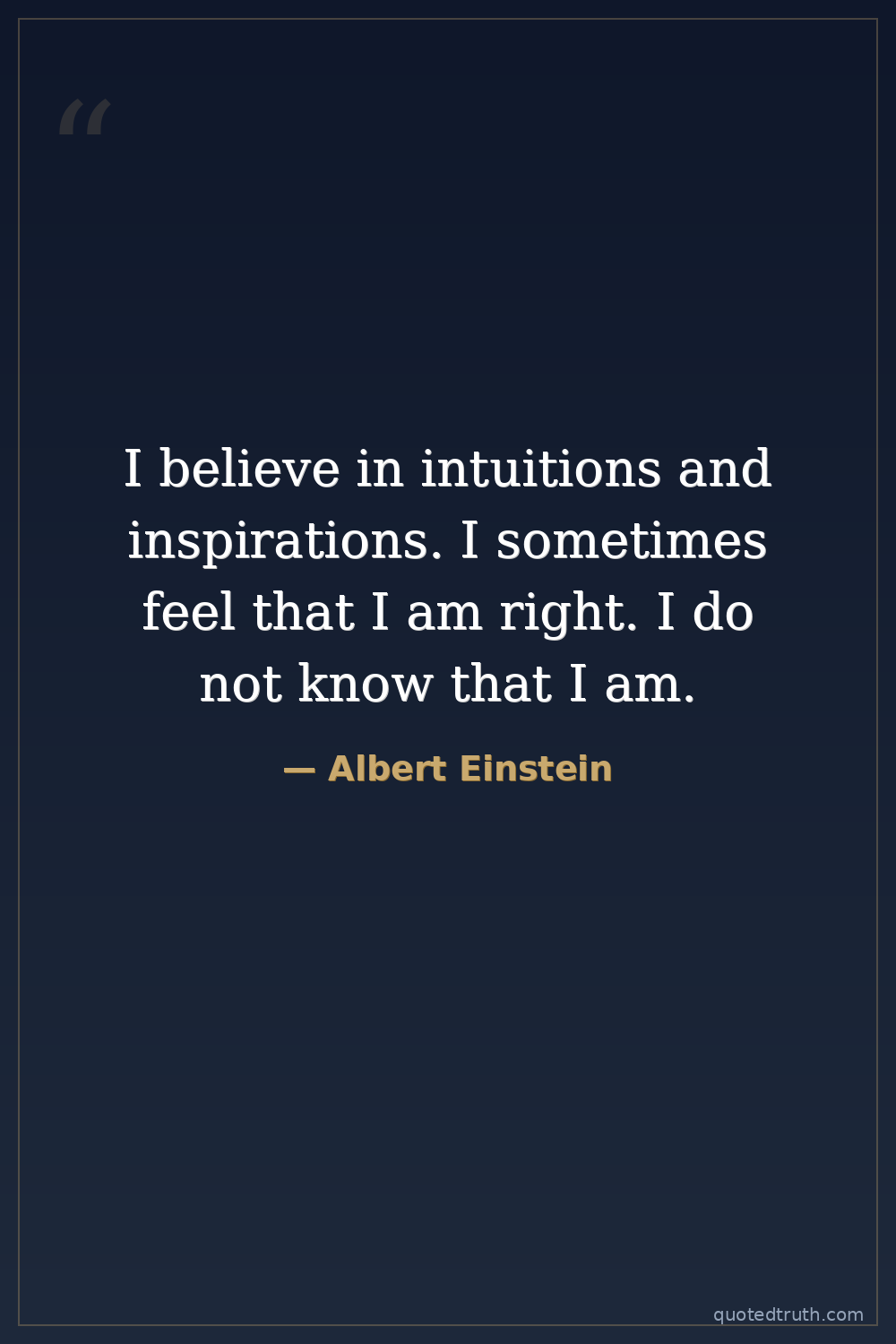
Albert Einstein — "I believe in intuitions and inspirations. I sometimes feel that I am right. I do…"
I believe in intuitions and inspirations. I sometimes feel that I am right. I do not know that I am.
I believe in intuitions and inspirations. I sometimes feel that I am right. I do not know that I am.
Click any product to generate a realistic preview. Up to 3 at a time.
* Initial load can take up to 90 seconds — revising the preview in another color is nearly instant.
"The most beautiful thing we can experience is the mysterious. It is the source of all true art and all science. He to whom this emotion is a stranger, who can no longer pause to wonder and stand rapt …"
"The Germans as a whole are guilty of these mass murders and must be punished as a people..."
"Gravitation cannot be held responsible for people falling in love."
"It has become appallingly obvious that our technology has exceeded our humanity."
"The difference between stupidity and genius is that genius has its limits."
Found in 1 providers: grok
1 source checked
True insight often arrives before proof does. You can sense something is correct — feel it with conviction — without yet having the evidence or logic to confirm it. This captures how discovery actually works: not as a clean chain of deduction, but as a gut feeling you then work to verify or disprove. Certainty is earned; intuition just opens the door.
Einstein famously trusted thought experiments over pure calculation — imagining riding a light beam led to special relativity before the math existed. He openly distrusted rigid empiricism and credited imagination over knowledge. His 1905 miracle year papers arrived as intuitive leaps he then formalized. His entire career demonstrated that scientific breakthroughs begin as feelings, not proofs.
Early 20th century physics was overthrowing Newtonian certainty. Quantum mechanics was revealing that even physicists couldn't fully know nature. Einstein lived through a revolution where old confident frameworks collapsed. In that climate, admitting 'I do not know that I am' was intellectually honest and radical — science was learning humility about absolute certainty at the same moment Einstein expressed his own.
AI-generated insights based on extensive research and information for context. Factual errors? Email [email protected].
Your cart is empty