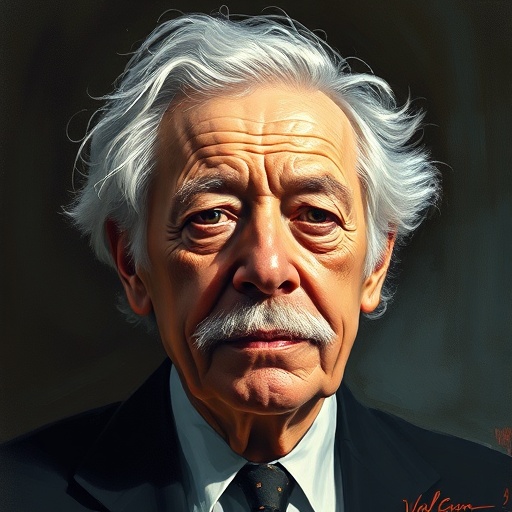
Linus Pauling — "I believe that every human being has the potential to be a creative genius."
I believe that every human being has the potential to be a creative genius.
I believe that every human being has the potential to be a creative genius.
Click any product to generate a realistic preview. Up to 3 at a time.
* Initial load can take up to 90 seconds — revising the preview in another color is nearly instant.
"I am not interested in fame or fortune. I am interested in truth."
"I have always been a curious individual, and I believe that curiosity is the engine of progress."
"On many questions I have a better understanding of the issues than any politicians."
"Like thousands of other boys, I had a little chemical laboratory in our cellar and think that some of our friends thought me a bit crazy."
"The only way to cope with a problem is to go right at it, and the only way to solve a problem is to keep on working at it until you've solved it."
Found in 1 providers: grok
1 source checked
Creative genius isn't reserved for a gifted few — it's a universal human capacity. Every person carries the raw intellectual and imaginative potential to produce breakthrough ideas. Genius isn't a fixed trait you're born with or denied; it's latent in everyone, waiting to be developed through curiosity, effort, and the right conditions. The ceiling on human creativity is far higher than society typically assumes.
Pauling won two unshared Nobel Prizes — in Chemistry and Peace — a feat no one else has matched. A self-taught scientist from modest Oregon beginnings, he pioneered valence bond theory, described the alpha helix, and later crusaded against nuclear testing. His own improbable rise from poverty to the heights of science gave him firsthand evidence that genius isn't inherited by elites. His democratic worldview, central to his peace activism, demanded equal human dignity and potential.
Pauling's career peaked during the Cold War, when nuclear weapons cast an existential shadow and scientific authority carried enormous cultural weight. Post-war America was simultaneously expanding university access via the GI Bill and grappling with lingering eugenicist ideas that ranked human intelligence by race or class. Pauling's assertion of universal creative potential directly challenged those hierarchies — and aligned with the emerging civil rights movement's demand that human worth and capacity not be arbitrarily limited.
AI-generated insights based on extensive research and information for context. Factual errors? Email [email protected].
Your cart is empty