Linus Pauling — "I believe that the human race has the ability to solve all of its problems, if w…"
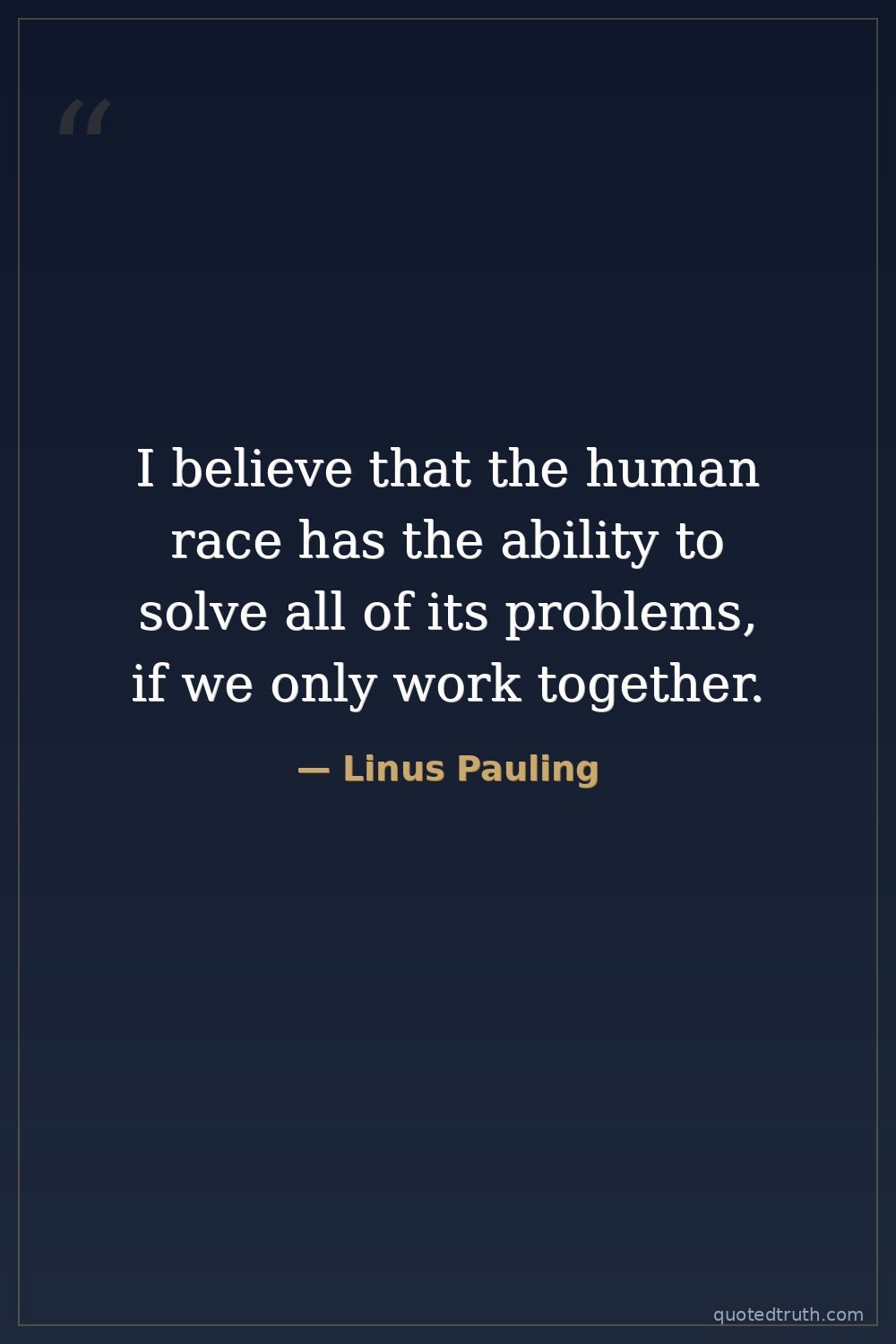
I believe that the human race has the ability to solve all of its problems, if we only work together.
I believe that the human race has the ability to solve all of its problems, if we only work together.
Click any product to generate a realistic preview. Up to 3 at a time.
* Initial load can take up to 90 seconds — revising the preview in another color is nearly instant.
"War is the greatest evil."
"Like thousands of other boys, I had a little chemical laboratory in our cellar and think that some of our friends thought me a bit crazy."
"I believe that every human being has the potential to be a creative genius."
"I refuse to be intimidated by the word impossible."
"I think that we should make the world safe for differences."
Found in 1 providers: grok
1 source checked
Humanity possesses the collective intelligence and capability to overcome every challenge it faces — war, disease, poverty, environmental destruction — but only through genuine cooperation across borders, ideologies, and disciplines. The obstacle is never capacity; it is division. When people pool knowledge and effort rather than compete destructively, no problem is fundamentally unsolvable. Unity of purpose transforms impossibility into achievable goals.
Pauling embodied this belief through his dual career: he won the Nobel Prize in Chemistry for revolutionary work on chemical bonds, then won the Nobel Peace Prize for his crusade against nuclear weapons testing. He circulated the Pauling Petition signed by over 11,000 scientists, demonstrating that collective expert action could shift policy. For him, collaboration was not idealism — it was proven scientific method applied to civilization itself.
Pauling's most active decades spanned the Cold War, when nuclear arsenals grew exponentially and humanity genuinely faced self-annihilation. The US-Soviet arms race, atmospheric nuclear testing, and Berlin crises made cooperation feel impossible. Yet Sputnik also showed science transcended politics, and the 1963 Partial Nuclear Test Ban Treaty proved international cooperation could succeed. His optimism was a direct counter-narrative to the fatalistic deterrence doctrine dominating that era.
AI-generated insights based on extensive research and information for context. Factual errors? Email [email protected].
Your cart is empty