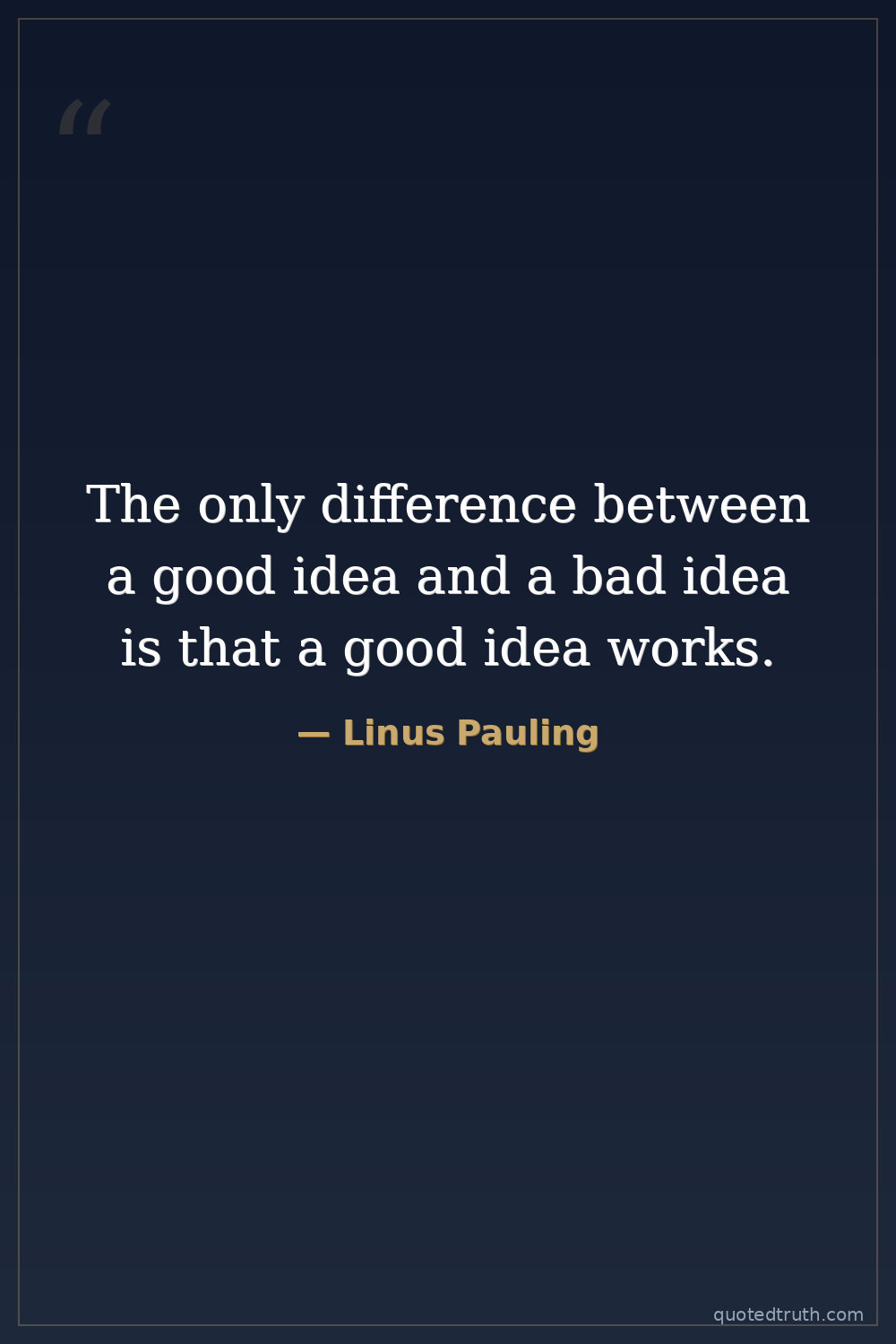
Linus Pauling — "The only difference between a good idea and a bad idea is that a good idea works…"
The only difference between a good idea and a bad idea is that a good idea works.
The only difference between a good idea and a bad idea is that a good idea works.
Click any product to generate a realistic preview. Up to 3 at a time.
* Initial load can take up to 90 seconds — revising the preview in another color is nearly instant.
"I believe that peace is not just the absence of war, but the presence of justice."
"The only way to cope with a problem is to go right at it, and the only way to solve a problem is to keep on working at it until you've solved it."
"The department of chemistry [at Harvard] seemed to me to be rather uncooperative in that the different professors ran their own little groups...I just thought that I wouldn't feel at home there...."
"Everyone should know that the 'war on cancer' is largely a fraud."
"The only limit to our realization of tomorrow will be our doubts of today."
Found in 1 providers: grok
1 source checked
Ideas aren't good or bad based on how clever or ambitious they sound — only real-world results determine their worth. No matter how elegant something appears in theory, it only becomes a good idea when it actually works in practice. This is a purely empirical standard: strip away prestige, enthusiasm, and hope, and the only honest test remaining is whether it delivers.
Pauling's career embodied this standard. His quantum mechanical theory of chemical bonding earned the 1954 Nobel precisely because it predicted real molecular structures accurately. His later Vitamin C megadose campaign showed the flip side — enthusiasm unsupported by lasting evidence. Winning two unshared Nobel Prizes, one in Chemistry and one for Peace, reflected his lifelong habit of judging ideas not by their elegance but by what they actually produced.
Pauling's career spanned the post-WWII era, when science gained unprecedented power and prestige. The Manhattan Project proved that theoretical physics could reshape civilization — but also cause mass destruction. In a Cold War climate where governments funded enormous scientific programs on promise rather than proof, Pauling's pragmatic standard cut through the noise. Whether the idea was nuclear deterrence or chemical warfare, he consistently asked: does this actually work for human survival?
AI-generated insights based on extensive research and information for context. Factual errors? Email [email protected].
Your cart is empty