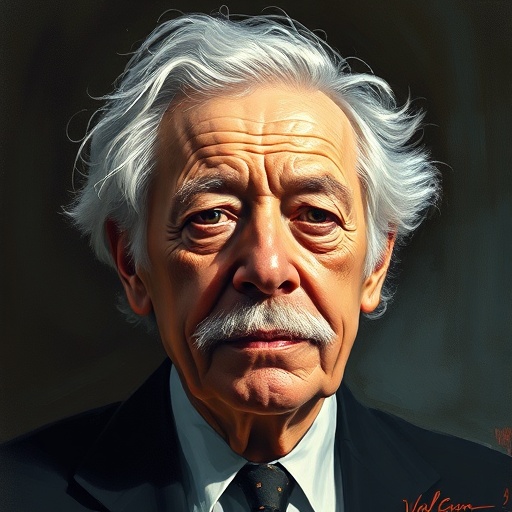
Linus Pauling — "I believe that there is a way to make the world better, and that we have a respo…"
I believe that there is a way to make the world better, and that we have a responsibility to find it.
I believe that there is a way to make the world better, and that we have a responsibility to find it.
Click any product to generate a realistic preview. Up to 3 at a time.
* Initial load can take up to 90 seconds — revising the preview in another color is nearly instant.
"I have been interested in vitamins for a long time, and I have taken large doses of vitamin C for many years."
"Every time you go to the doctor, the doctor asks you to take off your clothes, and then he looks at you, and he tells you what's wrong with you. But he doesn't know anything about you."
"The human body can make a number of substances, but it cannot make vitamin C."
"The most important thing in life is to be happy."
"The only way to cope with a problem is to go right at it, and the only way to solve a problem is to keep on working at it until you've solved it."
Found in 1 providers: grok
1 source checked
Optimism about human agency paired with moral obligation: the world's problems have solutions, and discovering them isn't optional. It rejects fatalism and passive acceptance of harm. Better outcomes are achievable, but only if people treat the search as a duty rather than a choice. It frames improvement not as luck or inevitability but as something that requires deliberate effort and collective responsibility to pursue.
Pauling lived this belief across two Nobel Prizes. He transformed chemistry by explaining atomic bonding through quantum mechanics, convinced that understanding nature benefits humanity. When Cold War nuclear testing contaminated global food supplies with radioactive fallout, he shifted to activism — organizing international scientists, petitioning against atmospheric tests, and helping secure the 1963 Partial Test Ban Treaty. He believed scientists carried special moral obligations beyond publishing papers, making this quote a precise summary of how he actually conducted his life.
Pauling's most active decades — the 1950s and 60s — saw hundreds of atmospheric nuclear tests by the U.S. and Soviet Union, genuine public fear of annihilation, and McCarthy-era political pressure silencing dissent. Scientists who helped build the bomb were wrestling with complicity. Pauling had his passport revoked and faced government harassment for speaking out. Asserting a responsibility to improve the world was neither safe nor obvious then — it was a deliberate stand against the era's dominant culture of institutional silence.
AI-generated insights based on extensive research and information for context. Factual errors? Email [email protected].
Your cart is empty