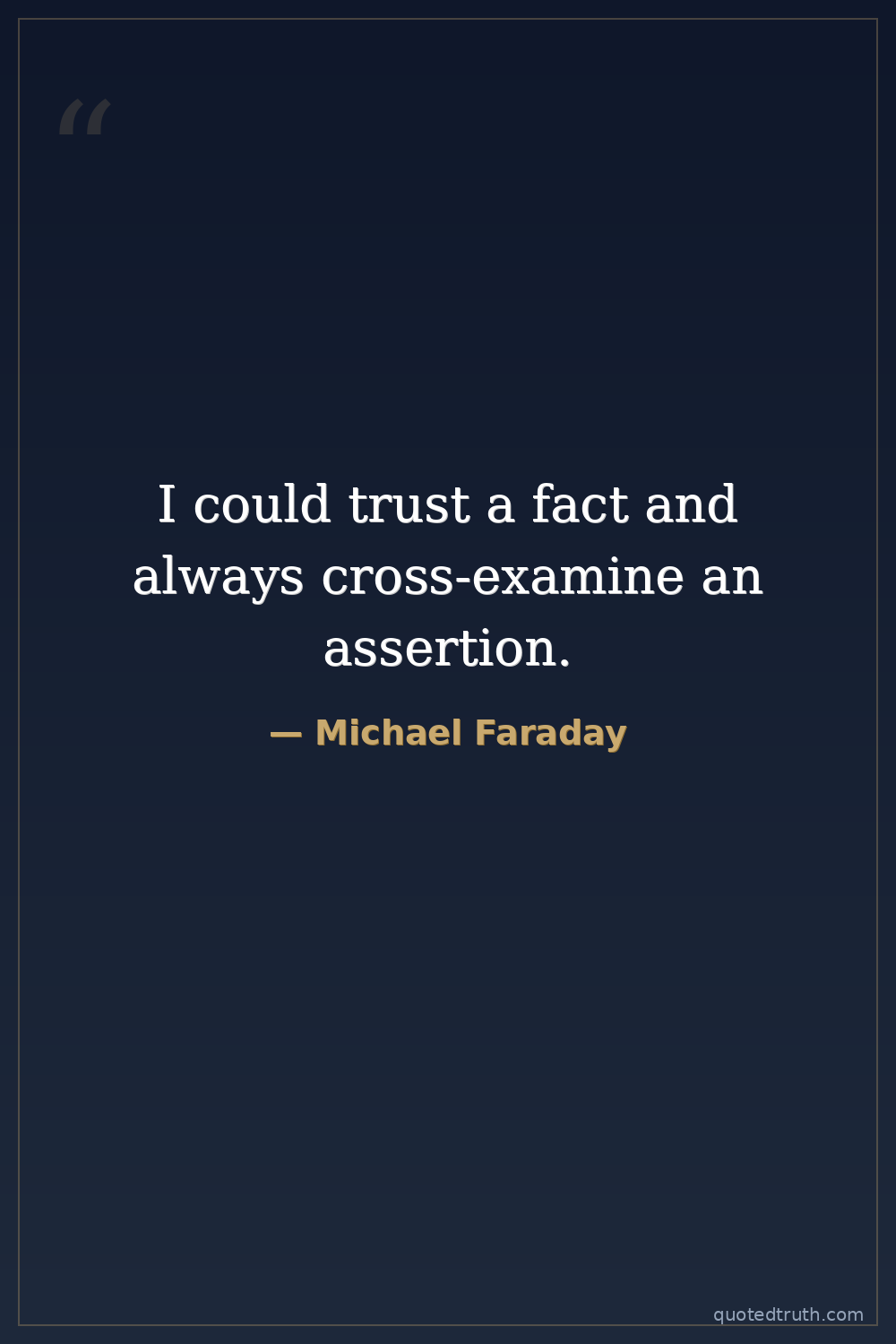
Michael Faraday — "I could trust a fact and always cross-examine an assertion."
I could trust a fact and always cross-examine an assertion.
I could trust a fact and always cross-examine an assertion.
Click any product to generate a realistic preview. Up to 3 at a time.
* Initial load can take up to 90 seconds — revising the preview in another color is nearly instant.
"I can at any moment convert my time into money, but I do not require more of the latter than is sufficient for necessary purposes."
"Magnetic curves are lines of force; they are not only lines of force but lines of action."
"It is right that we should stand by and act on our principles; but not right to hold them in obstinate blindness."
"I have always found that the more I work, the more I enjoy it."
"The most important instrument a scientist has is his own mind."
Found in 1 providers: deepseek
1 source checked
Faraday is saying he accepts verified observations as reliable starting points, but treats claims and opinions with skepticism until they are tested. Facts earn trust because they come from direct evidence, while assertions are just someone's statements and must be probed, questioned, and challenged. In short: believe what you can demonstrate, interrogate what you are merely told, no matter who says it.
Faraday, a self-taught bookbinder's apprentice turned giant of experimental science, discovered electromagnetic induction, electrolysis laws, and the Faraday effect by relentless bench work, not theory. Lacking formal mathematics, he relied on meticulous notebooks and repeated trials. He famously resisted fashionable speculation, including ether hype, and rejected a knighthood and Royal Society presidency. This quote captures his working creed: evidence above authority, experiment above assertion.
Faraday worked from the 1820s to 1860s, when science was professionalizing and Britain's Royal Institution lectures drew crowds. Romantic-era natural philosophy still mixed showmanship, spiritualism, and speculative theorizing with genuine discovery. Mesmerism, table-turning seances, and competing electrical theories filled public debate. Against this backdrop, Faraday and contemporaries like Lyell and later Darwin pushed rigorous empirical method, insisting on reproducible evidence. His emphasis on cross-examining assertions reflected that broader Victorian struggle to separate real science from persuasive bluster.
AI-generated insights based on extensive research and information for context. Factual errors? Email [email protected].
Your cart is empty