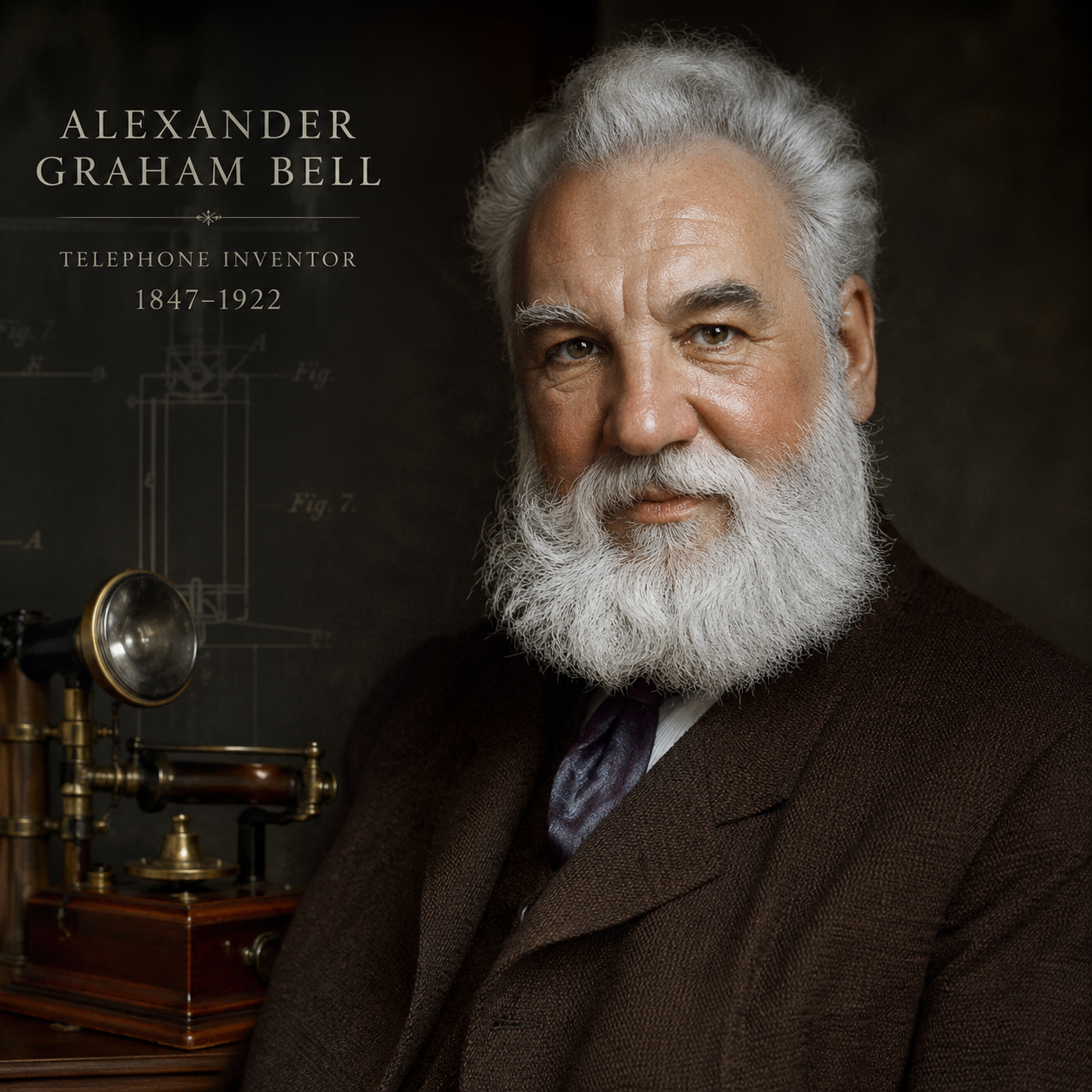
Alexander Graham Bell — "I did not invent the telephone, the telephone invented me."
I did not invent the telephone, the telephone invented me.
I did not invent the telephone, the telephone invented me.
Click any product to generate a realistic preview. Up to 3 at a time.
* Initial load can take up to 90 seconds — revising the preview in another color is nearly instant.
"I have always been a great believer in luck, and I find that the harder I work, the more I have of it."
"The most successful men in the end are those whose success is the result of steady accretion."
"Before you can achieve anything, you must know what you want. And you must be prepared to sacrifice your comfort to get it."
"Great discoveries and improvements invariably involve the cooperation of many minds."
"The deaf are not a race apart. They are a part of humanity."
Often attributed, but likely a playful or philosophical statement rather than a literal one.
Date: unknown
GeneralFound in 1 providers: grok
1 source checked
The quote captures the two-way nature of transformative creation — building something revolutionary reshapes the builder as profoundly as the artifact itself. Bell suggests his identity, purpose, and entire life trajectory were determined more by the telephone than by his own intentions. The invention consumed him, defining how the world saw him and how he understood himself, making the creator inseparable from his creation.
Bell spent decades fighting patent disputes and managing the telephone's commercial empire, far beyond his original research interests. He deeply resented being reduced to 'telephone inventor,' preferring his work with the deaf — his true passion, rooted in his deaf mother and wife. Yet history enshrined him as the telephone's father, illustrating precisely how his most famous invention overwrote his chosen identity.
Bell demonstrated the telephone in 1876 at America's Centennial Exposition, a watershed moment when industrial invention became national identity. The Gilded Age elevated inventors into celebrities and empire-builders. Rapid commercialization meant a single patent could reshape entire economies and permanently brand a person. In this era, what you built defined who you were publicly, regardless of personal desire, making the creator-consumed-by-creation dynamic especially vivid.
AI-generated insights based on extensive research and information for context. Factual errors? Email [email protected].
Your cart is empty