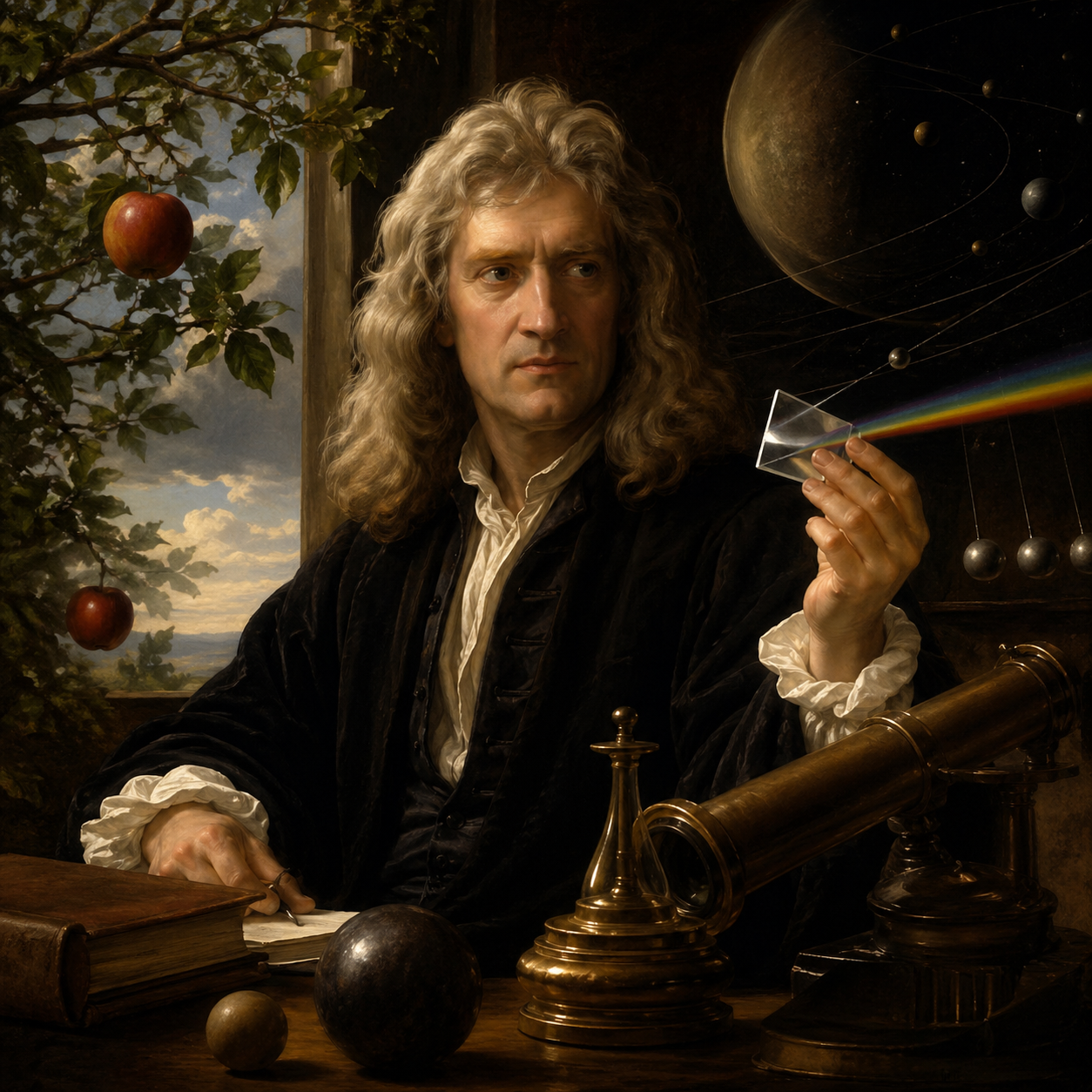
Isaac Newton — "I do not define time, space, place, and motion, as being well known to all."
I do not define time, space, place, and motion, as being well known to all.
I do not define time, space, place, and motion, as being well known to all.
Click any product to generate a realistic preview. Up to 3 at a time.
* Initial load can take up to 90 seconds — revising the preview in another color is nearly instant.
"For it is the property of true philosophy to deduce the causes of all natural effects from the simplest possible principles."
"The parts of all homogeneal hard bodies which fully touch one another, stick together with a very strong attraction."
"To every action there is always opposed an equal reaction."
"Atheism is so senseless. When I look at the solar system, I see the earth at the right distance from the sun to receive the proper amounts of heat and light. This did not happen by chance."
"The frame of nature, and the system of the world, we are to observe by the phenomena, and not to frame by imagination."
Found in 1 providers: deepseek
1 source checked
Newton is acknowledging that time, space, place, and motion are concepts everyone grasps from daily experience, so he won't formally define them from scratch. Yet this sets up his revolutionary distinction between absolute and relative forms of each — absolute time flows uniformly regardless of anything external, absolute space exists independently of matter. He's building rigorous mathematics on top of intuitions people already hold, without getting tangled in philosophical definitions.
This comes from the opening Scholium of Newton's Principia Mathematica (1687), his masterwork on mechanics. Trained in natural philosophy and mathematics at Cambridge, Newton habitually grounded revolutionary ideas in seemingly familiar concepts. His genius was taking 'obvious' notions and mathematizing them precisely. It reflects his careful, methodical character — he famously declared 'hypotheses non fingo,' refusing to speculate beyond evidence, yet built a rigorous framework governing the entire universe from basic observable foundations.
In the 17th century, natural philosophy was transitioning from Aristotelian categories to mathematical description. Before Newton, time and space were contested concepts debated by Descartes, Leibniz, and others. England's Royal Society, founded 1660, elevated experiment over scholasticism. Fierce debates raged about whether space was absolute or relational. Newton's careful framing — treating these concepts as already understood while secretly redefining them mathematically — was both strategically and intellectually shrewd given these unresolved controversies.
AI-generated insights based on extensive research and information for context. Factual errors? Email [email protected].
Your cart is empty