Isaac Newton — "The true way of considering a thing is by its causes."
The true way of considering a thing is by its causes.
The true way of considering a thing is by its causes.
Click any product to generate a realistic preview. Up to 3 at a time.
* Initial load can take up to 90 seconds — revising the preview in another color is nearly instant.
"I do not define time, space, place, and motion, as being well known to all."
"Errors are not in the art but in the artificers."
"This most beautiful system of the sun, planets and comets, could only proceed from the counsel and dominion of an intelligent and powerful Being."
"Nature is pleased with simplicity. And nature is no dummy."
"As a blind man has no idea of colours, so have we no idea of the manner by which the all-wise God perceives and understands all things."
Found in 1 providers: grok
1 source checked
Genuine understanding requires tracing phenomena back to their root causes rather than accepting surface appearances at face value. To truly know something, you must ask why and how it came to be — not just observe what it is. Causal reasoning is the foundation of real knowledge, rejecting superficial description in favor of deep inquiry into the mechanisms and forces that produce what we experience and observe.
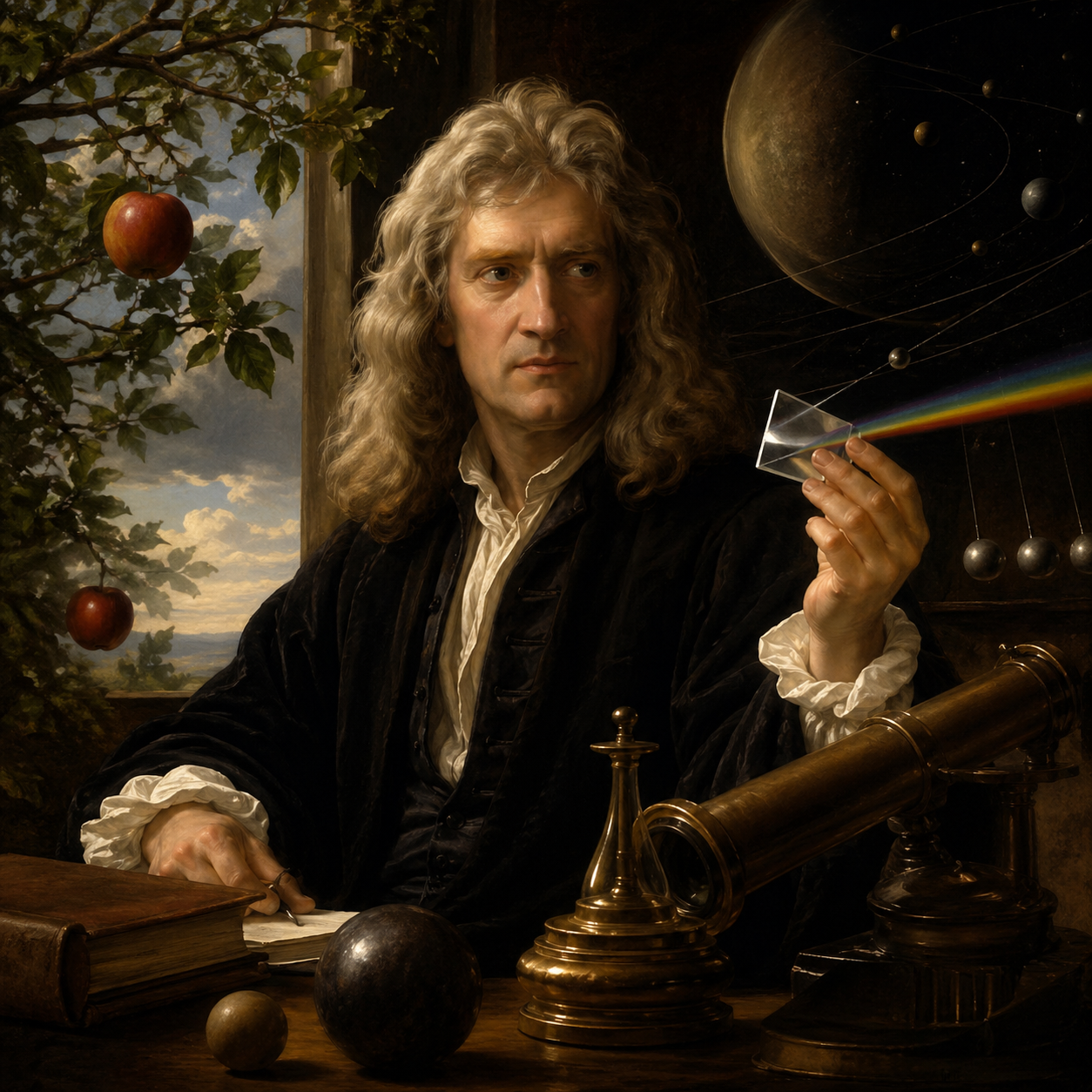
Newton's career embodied this principle — he never settled for describing phenomena without uncovering their causes. His Principia Mathematica revealed gravity as the cause of both falling apples and planetary orbits, unifying celestial and terrestrial mechanics. His optical experiments traced white light to its component colors. His famous declaration 'hypotheses non fingo' meant he grounded every causal claim in observed evidence, making him science's greatest practitioner of causal reasoning.
Newton worked during the Scientific Revolution, when Europe was overthrowing centuries of Aristotelian natural philosophy that explained phenomena through purpose and divine design rather than physical causes. Galileo and Descartes had begun the shift toward mechanical explanation. The newly founded Royal Society championed observation-based inquiry. Scholastic universities still taught from ancient authorities rather than causal investigation. Newton's insistence on causes — mathematical, physical, demonstrable — helped permanently displace faith in received wisdom with rigorous mechanistic science.
AI-generated insights based on extensive research and information for context. Factual errors? Email [email protected].
Your cart is empty